VERSO is our accounting tool for companies that hold digital assets. It reads the company's wallets across chains, splits every transaction into the movements it made, and prices each one on the day it happened, in Swiss francs, euros or dollars.
Wherever money left the company's wallets or arrived from outside, above a threshold the company sets, VERSO asks for a reason: a category, a note and a document. The accountant reads all of it in the export.
Product
VERSOMont3's own, for companies that hold digital assets.
Live
Since May 2026At verso.mont3.ch.
Built
From January 2026A portfolio tracker first, then a tool for the books.
The screens below come from a local copy with invented wallets and transactions.
What made it hard
- Every chain answers differently. Explorers differ from chain to chain, and public nodes forget old blocks. Each source needed a fallback.
- Holes in the history. A missing stretch of history invented holdings that never existed. Balances are now replayed backwards from the next known snapshot.
- Counting once. Wrapping and unwrapping, the same token in two spellings and Solana's case-sensitive addresses could each count a movement twice.
- The price on the day. A movement is worth what it was worth that day, not today, and a franc value needs that day's exchange rate.
- Tokens nobody asked for. Fake tokens with lookalike names land in wallets uninvited, and have to stay out of the totals.
- Speed. A wallet page once took up to a minute to load. It now takes about a second.
What shipped
- Wallets and groups. Addresses on Ethereum-compatible chains, Solana and Bitcoin, grouped the way the company works.
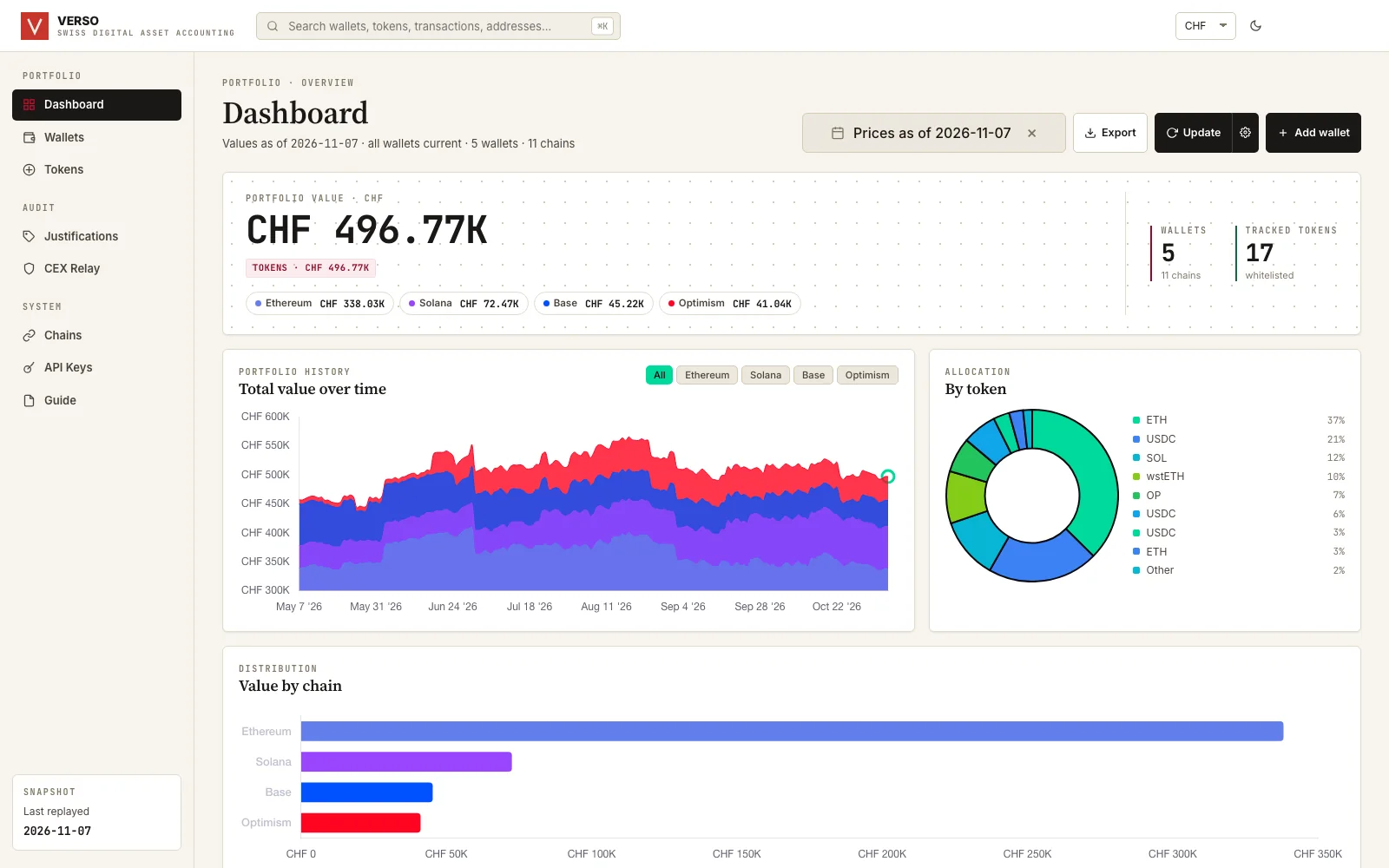
- A dashboard. Total value and its history, allocation by token and by chain, and a warning when a wallet is out of date.
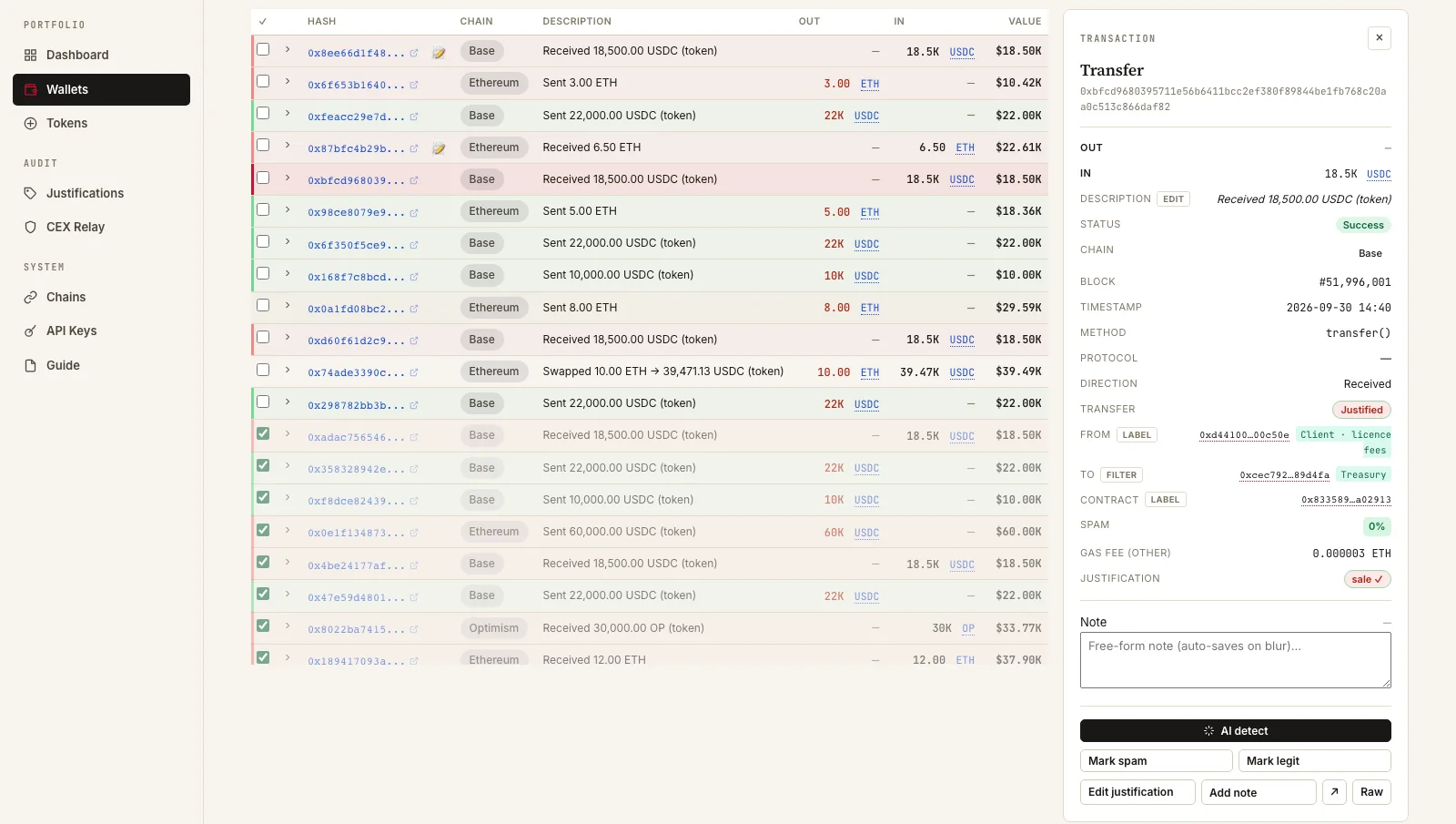
- The wallet page. Balances, every transaction with filters, and a panel with the movements of each.
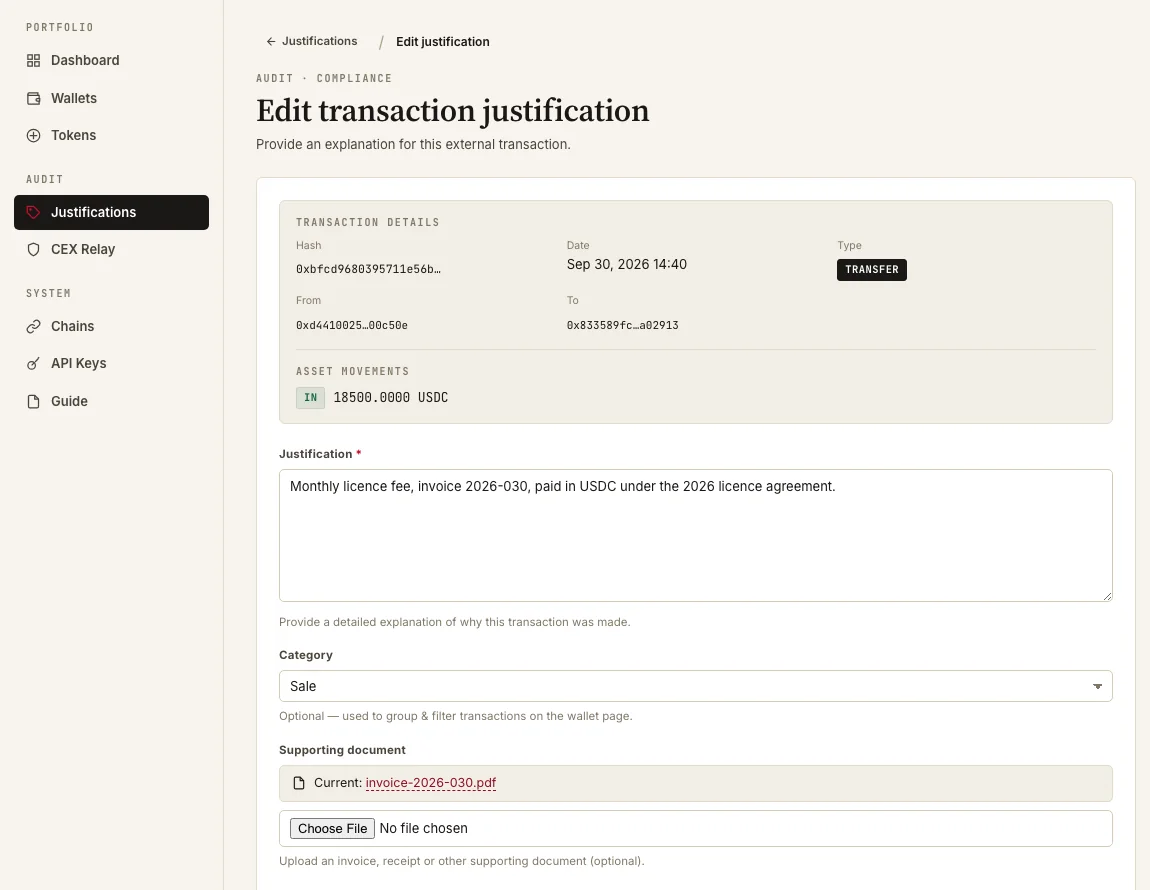
- Justifications. A category, a note and a document for each external flow above the threshold, and an audit tick per transaction.
- AI Detect. It suggests what a transaction was, and a person decides whether to apply the suggestion.
- Export. XLSX or CSV, in dollars, euros or francs.
From a transaction to a line in the books
- Find. The chain's explorer lists the wallet's transactions: ordinary, internal and token transfers.
- Read. Each transaction and its receipt come from a pool of public nodes, which take over from each other when one fails.
- Split. The value and the token transfers inside become movements, each marked in, out or internal to the company's own wallets.
- Price. Stablecoins count as one dollar. Everything else takes the day's price, looking back up to a week if that day has none. Francs and euros use that day's rate.
- Justify. The value moving to or from addresses that aren't the company's is added up, swaps aside. At or above the threshold, the transaction is marked external and waits for its reason.
- Suggest. AI Detect works through a transaction with five tools, for at most eight rounds, and makes a proposal, which is applied only when a person clicks.
How we built it
- January 2026. A portfolio tracker, with justifications and spam detection by the end of the month.
- February to April. Historical balances, Solana, more chains, exchange rates and the export in francs.
- May. The name VERSO, AI Detect, and the tool live on 14 May.
- June. Snapshots taken in the background, and verified signup.
- September. Prices on the transaction's own day, and history replayed from known balances.
Result
- A company's wallets on several chains, priced on the day, in francs if it wants.
- Every external movement above the threshold carries its reason and its document.
- One export for the accountant, with every movement priced and every external one explained.
Stack
- Backend. Django 4.2, with Chart.js for the charts.
- Chains. Etherscan and Blockscout explorers, public nodes, Helius for Solana, mempool.space for Bitcoin.
- Prices. DefiLlama for tokens, the European Central Bank's rates for francs and euros.
- AI. Claude, by Anthropic, for AI Detect.
Article 040 · 28 November 2026 · 4 min read.
Reply to paolo@mont3.ch.