SME Market is a private marketplace for Swiss small and mid-sized companies: owners who want to sell, and the buyers, family offices and fiduciaries looking for them. It is run by IBEX Services SA in Chiasso. We built the technology.
Companies like these change hands in private, through brokers, emails and personal networks. Neither side can see the other. News that a company is for sale can unsettle its staff and clients, and lower its price.
On SME Market every mandate is anonymous, and the two sides learn each other's names only when the operator confirms a match.
What made it hard
- A leak costs money. A seller's name, a client list or a set of accounts in the wrong hands can lower the price of the company. The platform had to hold them back until a person released them.
- Both sides verified. Sellers want to know who is looking, and buyers want to know the company exists. Both had to be verified before they could see anything that matters.
- An agreement for every step. Each step of a deal needs its own agreement, signed by the right parties.
- Four languages, one deal. A seller in Lugano and a buyer in Zurich read the same mandate, each in their own language, and get their emails in it.
What shipped
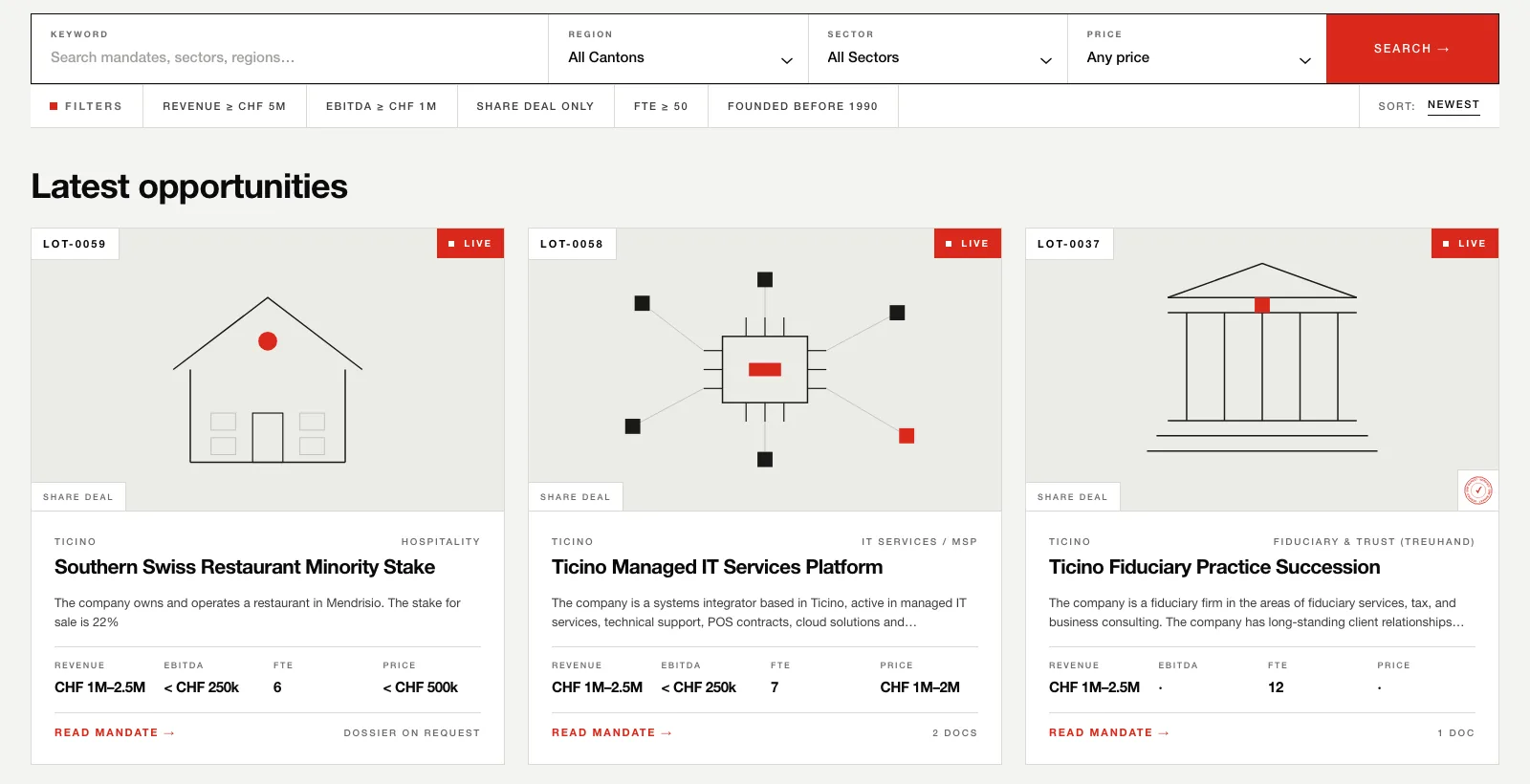
- Anonymous mandates. Sector, canton, size band, a short teaser and a lot number. No name.
- Buy-side requests. Buyers can post what they are looking for, anonymously too.
- A seller wizard. Four steps, with the company checked against the Swiss commercial register before it goes on.
- Field-by-field anonymity. The operator approves what each mandate shows, one field at a time.
- Verified buyers. One verification, then a seal on every request they make.
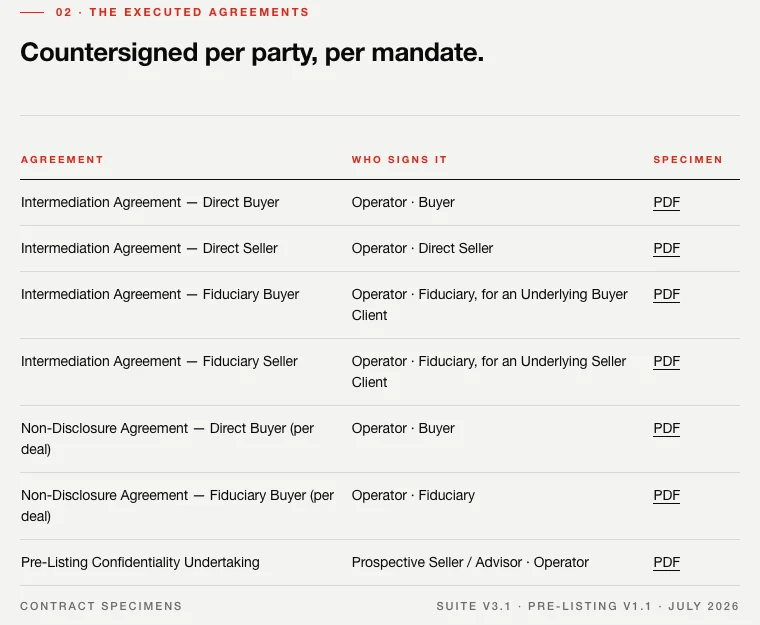
- Seven agreements. Chosen by who is signing and on which side, filled in for each party and typeset.
- A control room. Review queues, matches, contacts, statistics and every email the platform sends, in one place.
How identity is released
The platform keeps two locks apart. One opens the figures and the documents. The other opens the names.
- On the market. Anyone can see an anonymous mandate. Nothing in it identifies the company.
- The request. A verified buyer asks for the dossier. Both sides receive the agreements that fit them, already filled in.
- The first lock. The operator approves the request, and the commercial file opens: figures, documents, still without a name.
- The second lock. When the operator confirms the match, that confirmation is the introduction. Each side receives the other's name, firm and contacts.
A person decides every step. The AI in the platform drafts the anonymous titles and teasers, summarises uploaded files and translates. It never decides who sees what.
How we built it
- April 2026. A clickable prototype, to agree on the flows before building them.
- End of April. The platform rebuilt properly, on a server-rendered stack, and in production by May.
- May and June. An outside review of the flows, then a round of security fixes.
- July. The legal release: the agreements, their specimens and the terms, in every language.
- August. The flows attacked on purpose, to find what a determined user could break, and fixed.
Result
- A seller can be on the market without anyone knowing the company is for sale.
- Every agreement exists before it is needed, filled in for the party signing it.
- 10 mandates are live on the marketplace today, every one identity-verified.
- The platform is covered by more than 500 automated tests.
Stack
- Backend. Django, server-rendered pages, no single-page app.
- Security. Passkey and two-factor sign-in, permission checks on every file.
- Register. Zefix, the Swiss commercial register, checked when a company is added.
- AI. Gemini for drafting, summaries and translation, with a fallback model.
- Agreements. Typeset per party in LaTeX.
- Email. Sent in the recipient's language.
Article 034 · 10 November 2026 · 4 min read.
Reply to paolo@mont3.ch.