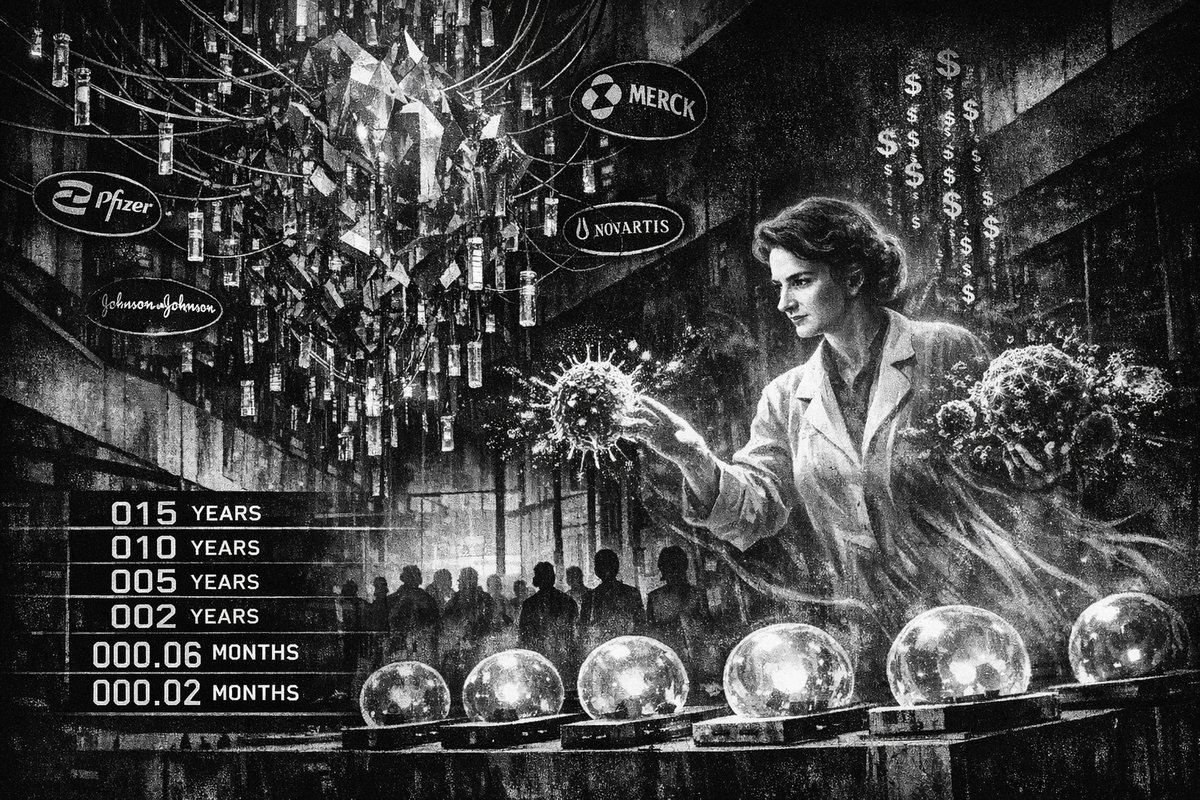
The 15-year drug development timeline isn’t just an inconvenience—it’s a death sentence for millions. While pharmaceutical companies burn through billions in R&D costs, patients wait, hope, and often die before breakthrough treatments reach market. OpenAI just threw down the gauntlet with GPT-Rosalind, their first biotech-specific AI model, and the timing couldn’t be more critical.
Named after Rosalind Franklin—the brilliant researcher whose X-ray crystallography work unlocked DNA’s structure but who died before receiving proper recognition—this isn’t just another AI model. It’s a direct assault on the most expensive, time-consuming process in modern medicine.
The $17 Billion Question: Why Now?
Since 2019, investors have poured over $17 billion into AI-driven drug discovery platforms. Yet according to PitchBook’s damning January report, not a single AI-developed drug has reached large-scale trials. That’s a spectacular failure rate that would kill any other industry.
But here’s the brutal reality: traditional drug discovery isn’t working either. The pharmaceutical industry’s current success rate hovers around 12% from clinical trials to FDA approval. Compare that to the Manhattan Project, which took just three years to develop nuclear weapons from theoretical physics, or the Apollo Program, which put humans on the moon in eight years. Drug discovery’s 15-year timeline isn’t just slow—it’s institutionally broken.
“Yesterday @OpenAI changed life sciences forever. OpenAI released GPT-Rosalind with 50 associated Codex plugins for life sciences. This was done very carefully with a strict governance structure to prevent misuse because the capability is real (0.751 BixBench, 95th percentile on RNA prediction).” — @MSaintjour
The Technical Breakthrough: More Than Just Pattern Recognition
GPT-Rosalind isn’t trying to replace human researchers—it’s designed to amplify their cognitive bandwidth. The model tackles the three critical bottlenecks that strangle drug discovery:
- Literature synthesis: Processing thousands of research papers in minutes instead of months
- Hypothesis generation: Identifying novel drug targets by connecting disparate biological pathways
- Experimental design: Suggesting optimized protocols that maximize data quality while minimizing time and cost
The historical parallel here is computational chemistry in the 1980s. When Schrödinger and Gaussian revolutionized molecular modeling, skeptics claimed computers could never replace wet-lab experimentation. They were right—but wrong about the impact. Computational tools didn’t replace experiments; they made experiments exponentially more targeted and effective.
Big Pharma’s AI Arms Race: Follow the Money
OpenAI’s partnerships tell the real story. Novo Nordisk, Eli Lilly, Amgen, Moderna, and Thermo Fisher Scientific aren’t making billion-dollar AI bets for incremental improvements. They’re positioning for a complete paradigm shift.
Consider Eli Lilly’s collaboration targeting drug-resistant bacteria—one of medicine’s most urgent crises. Traditional antibiotic discovery has essentially stalled since the 1980s, with most pharmaceutical giants abandoning the field due to poor economics. If AI can crack antimicrobial resistance, we’re not talking about faster drug discovery—we’re talking about reviving an entire therapeutic category.
“She discovered the structure of DNA. 3 men won the Nobel. 70 years later, OpenAI named the most powerful biotech AI after her.” — @usePicnicBR
The Rosalind Franklin Connection: Justice Through Innovation
The naming choice isn’t just marketing—it’s historically poetic. Franklin’s Photo 51, the X-ray diffraction image that revealed DNA’s helical structure, was used by Watson and Crick to win the 1962 Nobel Prize. Franklin had died four years earlier, at age 37, receiving no credit for her foundational work.
Today’s AI drug discovery mirrors that same dynamic: massive collaborative datasets, often built on decades of underrecognized research, finally yielding breakthrough insights. The difference is that GPT-Rosalind can analyze millions of “Photo 51” equivalents simultaneously, identifying patterns that would take human researchers decades to uncover.
Reality Check: The Specialization Shift
This launch signals something bigger than biotech AI. As one observer noted, the race has shifted from building larger general models to building deeper domain-specific ones. GPT-Rosalind beating GPT-5.4 on six out of eleven bioinformatics tasks proves that vertical specialization trumps horizontal scaling.
Historically, this mirrors the evolution from mainframe computers to specialized workstations in the 1980s. IBM’s massive general-purpose machines lost ground to Sun Microsystems’ engineering workstations and Silicon Graphics’ visualization systems. Each dominated their specific domain by focusing intensely on user needs rather than raw computational power.
“The market’s answer, delivered as OpenAI was still briefing reporters: it doesn’t — not against a frontier lab that shows up to the work” — @vector__news
What This Means for Patients
Cut through the hype and venture capital excitement—GPT-Rosalind’s real test isn’t benchmarks or partnerships. It’s whether a Stage IV cancer patient diagnosed today has access to treatments that don’t exist yet. Whether Alzheimer’s families get therapies before their loved ones forget their names. Whether rare disease patients finally escape the statistical irrelevance that kills drug development programs.
The 15-year timeline isn’t just inefficient—it’s immoral when we have the computational power to do better. If GPT-Rosalind can compress even three years from that timeline, it could save more lives than most medical advances in history.
The revolution isn’t coming. It’s here. And for once, it’s named after someone who actually deserved the credit all along.
Published in Stream · Dispatch #212 · April 18, 2026 · 4 min read.
Reply to paolo@mont3.ch - every email gets a human answer within 24h.