
There is no official figure for the average cost of developing a custom AI solution in Switzerland, because no federal office or trade association collects one. Providers publish prices, and they depend first on what is being built, whether a website, a web app, a mobile app or an automation.
This article gives the ranges we work in at Mont3 for six kinds of work, next to the prices other Swiss providers publish for the same work, with their sources. It then looks at what moves the bill, that is the hours, the hourly rate, the cost of running the system and the public funding. We read every figure on its public page in November 2026.
What each kind of work costs
The six rows of the chart are these, with the providers whose published prices we read. Each item opens with our own range. We build with AI agents, so the same scope takes fewer hours, and in each of the five rows with a published price our range ends below the highest one.
- Discovery study. Our discovery study costs CHF 3'000, takes about ten hours of our time, and is discounted if we then build. Mühlemann+Popp in Zurich sells a five-day discovery week for CHF 9'800, the Bern University of Applied Sciences estimates CHF 4'000 to 5'000 for a half-day workshop for public bodies, and devedis in Bern runs an eight-hour AI workshop for CHF 1'650.
- Website. We build a company website for CHF 2'000 to 10'000, with the deploy and a year of support included. Beyondweb in Rotkreuz gives CHF 10'000 as the guide value from which its web projects start, and Loaded, an agency with an office in Zurich, lists CHF 3'490, 8'990 and 14'999 by number of pages. SwissViva in Zug publishes packages from CHF 1'500 for a one-page site to CHF 6'900 for ten to fifteen pages.
- Vibe-code conversion. Taking an app built with AI coding tools and making it secure and ready for production costs CHF 5'000 to 10'000 with us, with the audit, the fixes and the deploy included. The Swiss providers we read publish a price for the check alone. SIDD, a brand of Priverion in Baar, asks from CHF 6'900 for a go-live review and from CHF 3'900 for a launch check, proapp in Bazenheid asks from CHF 2'900 for a deep check and CHF 490 for a quick one, and Loaded states that it names no starting price for the hardening.
- Web app. Our range for a web app is CHF 5'000 to 50'000. Edana, an agency in Geneva, gives CHF 90'000 to 220'000 as the budget of a business application and CHF 40'000 to 90'000 for a simple MVP, and Loaded asks from CHF 25'000 for a production-ready MVP with login, roles and billing. Hyperpage in Cham puts customer portals and booking systems mostly between CHF 10'000 and 25'000 and builds a simple web app with login and a database from CHF 8'900.
- Mobile app. Our range is CHF 30'000 to 150'000. soxes in Bubikon gives CHF 120'000 to 250'000 or more for a complex app, CHF 60'000 to 120'000 for a business app and about CHF 15'000 to 60'000 for a simple one. ondera in Lucerne starts from CHF 18'000, and ZGDevelopment, a developer in Gipf-Oberfrick, publishes an app from CHF 9'990 for iOS and Android and from CHF 5'990 for one platform.
- Agentic automation. Our range for an automation with agents is CHF 5'000 to 50'000. Edana puts a simple chatbot at CHF 50'000 to 150'000, infrastructure included, the Bern University of Applied Sciences estimates CHF 20'000 to 50'000 for a proof of concept, and TYTOS in Kriens asks from CHF 30'000 for a strategy with three to five automations. Loaded asks from CHF 12'000 for an AI agent on one process. A single workflow costs less, CHF 2'500 to 8'000 at raw in Winterthur and CHF 2'900 at a fixed price from KianeX.
The systems of large companies sit above all of these. Edana puts a multilingual chatbot connected to the CRM and the ERP at CHF 300'000 to 500'000, machine learning at industrial scale at CHF 300'000 to 800'000, a custom language model at CHF 500'000 to 2 million, and an AI platform across a large company at CHF 1 to 5 million.
A ready-made assistant sits below them. Swisscom's Swiss AI Assistant, for example, costs CHF 149 to 799 a month for 10 to 100 users, and it is a sensible first test before commissioning a custom build.
Hours and hourly rates
A custom build is priced as hours multiplied by an hourly rate, whoever sells it. Published hourly rates of Swiss web agencies go from CHF 120 to 250, according to a review of 161 agencies by Beyondweb, and the twelve suppliers that won the federal IT framework contracts in 2024 bid between CHF 178 and 215. Those rates follow salaries, with the median ICT salary at CHF 130'200 a year in the SwissICT study of 2026 and AI roles between CHF 120'000 and 170'000 according to Robert Walters.
At these rates CHF 50'000 buys between 200 and 417 hours, that is five to ten weeks of one person. The rate changes little from one provider to the next, so the price is decided by the number of hours.
The number of hours has changed in the last two years. Our team writes software with AI agents, and by our estimate writing code went from about 80% of the work to about 20%. The time that remains goes into understanding what to build, preparing the data, connecting the systems the company already has and checking the result. For this reason a scope now costs about a third of what we used to quote for it, and two quotes for the same request can be far apart.
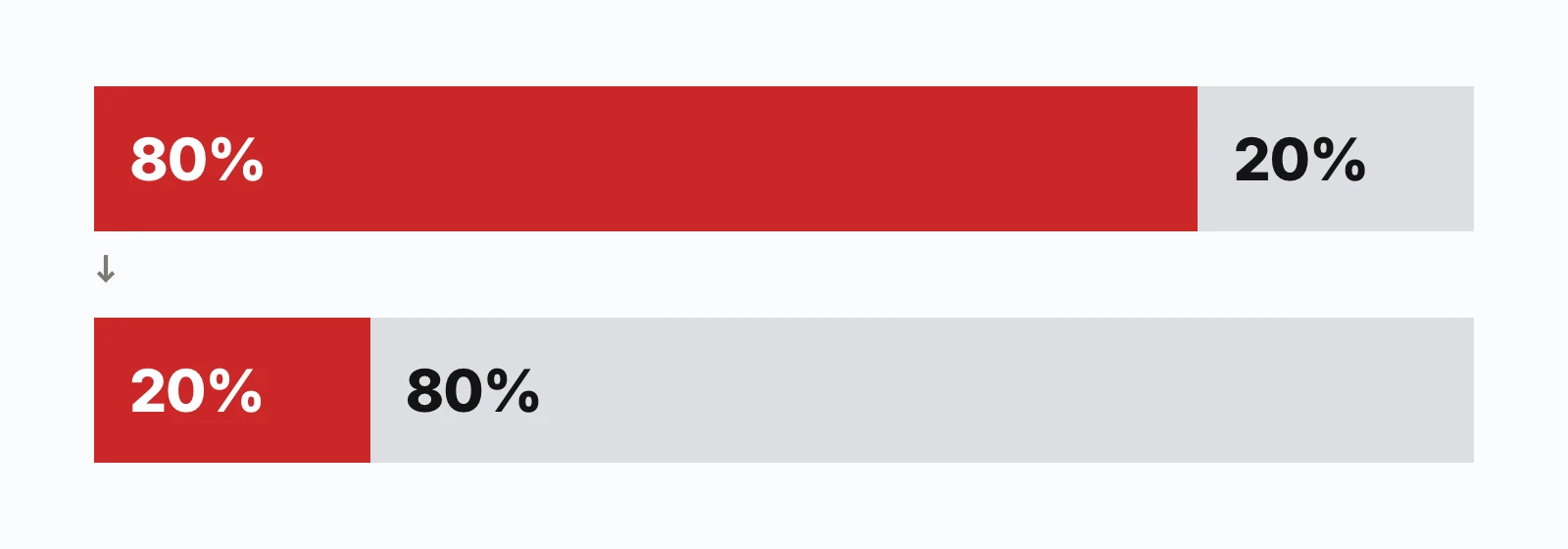
Agents shorten the work on data least, and Edana estimates that collecting, cleaning and labelling data often takes 40% to 60% of the budget of an AI project.
What it costs to run
After the build there are three recurring costs, namely the model, the hosting and the maintenance.
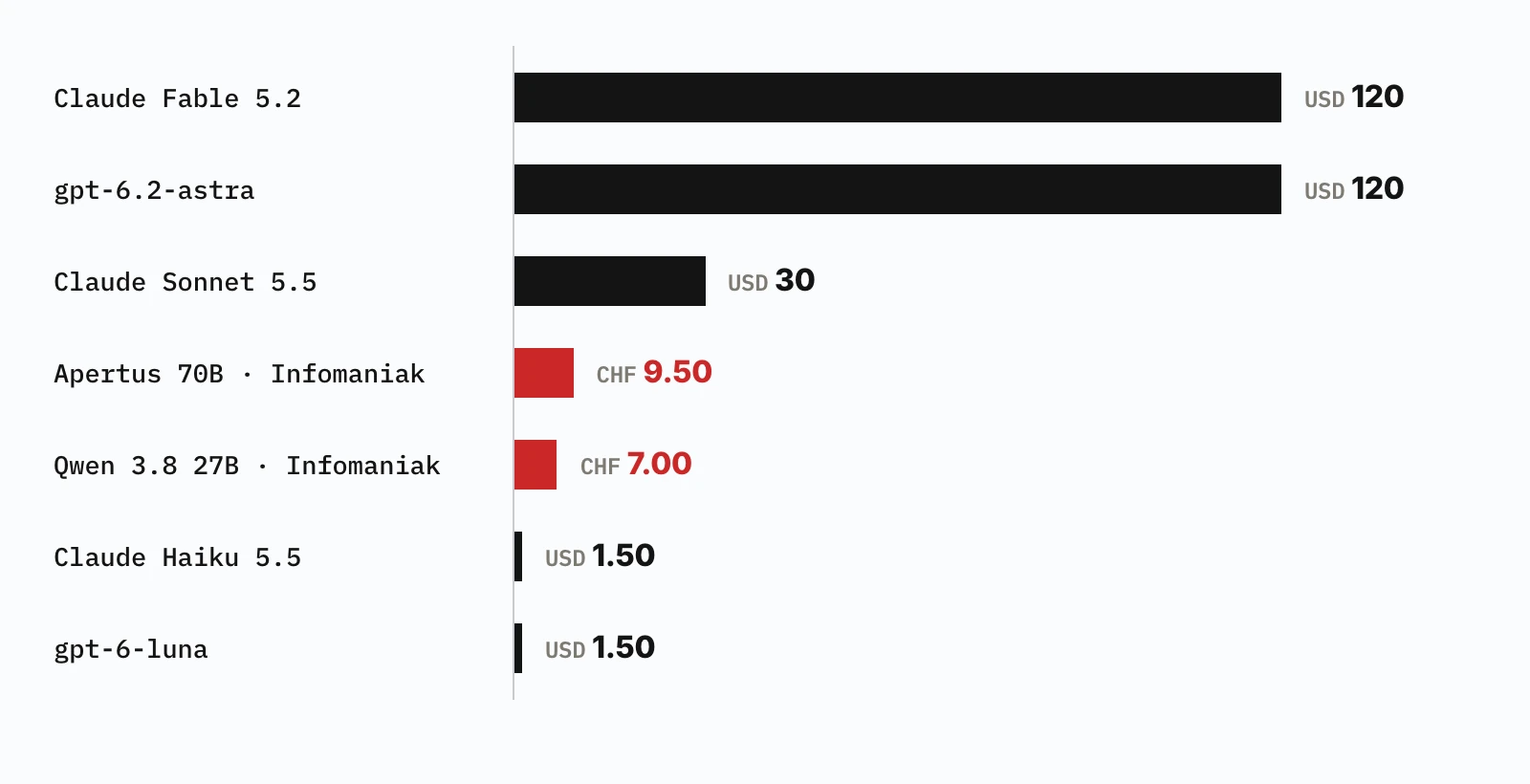
The model is paid by use, per million tokens read and written. Take an assistant that answers 1'000 questions a month, each with 10'000 tokens of company documents to read and 1'000 tokens of answer. At the list prices of 21 November 2026 that month costs about USD 30 with Claude Sonnet 5.5 and USD 120 with Claude Fable 5.2 or OpenAI's gpt-6.2-astra, while a small model such as Claude Haiku 5.5 does it for under USD 2. On the Swiss host Infomaniak the same month costs about CHF 7 with the open model Qwen 3.8 27B and CHF 9.50 with Apertus 70B, the Swiss open model. For a company of this size the model is the smallest line of the bill.
A company that prefers to keep its documents in Switzerland can use a Swiss host such as Infomaniak, or buy its own machine. Such a machine, a workstation that runs the open models most companies need, costs CHF 2'500 to 8'000 once, as we detail on our local AI page, and it has no cost per token.
Maintenance is usually the largest recurring cost, and we found no Swiss figure for it. A benchmark of 24 software products in Germany, Austria and Switzerland by the agency Wavect gives a median of 21% to 26% of the build cost per year, and Wavect itself calls it a guide value.
Projects that stop at the pilot
The share of Swiss SMEs that have integrated AI went from 22% to 34% in one year, according to AXA's labour market study of 2025. A part of what companies spend never reaches daily use. In EY's survey of 604 employees in Switzerland in 2026, 55% said their company uses AI in at least one area and 31% said it is still in a pilot phase. Gartner expects more than 40% of agentic AI projects to be cancelled by the end of 2027 because of rising costs and unclear business value.
For this reason we suggest deciding what to build before paying for the build. A study costs a few thousand francs and names the process where AI saves the most time, with the cost of each option, so that the first build covers that one process.
Public funding
Two public measures lower the first bill, one federal and one in Ticino. The Innosuisse innovation cheque pays 100% of the costs of a Swiss research partner, up to CHF 15'000, for a preliminary study, and it is open to Swiss companies with fewer than 250 full-time positions. In Ticino the canton presented in November 2025 a measure under its law for economic innovation that supports experimental projects between Swiss research centres and Ticino companies with up to CHF 50'000.
Both pay for work done with a research institute, such as a university of applied sciences, so they fit a feasibility question more than the build of a product.
How we price it at Mont3
Mont3 is an AI development studio in Lugano, founded in February 2026, and we build custom software and AI solutions for companies in Switzerland. We work mainly for startups and SMEs, at competitive prices that usually go from CHF 10'000 to 50'000, depending on the service, and on request we also take on larger and more structured projects. We start with a free call of thirty minutes.
If the company does not yet know what to build, the discovery study costs CHF 3'000 and takes about ten hours of our time. It ends with three ways to bring AI in, each with its cost and its benefits, and its price is discounted if we then build one of them.
For a build the ranges above say where a project usually lands. The figure for each one follows the effort and is set after a week of scoping, before the company commits. Afterwards we can stay on as advisers, by the hour or on a monthly budget.
How we read the figures
Every price in this article was read on its public page on 21 or 22 November 2026, and the pages are listed below. They are prices that sellers publish, so they show what is asked for and say nothing about what is finally paid. Most providers publish no prices at all and are therefore absent.
Amounts are in Swiss francs as each page states them, and the model prices of American providers are in US dollars. The ranges given for Mont3 are our own, and the split of our own work between code and everything else is our estimate.
Sources
- devedis, AI Workshop; Bern University of Applied Sciences (BFH), KI-Angebote für den öffentlichen Sektor; Mühlemann+Popp, AI Discovery week, all read 22 November 2026.
- SwissViva, swissviva.ch; Loaded, Preise; Beyondweb, Website for SMEs, all read 22 November 2026.
- proapp, KI-Check; SIDD, Vibe coding security review; Loaded, Vibe Coding produktionsreif, all read 22 November 2026.
- Hyperpage, App-Entwickler-Agentur; Loaded, SaaS-Entwicklung, read 22 November 2026; Edana, How much does web application development cost in Switzerland, 31 March 2026.
- ZGDevelopment, Mobile Apps; ondera, Mobile Apps; soxes, App-Entwicklung Kosten, all read 22 November 2026.
- KianeX, KI-Automatisierung Kosten, 22 October 2026; raw, KI-Automatisierung; Loaded, KI-Agenten; TYTOS, KI Komplett, read 22 November 2026.
- Edana, Cost of AI development in 2026, 28 March 2026.
- Swisscom, Swiss AI Assistant, read 21 November 2026.
- Beyondweb, Was kostet eine Website in der Schweiz, updated 11 October 2026.
- Netzwoche, Der Bund schliesst Rahmenverträge mit zwölf IT-Dienstleistern ab, 14 March 2024.
- Netzwoche, ICT-Löhne legen kaum noch zu, on the SwissICT salary study 2026, 26 August 2026.
- IT Reseller, Schweizer Löhne im Tech-Sektor, on the Robert Walters study, 19 November 2026.
- Anthropic, Pricing, and OpenAI, API pricing, read 21 November 2026.
- Infomaniak, AI Services prices, read 21 November 2026.
- Wavect, benchmark of software maintenance costs, 10 July 2026.
- SME portal of the Confederation, KI in Schweizer KMU auf dem Vormarsch, on the AXA study, 5 November 2025.
- SME portal of the Confederation, KI setzt sich in Schweizer Unternehmen zunehmend durch, on the EY survey, 15 July 2026.
- Reuters, carried by The Star, Over 40% of agentic AI projects will be scrapped by 2027, Gartner says, 25 June 2025.
- Innosuisse, Innovation cheque, read 21 November 2026.
- USI, news of 24 November 2025 on the Ticino law for economic innovation.
Article 045 · 22 November 2026 · 7 min read.
Reply to paolo@mont3.ch.