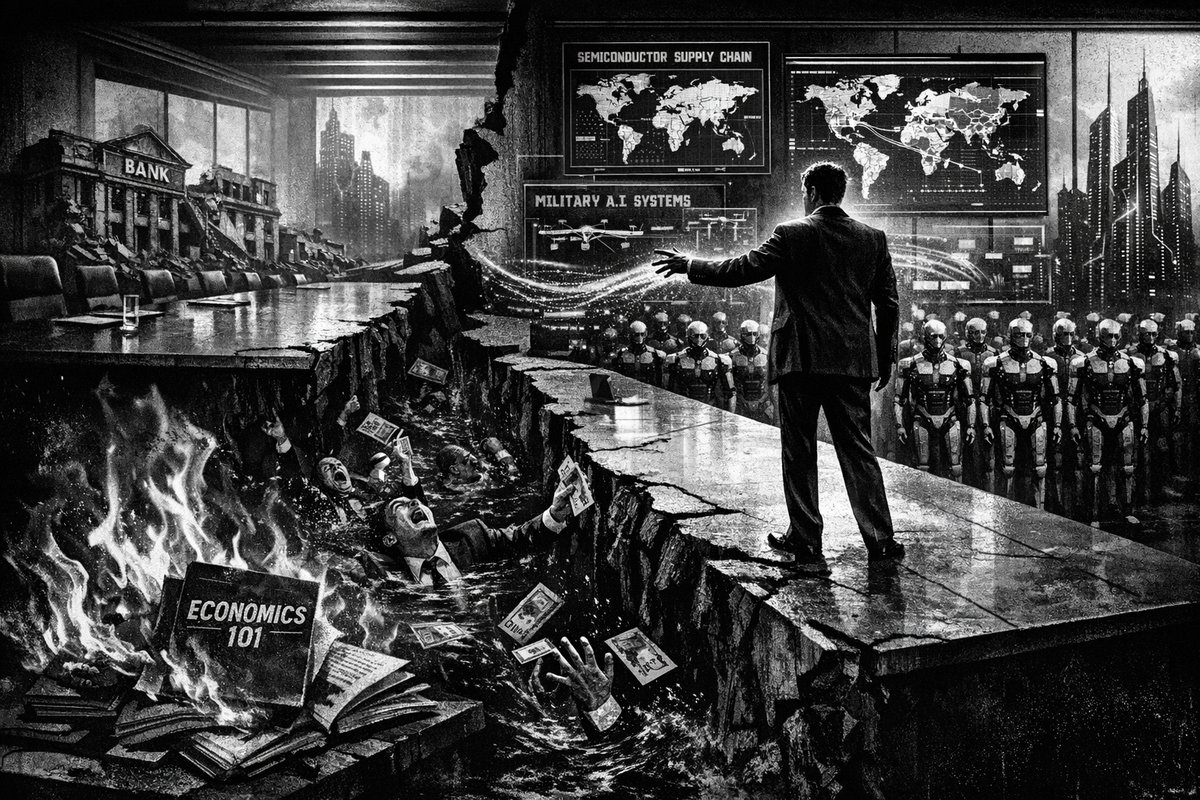
Forget everything you thought you knew about market fundamentals. Interest rates and inflation—the twin pillars that have dominated financial discourse for decades—are about to become background noise in a world where artificial intelligence and geopolitical tech warfare determine who eats and who gets eaten.
A prominent billionaire investor just dropped a truth bomb that most traditional investors won’t see coming until it’s too late: “You have to be a tech person today.” This isn’t investment advice—it’s a survival mandate for anyone who wants to remain economically relevant in the next decade.
The Great Decoupling: When Old Rules Stop Working
We’re witnessing the most dramatic shift in economic power dynamics since the Industrial Revolution. But unlike the 1800s, when steam engines took decades to reshape society, AI transformation is happening at semiconductor speed. The traditional metrics that guided investment decisions for generations are becoming as obsolete as using a telegraph in the smartphone era.
Consider this: during the 1970s oil crisis, energy scarcity redefined global power structures overnight. Nations with oil reserves suddenly held the world’s economic fate in their hands. Today’s equivalent isn’t crude oil—it’s computational power, semiconductor manufacturing, and AI infrastructure. The difference? This transition is happening faster and with higher stakes.
“Taiwan is straight-up the AI heart of the planet right now. NVIDIA dropping $100B+ (heading to $150B) shows just how critical TSMC is to the entire chip revolution. Jensen isn’t just building GPUs, he’s betting the future on one island. Geopolitics just got way more interesting.” — @maxispetty
The Tech Literacy Imperative: Adapt or Get Crushed
Here’s the brutal reality: traditional investment strategies built on interest rate predictions and inflation hedging are becoming dangerously inadequate. The new economic winners understand that geopolitical tech competition drives market movements more than Federal Reserve meetings.
Why this matters right now:
- AI infrastructure investments are reshaping entire industries faster than regulatory frameworks can adapt
- Semiconductor supply chains have become national security priorities, not just business considerations
- Data sovereignty and computational independence are driving trillion-dollar government spending programs
- Space-based assets and quantum computing breakthroughs can obsolete entire market sectors overnight
The parallel to the 1990s internet boom is striking, but with one critical difference: this time, the technology isn’t just changing business models—it’s redefining the fundamental nature of economic and military power.
When Markets Become Battlefields
The convergence of artificial intelligence and geopolitics has created a new category of market risk that traditional financial models can’t calculate. We’re not just talking about tech stocks—we’re witnessing the emergence of technological sovereignty as the primary driver of international relations.
“The future of geopolitics will not be shaped by governments alone. Defense technology, AI infrastructure, space assets, energy systems, semiconductors, Bitcoin, and critical infrastructure are becoming central to national power and international competition.” — @SHABAZGIL
This isn’t hyperbole. China’s AI development programs, Europe’s digital sovereignty initiatives, and America’s CHIPS Act represent the largest peacetime technology mobilization in human history. The economic implications dwarf the Manhattan Project and Space Race combined.
The Historical Pattern: Technology Reshapes Everything
History shows us that paradigm shifts in technology create entirely new categories of winners and losers. The railroad boom of the 1800s didn’t just change transportation—it redefined which cities thrived and which disappeared. The electrification of the early 1900s didn’t just bring light to homes—it created entirely new industries and obsoleted others.
Today’s AI revolution follows the same pattern, but compressed into a timeframe that makes the dot-com boom look gradual. The difference? This time, the technology directly impacts national defense capabilities, economic competitiveness, and social control systems simultaneously.
The Bottom Line: Evolution or Extinction
The investors who survive the next decade will be those who understand that technology literacy isn’t optional anymore—it’s existential. Traditional portfolio diversification strategies built around bonds, real estate, and blue-chip stocks won’t protect you when AI disruption can eliminate entire industry sectors in months, not years.
The billionaire investor’s warning isn’t just market analysis—it’s a wake-up call. In a world where algorithmic trading, quantum computing breakthroughs, and geopolitical tech warfare drive market volatility, being technologically illiterate is like being financially illiterate was in previous generations.
“Over the last 100 years, geopolitics has revolved around coal, oil, shipping lanes, food, semiconductors &data. The next century may be defined by rare earths, lithium, cobalt, AI compute& critical minerals. The commodity that powers economies ultimately shapes the geopolitics.” — @drraju2
The choice is simple: develop deep technical literacy now, or watch from the sidelines as a new generation of tech-savvy investors captures the wealth creation opportunities of the AI age. The old rules are dead. The new game has already begun.
Published in Stream · Dispatch #411 · May 31, 2026 · 4 min read.
Reply to paolo@mont3.ch - every email gets a human answer within 24h.