Forget everything you thought you knew about job security. The convergence of artificial intelligence and blockchain technology isn’t just changing the workforce—it’s obliterating traditional employment models and rebuilding them from the ground up. This isn’t your grandfather’s industrial revolution, where steam engines replaced manual labor over decades. This is a digital metamorphosis happening at lightning speed, and most workers are completely unprepared.
The Numbers Don’t Lie: Web3 Jobs Are Exploding
While traditional industries hemorrhage positions, the blockchain and AI sector is on a hiring spree that would make Silicon Valley’s dot-com boom look modest. Recent data shows a staggering surge in specialized roles that didn’t exist five years ago.
“🔄 48 fresh Web3 jobs found today (Apr 15, 2026): 📈 Senior BD Manager/Lead — Remote (Global) | Full-time | Base salary + commission | Business Development · Crypto | 💻 Blockchain Developer — Remote (GMT/EST overlap) | Full-time | $70K–$95K | Solidity · Hardhat · Web3.js | 📊 Prediction Market Trader — Remote (Global) | Trading role | OTE $500K–$800K | Prediction Markets · Crypto” — @crypto_vazima
These aren’t entry-level positions. Companies are offering $500K-$800K for prediction market traders and $210K-$320K for blockchain architects. The demand for AI automation engineers, treasury managers, and on-chain data analysts is creating salary inflation that’s leaving traditional tech roles in the dust.
The Brutal Reality: Adapt or Become Obsolete
Here’s the uncomfortable truth: the merger of AI and blockchain isn’t just creating new jobs—it’s systematically eliminating entire categories of human work. Unlike the Industrial Revolution, which took generations to fully transform society, this digital revolution is compressing decades of change into years.
Consider the historical parallels. When Henry Ford’s assembly line revolutionized manufacturing in 1913, it created new factory jobs while eliminating artisan craftsmen. But workers had time to retrain. Today’s AI-blockchain convergence is different—it’s simultaneously:
- Automating complex decision-making (AI)
- Eliminating intermediaries (blockchain)
- Creating entirely new economic models (DAOs, DeFi, NFTs)
- Enabling machines to participate in the economy independently
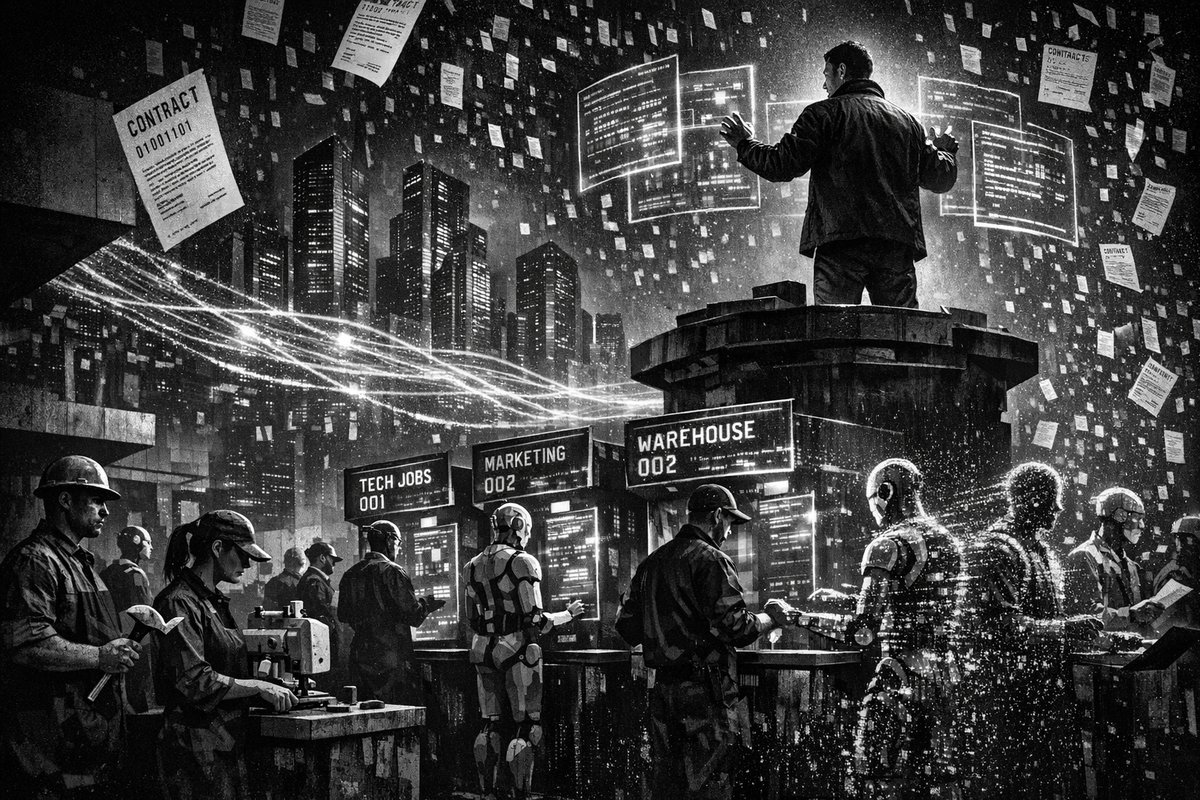
Machines That Earn: The Economic Singularity
The most radical shift isn’t just about humans working with AI and blockchain—it’s about machines working independently within blockchain-based economic systems. This represents a fundamental break from all previous technological revolutions.
“Most people think AI will only live in software. But projects like @konnex_world are pushing a different idea: robots + AI + blockchain = a real economic network If machines can accept jobs, prove results, and get paid on-chain, that’s a completely new layer of the global economy” — @Tetianawww
When the steam engine was invented, it still needed human operators. When computers emerged, they required programmers and users. But AI agents operating on blockchain networks can:
- Accept jobs autonomously
- Execute complex tasks without human oversight
- Receive payments directly to their wallets
- Reinvest earnings into computational resources
- Scale operations based on demand
This isn’t science fiction. It’s happening now, and it’s creating an economic layer where humans compete directly with autonomous agents for work.
The Skills That Survive the Purge
Not all jobs are doomed, but the survivors share specific characteristics that make them resistant to AI-blockchain automation. The emerging job market demands a brutal combination of technical expertise and human adaptability:
High-Demand Skill Categories: - Blockchain architecture and smart contract development - AI prompt engineering and model training - Tokenomics design and DeFi protocol management - Cross-chain interoperability expertise - Regulatory compliance for digital assets - Community management for decentralized organizations - Security auditing for blockchain applications
The pattern is clear: jobs that require deep understanding of both human psychology and cutting-edge technology are thriving. Meanwhile, roles focused on routine processing, basic analysis, or simple coordination are vanishing faster than Blockbuster stores after Netflix arrived.
The Great Resistance: Why User Experience Matters More Than Ever
As this technological revolution accelerates, there’s a growing recognition that human-centered design remains crucial. The blockchain industry is learning painful lessons about prioritizing technology over user experience.
“As a blockchain product designer, you have to understand the reality of your users. A large percentage of people in the crypto space are constantly searching for the next 10x or 100x opportunity. They are not looking for obstacles or friction. Most users barely read lengthy terms or navigate complex flows. We always want speed, clarity, and simplicity. If your product slows us down, we move on. Build for movement. Build for ease. Build for how people actually behave not how you expect them to behave.” — @alphacyl
This insight reveals a critical truth: while AI and blockchain can automate processes, human behavior remains unpredictable and resistant to pure technological solutions. The companies that succeed will be those that use these powerful technologies to enhance human decision-making rather than simply replace it.
Historical Precedent: Learning from Past Revolutions
The Luddites of early 19th-century England weren’t wrong to fear technological change—they were just fighting the inevitable. The textile workers who smashed mechanized looms in 1811 lost their immediate battle, but their concerns about technological unemployment were legitimate. What they couldn’t foresee was how industrialization would eventually create entirely new categories of work.
Today’s AI-blockchain revolution carries similar patterns but with compressed timelines. Where the Industrial Revolution took 80+ years to fully transform Western economies, this digital transformation is happening in less than a decade. The workers who adapt quickly will thrive; those who resist will find themselves economically stranded.
The Verdict: Brutal Efficiency Wins
The convergence of AI and blockchain isn’t asking permission to reshape the workforce—it’s already doing it. Companies are paying premium salaries for specialized skills while entire departments become redundant. Machines are beginning to participate directly in economic networks, creating competition that never existed before.
The choice is stark: develop expertise in AI-blockchain technologies, focus on uniquely human capabilities that complement these systems, or accept gradual economic irrelevance. Unlike previous technological shifts, this revolution won’t wait for society to catch up. The workers and organizations that understand this brutal reality and act accordingly will inherit the new economy. Those that don’t will become historical footnotes.
The future belongs to those who can dance with machines, not those who fight them.
Published in Stream · Dispatch #204 · April 16, 2026 · 5 min read.
Reply to paolo@mont3.ch - every email gets a human answer within 24h.