The age of autonomous AI agents is not coming—it’s already here. But as these digital entities evolve from simple chatbots to sophisticated systems capable of negotiating contracts, executing trades, and coordinating complex tasks without human intervention, a critical infrastructure gap has emerged. According to IPv6 Forum President Professor Latif Ladid, the solution requires two fundamental building blocks: IPv6 addresses for global reachability and scalable blockchain for trustless transactions.
This isn’t just another tech upgrade. Ladid predicts we’ll see 900 billion AI agents by 2030, creating what he calls the “Internet of Agents”—a massive network where every autonomous system needs a unique identifier and the ability to transact independently. The current internet infrastructure simply cannot handle this scale.
The IPv4 Bottleneck: A Familiar Infrastructure Crisis
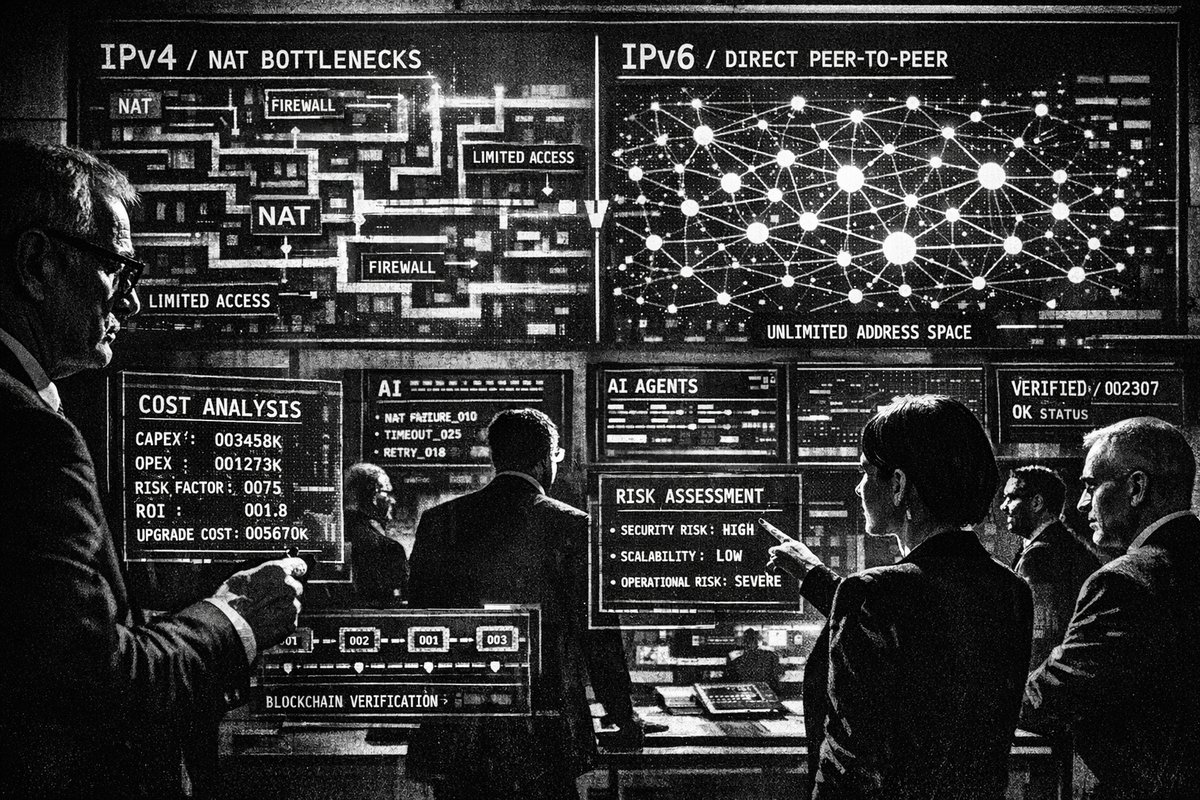
The parallels to previous internet scaling crises are striking. Just as the web’s explosive growth in the 1990s exposed the limitations of dial-up connections, today’s AI agent proliferation is hitting the hard ceiling of IPv4’s 4.3 billion address limit. The stopgap solution—Network Address Translation (NAT)—broke the internet’s original end-to-end connectivity model, forcing peer-to-peer systems to rely on complex workarounds.
IPv6, with its virtually unlimited address space, was designed to solve exactly this problem. But adoption has stalled because the current system is “good enough” for human users browsing websites. AI agents operating at machine speed with machine-to-machine communication requirements change this calculus entirely.
IPv6 offers three critical capabilities that AI agents need: - Programmable routing (SRv6) for dynamic network optimization - Application-aware networking (APN6) for quality-of-service guarantees - Real-time telemetry (iFIT) for performance monitoring and adjustment
Forcing the IPv6 Transition: Economic Pressure Over Technical Mandates
Ladid’s approach to accelerating IPv6 adoption mirrors successful infrastructure transitions throughout history. Rather than mandating change through regulation, he advocates making the old system economically painful while making the new system irresistibly cheap.
The strategy involves three pressure points: - Cloud provider pricing leverage: Major providers already charge for IPv4 addresses; the next step is dramatic price differentiation favoring IPv6-only deployments - Cyberinsurance premium differentiation: A 5-10% discount for verifiable IPv6-only workloads would immediately capture CISO attention - Procurement mandates with sunset clauses: Government and enterprise buyers requiring IPv6-only operation within 24 months
This approach echoes how the transition from horse-drawn carriages to automobiles happened—not through banning horses, but by making cars faster, cheaper, and more reliable. Amazon’s recent announcement that Lightsail CDN now supports IPv6-only instances signals that major infrastructure providers are treating IPv6-only as production-ready.
Blockchain as the Trust Layer: Beyond Cryptocurrency Hype
While IPv6 solves the addressing problem, autonomous agents need something equally fundamental: a way to transact and establish trust without human intermediaries. This is where scalable blockchain technology becomes essential—not as speculative investment vehicles, but as infrastructure for machine-to-machine commerce.
The requirements are brutal: sub-10-millisecond latency, millions of transactions per second, and micropayment capabilities that can handle fractions of a cent without prohibitive fees. Most blockchain networks, designed for human users making occasional high-value transactions, cannot meet these demands.
Ladid specifically highlights BSV blockchain with its Teranode implementation, capable of processing over 1 million transactions per second. But the technical specifications matter less than the fundamental capability: providing an immutable audit trail of agent decisions while enabling direct economic relationships between autonomous systems.
“AI agents won’t scale on intelligence alone. They need a global address system and a ledger built for trust.” — @RealCoinGeek
The Governance Bottleneck: When Human Oversight Becomes the Problem
Perhaps the most challenging aspect of the Internet of Agents isn’t technical—it’s organizational. Ladid’s concept of the “Zero Employee Company” raises fundamental questions about human oversight in autonomous systems. If agents can operate in milliseconds while humans require minutes or hours for decision-making, traditional oversight models break down.
The mathematics are stark: a fully autonomous enterprise making millions of decisions per day would require “a human per thousand decisions,” defeating the efficiency premise entirely. The solution involves shifting from real-time approval to ex-ante constraints (hard-coded rules and spending limits) and ex-post auditing (outcome analysis and circuit breakers).
This mirrors the evolution of financial markets, where human floor traders gave way to algorithmic trading systems operating under predefined rules and regulatory frameworks. The question isn’t whether this transition will happen, but whether organizations will adapt their governance models to accommodate machine-speed decision-making.
“Agents are not going to use the internet the way humans do. They do not need checkout pages, invoices, or manual approval loops. They need wallets, identity, escrow, reputation, review, and settlement built into the work itself.” — @tetsuoai
Early Signals: The Infrastructure Is Already Shifting
China’s IPv6 deployment provides a glimpse of what rapid infrastructure transition looks like: from minimal adoption in 2017 to 865 million active IPv6 users (77% of internet users) by 2025. That’s 300x growth in eight years, demonstrating that network infrastructure can scale dramatically when driven by clear policy and economic incentives.
Meanwhile, blockchain-based agent payments are already happening at significant scale. Early platforms report that 65% of agentic payments are occurring on fast, low-cost blockchain networks, suggesting that autonomous systems are finding ways to transact independently even with current infrastructure limitations.
“65% of agentic payments are already happening on Solana. Right now, we’re witnessing the early shape of a new economic layer… AI agents need: • instant settlement • sub-cent fees • programmable money • internet-native payments” — @defidevcorp
The Infrastructure Decision Point
The parallel between IPv6 and scalable blockchain adoption is more than coincidental. Both technologies aim to restore capabilities that workarounds and middlemen stripped away—direct addressability in IPv6’s case, direct transactionality in blockchain’s case. Both face adoption headwinds because current solutions work adequately for existing use cases.
But AI agents aren’t existing use cases. They represent a fundamental shift in how digital systems interact, operate, and transact. The infrastructure decisions being made now by cloud providers, insurance companies, procurement officers, and protocol developers will determine whether autonomous systems can operate at the scale their proponents envision.
The agents are coming. The question isn’t whether they’ll arrive, but whether the network will be ready to support them—or whether they’ll be forced to operate through the same inefficient workarounds that have constrained peer-to-peer innovation for decades. The window for building proper infrastructure is narrowing, and the cost of waiting may be measured in lost decades of autonomous system potential.
Published in Stream · Dispatch #387 · May 26, 2026 · 5 min read.
Reply to paolo@mont3.ch - every email gets a human answer within 24h.