The AI industry has a massive coordination problem. Training today’s largest models requires thousands of GPUs working in perfect harmony, consuming megawatts of power, and costing millions of dollars. But what if we could harness idle computing power scattered across the globe? What if your gaming rig could contribute to training the next GPT while you sleep? This isn’t science fiction—it’s the promise of blockchain-powered distributed AI training, and it’s happening right now.
The SETI@Home Moment for AI Training
Remember SETI@Home? Back in 1999, millions of people donated their computer’s spare cycles to search for extraterrestrial intelligence. The project processed more data than any supercomputer of its era by cleverly coordinating distributed work. Today’s blockchain-based AI training networks are attempting something far more complex: real-time coordination of neural network training across thousands of unreliable nodes.
The technical challenges are staggering. Traditional distributed AI training requires ultra-low latency connections between GPUs—we’re talking microseconds, not milliseconds. These systems typically run in controlled data centers with specialized InfiniBand networking. Now imagine trying to coordinate gradient updates across nodes in Tokyo, Toronto, and Timbuktu, all connected by regular internet.
“We’re speeding up distributed training on IOTA by leveraging Apex competitions. We thought miners had almost maxxed out the throughput.. but then came a second wave where top submissions started forecasting the future state of the network in order to stay ahead of network congestion. Now it’s going off!” — @macrocrux
The Communication Breakthrough
The game-changer lies in compression algorithms and asynchronous training methods. Projects like PULSELoCo are claiming 100x reductions in trainer-to-trainer communication—a breakthrough that could make geo-distributed training actually feasible. This isn’t just incremental improvement; it’s the kind of leap that transforms entire industries.
“Today we’re releasing PULSELoCo: over 100x lower trainer-to-trainer communication for distributed RL post-training. Paired with PULSESync, every node can sit anywhere in the world. Geo-distributed RL post-training over commodity links, no datacenter interconnect needed.” — @covenant_ai
Traditional centralized training resembles a perfectly choreographed orchestra—every musician must hit their note at precisely the right millisecond. Blockchain-distributed training is more like jazz improvisation—nodes contribute when they can, and the system adapts dynamically to whoever shows up.
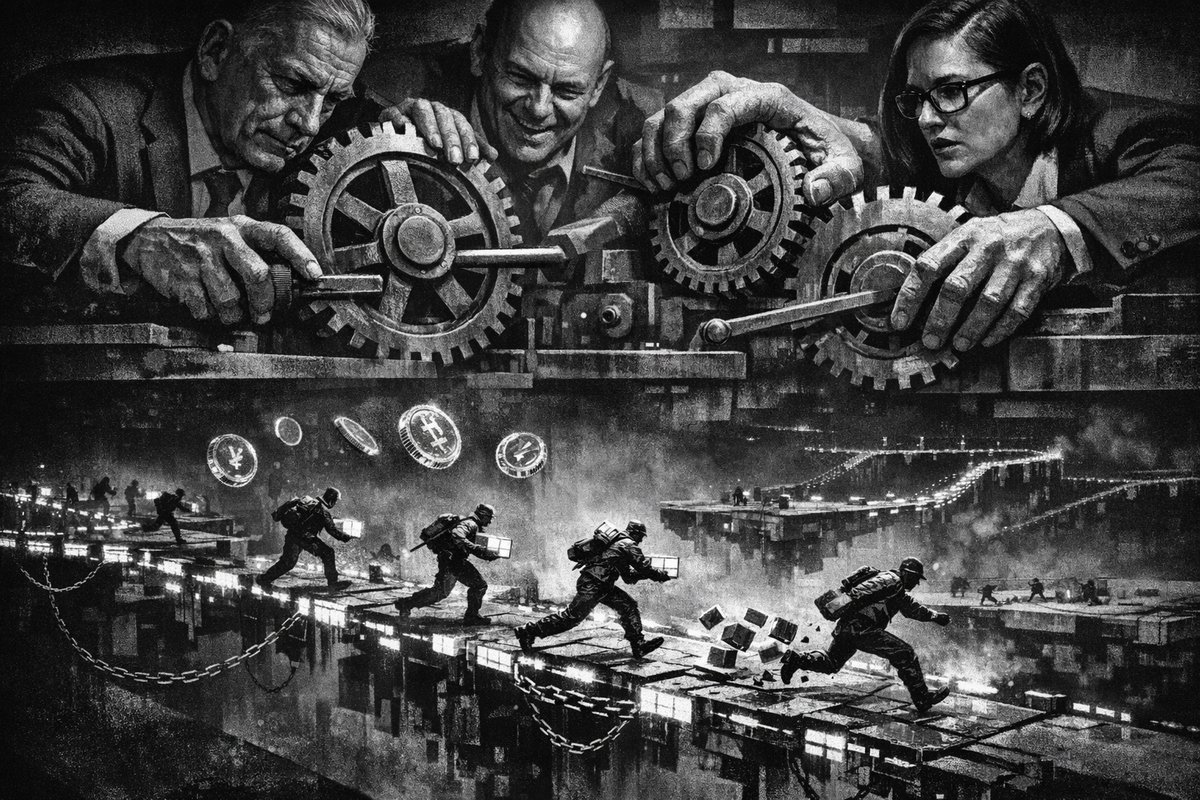
The Incentive Alignment Challenge
Here’s where blockchain truly shines: economic incentives. In traditional distributed computing projects, participants donated resources altruistically. Blockchain networks can actually pay contributors for their computing power, creating sustainable economic models. But getting the incentives right is brutally difficult.
Participants need rewards that: - Scale with actual contribution to prevent gaming - Account for network effects and reliability - Balance fairness across different hardware capabilities - Discourage malicious behavior without stifling participation
“completely agree no-one has properly figured out incentivisation in distributed training yet - the tech and efficiency is getting there but the business model is still unproven” — @benfielding
Projects like Bittensor are experimenting with competitive validation where nodes compete not just on speed, but on the quality of their training contributions. It’s like turning AI training into a massive multiplayer optimization game.
The Infrastructure Reality Check
Building these systems requires massive engineering effort. Teams are constructing entire technology stacks from scratch:
- Distributed data processing for billions of training samples
- Real-time GPU monitoring and health checking
- Fault-tolerant training algorithms that handle node failures gracefully
- Custom communication protocols optimized for blockchain networks
- Economic mechanism design to prevent cheating and maximize participation
This complexity explains why most attempts have failed historically. The telecommunications industry faced similar coordination challenges in the 1990s when building the modern internet—multiple competing standards, complex technical requirements, and the need for massive network effects to achieve viability.
The Compound Effect of Consumer Hardware
Consumer hardware is getting ridiculously powerful. Apple’s M4 chips pack serious AI training capabilities. High-end gaming PCs now sport GPUs that rival professional workstations from just five years ago. As this trend accelerates, the potential distributed computing power available to blockchain networks grows exponentially.
Imagine millions of MacBooks and gaming rigs contributing training cycles during downtime. The aggregate computing power could rival or exceed any centralized facility—and it’s already paid for by consumers who bought the hardware for other purposes.
Historical Precedents and Future Trajectories
Linux conquered enterprise computing through distributed development. Bitcoin proved that financial systems could run on distributed consensus. BitTorrent demonstrated that distributed networks could outperform centralized content delivery. Each breakthrough seemed impossible until suddenly it wasn’t.
Blockchain-powered AI training faces the same chicken-and-egg problem that plagued early internet protocols. Networks need participants to be valuable, but participants need valuable networks to justify joining. The projects showing early traction are those solving this bootstrap problem through clever economic design and demonstrable technical progress.
The real question isn’t whether blockchain can make distributed AI training work—it’s whether it can make it work better than centralized alternatives. That’s a much higher bar, but the potential rewards are proportionally massive.
The Road Ahead
We’re witnessing the earliest stages of what could become computing’s next paradigm shift. Like the transition from mainframes to personal computers, or from desktop software to cloud services, blockchain-distributed AI training represents a fundamental restructuring of how computational work gets organized and executed.
The technical challenges are real, the economic models are unproven, and the coordination problems are formidable. But the potential to democratize AI training—to break the monopoly of big tech companies with massive data centers—makes this one of the most important technological developments to watch in 2026.
Published in Stream · Dispatch #367 · May 22, 2026 · 5 min read.
Reply to paolo@mont3.ch - every email gets a human answer within 24h.