The quantitative finance world is experiencing a seismic shift. For decades, elite hedge funds and investment banks have relied on armies of PhDs manually grinding through market data, hunting for those elusive alpha signals that could predict future returns. This painstaking process often took weeks or months, moving between data scientists, developers, and analysts in a fragmented workflow that couldn’t keep pace with markets that move in milliseconds.
That era is ending. NVIDIA’s latest breakthrough in multi-agent systems is automating the entire signal discovery pipeline, transforming what was once a manual slog into an autonomous, self-evolving research engine. This isn’t just an incremental improvement—it’s a fundamental reimagining of how quantitative research operates.
The Three-Agent Revolution
NVIDIA’s NeMo Agent Toolkit orchestrates three specialized AI agents that work in continuous collaboration:
- Signal Agent: Acts as the creative brain, hypothesizing new alpha signals from market data using nemotron-3-nano-30b-a3b
- Code Agent: Translates natural language signal descriptions into executable Python code
- Evaluation Agent: Runs backtests, calculates performance metrics, and provides iterative feedback for signal refinement
This trinity of specialized agents represents a quantum leap beyond traditional approaches. Where human researchers might test dozens of signals over months, these AI agents can generate, code, and evaluate hundreds of potential signals in the time it takes to grab coffee.
Beyond Human Limitations: The Mathematics of Machine Creativity
The system’s sophistication becomes apparent in its mathematical rigor. The Signal Agent doesn’t just hallucinate random formulas—it operates with a structured library of 66 mathematical operators covering everything from basic arithmetic to complex time series analysis. Take the Rank_Add operator, which normalizes different data sets like price and volume into a shared percentile scale before combining them. This level of mathematical precision ensures that generated signals are both theoretically sound and practically implementable.
The evaluation metrics are equally sophisticated. The system tracks Information Coefficient (IC) and Rank IC metrics, with institutional-grade signals typically maintaining a mean Rank IC between 0.02 and 0.05. Anything consistently above 0.05 is considered exceptionally strong—the kind of signal that drives high-frequency momentum strategies at top-tier funds.
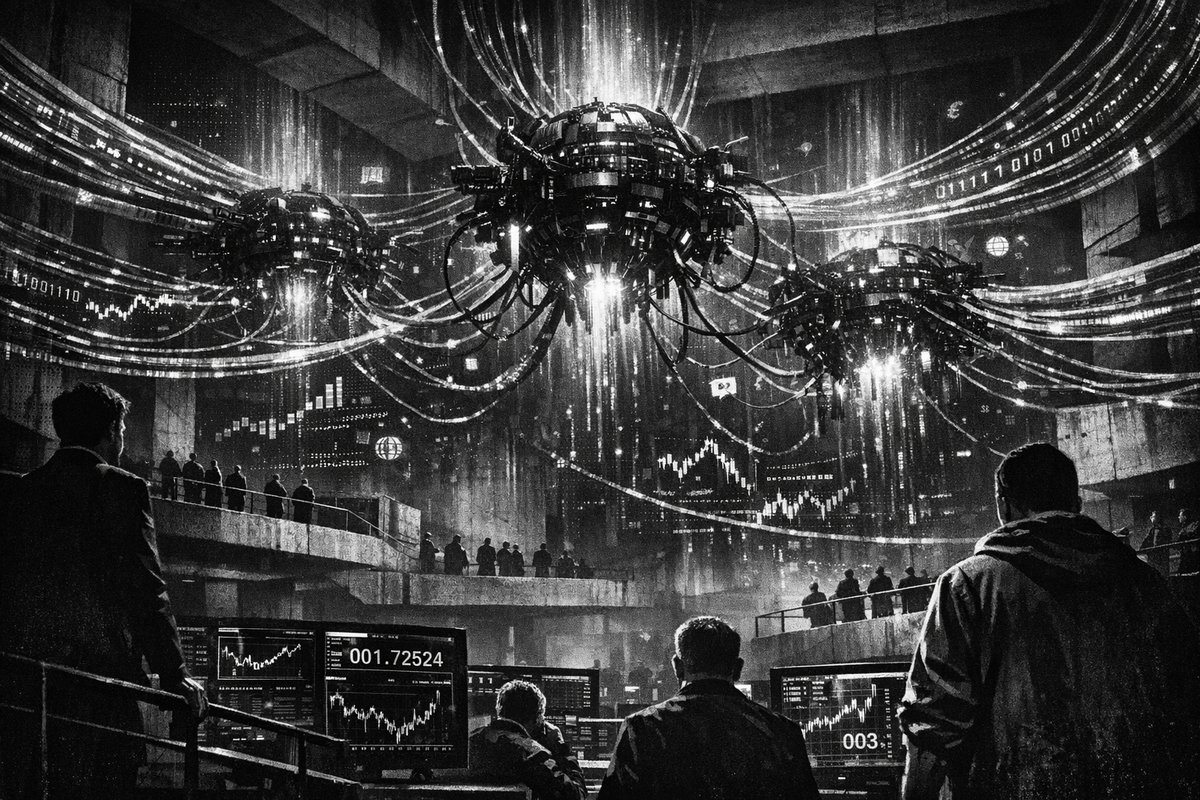
Historical Context: From Renaissance to AI Renaissance
This automation represents the fourth major evolution in quantitative finance. The first wave came in the 1970s with the Black-Scholes model revolutionizing options pricing. The second arrived in the 1980s when firms like Renaissance Technologies began applying statistical arbitrage at scale. The third wave emerged in the 2000s with high-frequency trading and machine learning integration.
Now we’re witnessing the fourth wave: fully autonomous research systems that can hypothesize, test, and refine trading strategies without human intervention. This mirrors the transformation we saw in chess, where Deep Blue’s brute-force approach in 1997 evolved into today’s self-learning engines that develop entirely novel strategies.
“Quant AI: is a platform that acts like an AI copilot for quantitative finance. It removing the Friction Between Idea and Insight. Most trading edges die in the gap between ‘what if’ and does it work. Quant AI closes that gap.” — @CryptoFi090
The Configuration Revolution
One of the most game-changing aspects of NVIDIA’s approach is its config-driven architecture. Rather than hard-coding agent interactions, the entire system logic—personas, tools, constraints—is defined through YAML configuration files. This modularity allows researchers to assign different models for different tasks: a high-reasoning model for hypothesis generation, a faster model for code execution.
The implications are staggering. Quantitative researchers can now iterate at unprecedented velocity, adjusting parameters like forward-returns periods or IC thresholds simply by editing a configuration file. What once required rewriting entire codebases now takes minutes.
The Democratization Dilemma
This technology raises profound questions about market dynamics. Historically, the most sophisticated quantitative strategies were the exclusive domain of firms with billion-dollar research budgets. Renaissance Technologies’ Medallion Fund, arguably the most successful hedge fund in history, built its edge through proprietary research that took decades to develop.
“Lulusan finance yang masuk bank investasi rata-rata digaji sekitar Rp1,9 miliar per tahun Namun talenta matematika dan coding yang masuk Jane Street, Citadel, Two Sigma, dan D. E. Shaw & Co. bisa meraih hingga Rp10 miliar per tahun” — @Sizukanft02
Now, with open-source tools and democratized AI, smaller firms and individual traders can access research capabilities that previously required armies of PhDs. This democratization could fundamentally alter the competitive landscape of quantitative finance.
The Speed Imperative
Speed has always been king in quantitative finance, but AI agents operate on an entirely different temporal scale. Human researchers working in weekly or monthly cycles simply cannot compete with systems that generate and test new hypotheses in real-time. This creates a winner-take-all dynamic where early adopters gain increasingly insurmountable advantages.
The historical parallel is striking: when high-frequency trading emerged, firms that adopted microsecond-latency infrastructure left traditional traders in the dust. We’re witnessing a similar inflection point, but this time the advantage comes from research velocity rather than execution speed.
Looking Forward: The New Quant Paradigm
NVIDIA’s multi-agent system represents more than technological advancement—it’s a paradigm shift toward fully autonomous financial research. We’re moving from a world where humans direct machine learning models to one where AI systems conduct independent research, form hypotheses, and continuously improve their own strategies.
This transformation will likely reshape the entire quantitative finance industry. Firms that embrace agentic research systems will develop and deploy strategies faster than ever before, while those clinging to traditional approaches risk obsolescence. The question isn’t whether AI will transform quantitative finance—it’s how quickly that transformation will complete, and which firms will survive the transition.
The age of human-led signal discovery is ending. The age of AI-driven alpha generation has begun.
Published in Stream · Dispatch #366 · May 22, 2026 · 5 min read.
Reply to paolo@mont3.ch - every email gets a human answer within 24h.