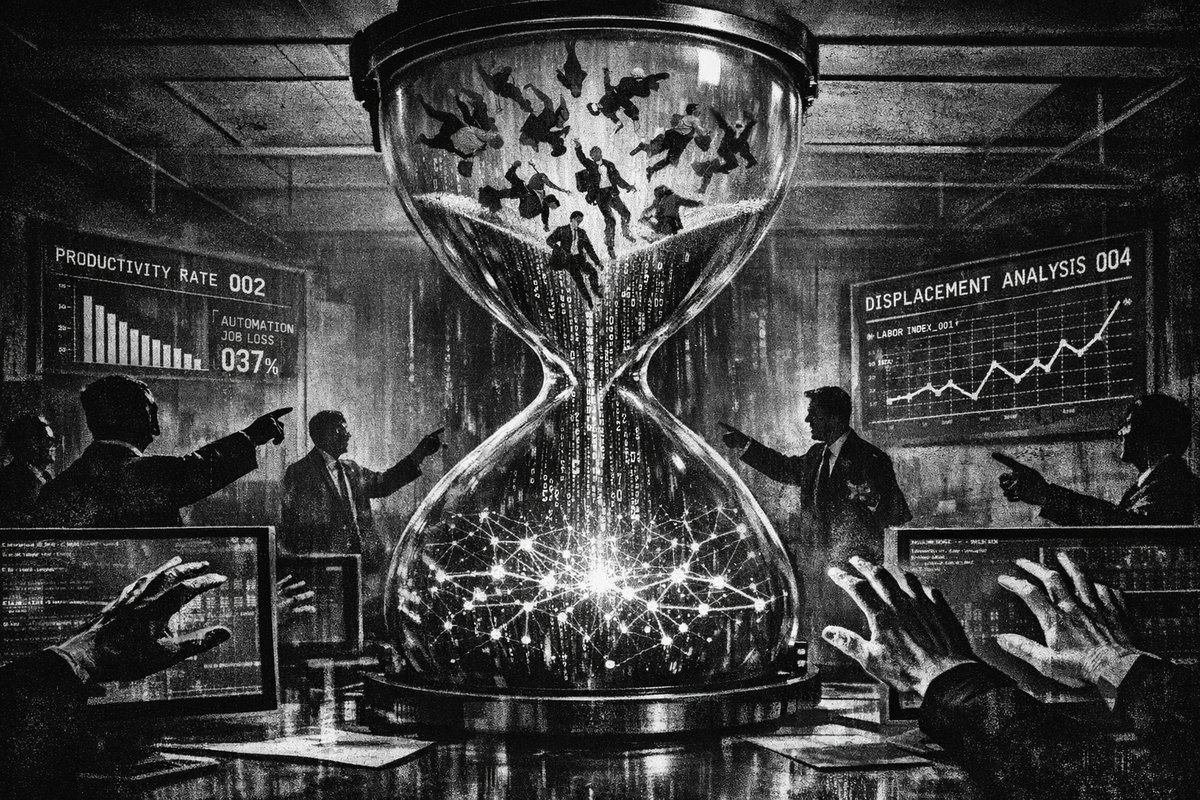
Mustafa Suleyman, CEO of Microsoft AI, just delivered a stark prediction that should make every office worker pause mid-keystroke: AI will automate virtually all white-collar work within 18 months. This isn’t hyperbole from a tech evangelist—it’s a calculated assessment from someone building the very technology that could reshape the professional landscape.
Suleyman’s timeline is aggressive, even by Silicon Valley standards. He predicts “human-level performance on most, if not all professional tasks” will be achieved by AI before 2028. Accounting, legal work, marketing, and project management—careers that have anchored the middle class for decades—are all in the crosshairs.
The Historical Parallel: Faster Than Industrial Revolution
This moment feels eerily similar to the Industrial Revolution, but compressed into a timeframe that would make Henry Ford dizzy. The transformation from agricultural to industrial society took roughly 100 years. The shift from industrial to information-based work unfolded over 50 years. Now, Suleyman suggests the transition from human to AI-driven professional work could happen in under two years.
The comparison to February 2020 is particularly striking. AI researcher Matt Shumer argues this transformation will dwarf the pandemic’s economic impact. Unlike COVID-19, which temporarily disrupted work patterns, AI automation threatens permanent structural change to entire professions.
“The polling for AI is awful because tech leaders say things like ‘all white collar work will be gone in 18 months,’ or tell us ‘abundance’ means no jobs, but don’t worry, the government will send you a check every month.” — @clintbetts
This public skepticism reflects a fundamental disconnect between tech leaders’ promises and workers’ lived experiences.
The Reality Check: Current AI Performance
Here’s where Suleyman’s prediction hits a wall of inconvenient facts. Real-world AI deployment tells a different story than the boardroom presentations suggest.
Current evidence of AI’s professional impact reveals mixed results at best:
- Thomson Reuters 2025 report: Lawyers and accountants see only marginal productivity improvements from AI tools
- METR study: AI actually made software developers 20% slower at their tasks
- Economic data: AI productivity gains remain largely confined to Big Tech, with minimal impact on broader markets
- Job displacement: Only 49,135 AI-related job cuts reported this year—significant but hardly the tsunami predicted
The Computational Power Argument
Suleyman anchors his prediction in exponential computational growth. As “compute” advances, he argues, AI models will surpass human coders and knowledge workers. This echoes Moore’s Law—the observation that computing power doubles roughly every two years—but applies it to cognitive rather than processing capabilities.
The historical precedent is sobering. When Deep Blue defeated Garry Kasparov in 1997, it didn’t just beat one chess player—it fundamentally altered our understanding of machine versus human intelligence. Suleyman suggests we’re approaching a similar inflection point across all cognitive work.
“Mustafa Suleyman says 18 months until AI automates all white-collar work. Microsoft AI CEO Mustafa Suleyman predicts ‘human-level performance on most professional tasks’ within 18 months. Accounting, legal, marketing, project management, all fully automated.” — @kevinlewis4801
Market Signals and Corporate Behavior
The “SaaSpocalypse” of February 2026 offers a glimpse into market psychology around AI automation. Software stocks cratered when Anthropic and OpenAI launched agentic AI systems designed to replace traditional SaaS functions. The selloff revealed that investors, while bullish on AI companies, remain skeptical about widespread productivity gains.
Microsoft’s own actions provide additional context. The company eliminated 15,000 workers while CEO Satya Nadella spoke about “reimagining our mission for a new era.” This suggests even AI leaders are hedging their bets, reducing human capital while building automated alternatives.
The Superintelligence Gambit
Suleyman’s ultimate goal extends beyond automating existing jobs—he’s pursuing “superintelligence.” His vision involves making AI model creation as simple as “writing a blog or creating a podcast.” This democratization of AI development could accelerate automation timelines, assuming the technology delivers on its promises.
The comparison to podcast creation is telling. In 2004, podcasting required technical expertise. By 2024, anyone with a smartphone could launch a show. If AI development follows a similar trajectory, Suleyman’s 18-month timeline becomes more plausible.
The Resistance Factor
Not everyone is buying into the AI automation narrative. Recent surveys show 80% of white-collar workers actively resist AI adoption mandates. This human factor—often overlooked in technical predictions—could significantly slow automation timelines.
Historical precedent supports worker skepticism. The Luddites of early 19th-century England weren’t anti-technology zealots—they were skilled workers defending their economic interests against mechanization. Today’s AI resistance follows similar patterns.
The Verdict: Revolution or Hype?
Suleyman’s 18-month prediction represents either prescient insight or spectacular overconfidence. Historical technology adoptions suggest the truth lies somewhere between revolutionary transformation and incremental change.
The evidence currently favors caution over catastrophe. While AI capabilities continue advancing, the gap between demonstration and deployment remains substantial. Real-world performance lags laboratory promises, and human institutions adapt more slowly than algorithms improve.
The next 18 months will test whether Suleyman’s vision materializes or joins the graveyard of premature technological predictions. For now, white-collar workers might want to learn AI tools without abandoning their day jobs entirely.
Published in Stream · Dispatch #343 · May 17, 2026 · 4 min read.
Reply to paolo@mont3.ch - every email gets a human answer within 24h.