The banking industry just delivered its harshest reality check yet. Standard Chartered announced plans to eliminate almost 8,000 jobs as artificial intelligence takes over core banking functions. This isn’t gradual workforce optimization—this is systematic human replacement at industrial scale.
CEO Bill Winters made the bank’s position crystal clear: they’re not losing jobs, they’re “reducing roles in favor of machines.” That semantic sleight of hand reveals everything about how financial institutions now view human workers—as legacy systems awaiting decommission.
The Numbers Don’t Lie: Banking’s Automation Avalanche
Standard Chartered’s cuts represent 15% of corporate roles targeted for elimination by 2030. But context matters here. This mirrors historical industrial shifts, but with unprecedented speed and scope:
- Industrial Revolution (1760-1840): Textile workers displaced over 80 years
- Computer Revolution (1950-1990): Clerical jobs automated over 40 years
- AI Revolution (2020-2030): Banking roles eliminated in under 10 years
The velocity is staggering. What took generations now happens within single career spans.
“Everyone is talking about job loss in IT companies, but I am much worried about the mega job loss in Banking sector. With AI, except some people in Sales, other staff will become useless. Even most of the sales will come from online channels.” — @InvestorOfJAMMU
This concern reflects broader market anxiety. Banking was supposed to be recession-proof, automation-resistant. Knowledge work was the safe harbor. Not anymore.
AI’s Banking Takeover: What’s Actually Being Automated
Standard Chartered isn’t cutting random positions. They’re strategically targeting back-office operations—the analytical backbone that processes transactions, manages compliance, and handles risk assessment. These roles require pattern recognition, data analysis, and systematic decision-making. Precisely what AI excels at.
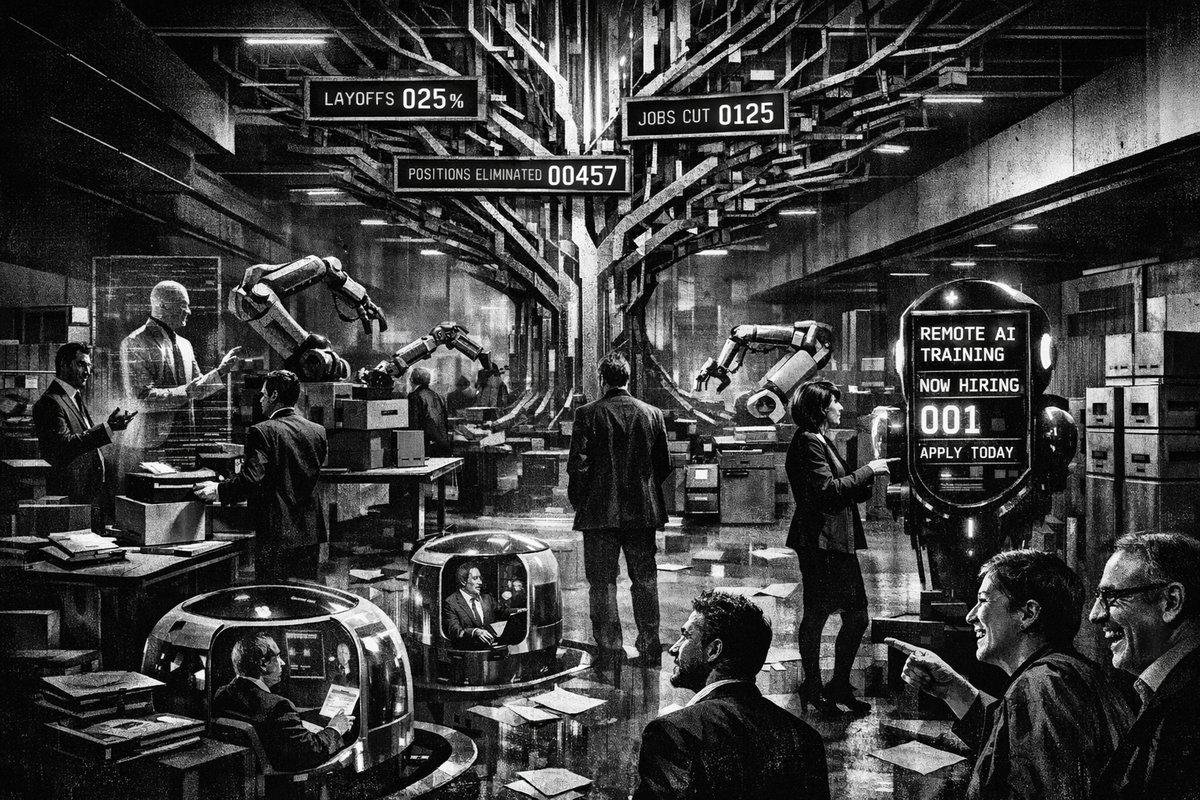
Consider the scope of automation now possible:
- Document processing: AI reads legal contracts faster than lawyers
- Fraud detection: Machine learning spots anomalies humans miss
- Credit analysis: Algorithms assess loan risk using thousands of variables simultaneously
- Regulatory compliance: Automated systems track rule changes across jurisdictions
- Customer service: Chatbots handle 80% of routine inquiries
Traditional banking hierarchies built around human oversight become obsolete when machines outperform humans at core analytical tasks.
The Geopolitical Shift: Asia-First Banking
Standard Chartered’s cuts aren’t happening in isolation. The bank is simultaneously shifting operations toward Asia-Pacific markets, where growth opportunities and AI infrastructure converge. This reflects a massive geopolitical realignment in global finance.
Historically, London and New York dominated international banking. But demographic and economic gravity now pulls toward Asian markets. Singapore, Hong Kong, and Dubai emerge as new financial command centers, while European back-offices face obsolescence.
The combination of AI automation and geographic rebalancing creates a double displacement effect for Western banking workers.
Historical Parallels: When Industries Vanish
Banking’s AI transition echoes previous industry extinctions, but with crucial differences:
Telegraph Operators (1920s-1950s): Radio and telephone technology eliminated an entire profession. Tens of thousands of skilled Morse code operators became unemployed within decades.
Switchboard Operators (1950s-1980s): Automated telephone switching replaced hundreds of thousands of operators. The job category simply disappeared.
Travel Agents (1990s-2010s): Online booking platforms eliminated most retail travel agencies. Physical locations closed, entire business models collapsed.
But banking automation differs in scale and intelligence level. Previous disruptions replaced manual labor or routine coordination. AI replaces analytical thinking, pattern recognition, and complex decision-making.
“AI Will Replace Thousands Of Banking Jobs, Warns Standard Chartered CEO Bill Winters — Here’s Why” — @NDTVProfitIndia
Winters isn’t making predictions. He’s announcing executions.
The Velocity Problem: No Time for Retraining
Previous industrial transitions allowed workforce adaptation through retraining and generational turnover. The AI transition compresses this timeline dramatically. Banking professionals with 20-year careers face skill obsolescence within 5-year windows.
Retraining programs can’t match AI development speed. By the time curricula get designed, approved, and delivered, the technology has advanced two generations. Human learning cycles operate at biological speed while AI capabilities advance at computational speed.
What This Means for Global Finance
Standard Chartered’s announcement signals broader transformation across financial services:
Investment Banking: Algorithm-driven trading already dominates equity markets. Human traders become risk managers for AI systems rather than decision-makers.
Commercial Banking: Loan origination, underwriting, and portfolio management increasingly automated. Relationship managers survive, but support staff vanish.
Insurance: Claims processing, actuarial analysis, and policy administration handled by AI. Human involvement limited to complex negotiations and regulatory interface.
The financial services employment model built around large back-office operations supporting client-facing staff becomes economically unsustainable when machines cost less than minimum wage.
“Standard Chartered plans to cut almost 8,000 jobs as AI use accelerates, showing how banking is being reshaped by automation. Big tech isn’t the only sector feeling the impact - finance is next.” — @babytrillion_
Exactly right. Finance follows tech’s automation playbook, but with higher stakes and faster implementation.
The Brutal Truth About AI-First Banking
Standard Chartered’s 8,000-job elimination represents more than cost-cutting. It’s institutional acknowledgment that human cognitive labor in banking has become economically obsolete for most functions.
This isn’t temporary disruption requiring adjustment—it’s permanent structural change requiring entirely new career frameworks.
The banking industry built employment models around human analysis, oversight, and processing. AI eliminates the economic rationale for those roles. What emerges is ultra-lean organizations where small teams manage vast AI systems serving millions of customers.
Financial institutions face a stark choice: automate aggressively or lose competitive advantage to AI-first competitors. Standard Chartered chose automation. Expect every major bank to follow within 24 months.
The era of employment security in financial services just ended. The question isn’t whether AI will replace banking jobs—it’s how fast incumbents can execute the transition before startups build AI-native alternatives that make traditional banks irrelevant entirely.
Published in Stream · Dispatch #351 · May 19, 2026 · 5 min read.
Reply to paolo@mont3.ch - every email gets a human answer within 24h.