Robinhood just handed artificial intelligence the keys to 27 million retail portfolios. With the launch of Agentic Trading and the Agentic Credit Card, the company has crossed a technological Rubicon that transforms how ordinary investors interact with financial markets. This isn’t just another fintech feature—it’s the democratization of algorithmic trading tools that have been the exclusive domain of Wall Street institutions for decades.
Breaking Down the Digital Divide: From Institutional to Individual
For years, high-frequency trading firms and hedge funds have deployed sophisticated AI systems to execute millions of trades per second. Renaissance Technologies, the legendary quant fund, has generated annual returns exceeding 35% using algorithmic strategies since the 1990s. Citadel Securities processes roughly 26% of all U.S. equity volume through automated systems. Yet retail investors—the mom-and-pop traders with $1,000 portfolios—have been locked out of this technological revolution.
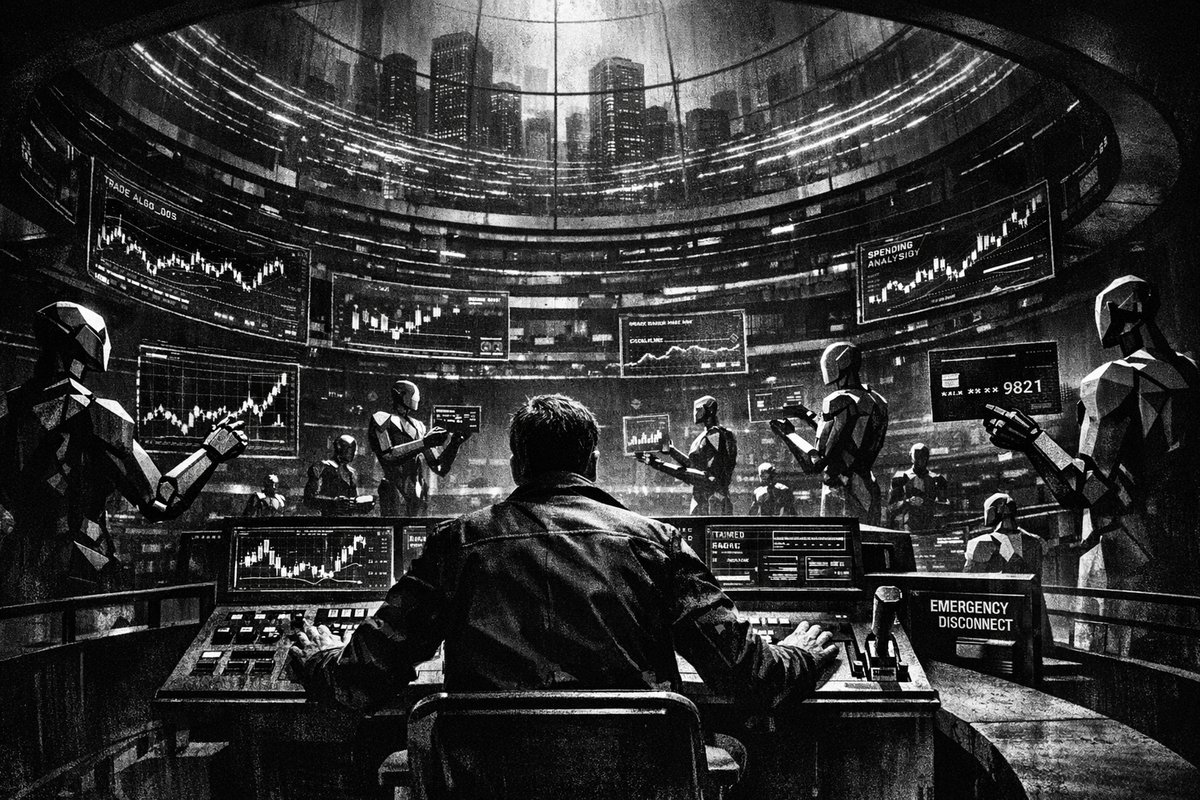
Robinhood’s move changes that calculus entirely. The Agentic Trading platform allows users to deploy AI agents that can rebalance portfolios, monitor investment themes, and execute complex strategies automatically. Think of it as hiring your own quantitative analyst that never sleeps, never gets emotional, and processes market data at machine speed.
“AI agents can now: Trade your stocks. Spend on your credit card. Monitor your portfolio in real time. Robinhood just went live with Agentic Trading and an Agentic Credit Card for 27 million retail investors. The agent economy isn’t coming. It opened for business today.” — @aryamanupmanyu
The Technical Architecture: Safety First
Robinhood’s implementation addresses the elephant in the room: giving autonomous systems control over real money. The company has built multiple layers of protection that mirror—and in some ways exceed—institutional safeguards:
- Sandboxed accounts separate from main portfolios
- Real-time notifications for every trade execution
- Instant disconnect capabilities for immediate agent termination
- Spending limits and manual approval gates for credit card transactions
- Fraud monitoring systems that analyze both user instructions and agent actions
This approach echoes the circuit breakers implemented after the 1987 Black Monday crash, when the Dow Jones fell 22.6% in a single day. Just as those mechanisms prevent runaway selling, Robinhood’s guardrails aim to prevent runaway algorithms from devastating individual accounts.
Historical Parallels: When Technology Meets Money
The introduction of AI agents to retail trading mirrors several pivotal moments in financial history. The 1975 deregulation of brokerage commissions democratized stock trading by eliminating fixed fees. The launch of E*TRADE in 1991 brought electronic trading to individual investors. Robinhood’s own commission-free model in 2013 further lowered barriers to market participation.
Each breakthrough faced similar skepticism about putting sophisticated tools in inexperienced hands. Critics worried that day trading platforms would turn investing into gambling. Yet these innovations ultimately expanded market participation and improved price discovery.
The AI agent revolution follows this same pattern—taking institutional-grade technology and making it accessible to retail investors.
The Credit Card Wildcard
The Agentic Credit Card represents an even bolder experiment. AI agents can now search for deals, compare prices, and complete purchases using virtual credit cards with 3% cashback. This functionality extends beyond trading into everyday commerce, potentially automating everything from grocery shopping to travel bookings.
“Robinhood just gave AI agents a credit card (3% cash back) + a separate Agentic Trading account for portfolio management. $HOOD $COIN 🟢 $700K Gold cardholders eligible @RobinhoodApp” — @pingthepingping
The implications are staggering. Consider how Amazon’s recommendation engine already influences 35% of purchases on the platform. Now imagine AI agents that don’t just recommend—they actually buy, optimizing for price, timing, and personal preferences across multiple retailers simultaneously.
Risk Assessment: The Double-Edged Algorithm
Every technological leap carries inherent risks. The Flash Crash of 2010 saw algorithmic trading systems trigger a 1,000-point drop in the Dow within minutes. Knight Capital lost $440 million in 45 minutes due to a software glitch in 2012. These incidents highlight how quickly automated systems can amplify market volatility.
Robinhood’s retail focus introduces additional complexity. Institutional traders have risk management teams, real-time monitoring, and sophisticated hedging strategies. Retail investors typically lack these safeguards, making them more vulnerable to algorithmic errors or market manipulation.
The key differentiator lies in implementation. By limiting agent access to segregated accounts and requiring explicit capital allocation, Robinhood creates natural firebreaks that prevent system-wide account destruction.
Looking Forward: The Agent Economy
Robinhood’s launch signals the beginning of a broader agent economy where AI systems handle routine financial decisions. The company plans to expand beyond equities to include options, cryptocurrency, and futures trading—each adding layers of complexity and potential reward.
“AI agents need guardrails. So do engineers. When we design agents, we think about constraints. What tools can it use? What actions are allowed? What should require approval?” — @sachindotcom
This evolution could reshape financial services entirely. Traditional banks, with their legacy systems and regulatory constraints, may struggle to compete with AI-native platforms that offer seamless, automated financial management.
The Verdict: Evolution, Not Revolution
Robinhood’s AI agents represent evolutionary progress rather than revolutionary disruption. The technology builds on decades of algorithmic trading development, applying proven concepts to a new market segment. The real innovation lies in the democratization of access—giving individual investors tools previously reserved for institutional players.
Success will depend on execution. If Robinhood’s safeguards prove robust and user adoption grows steadily, other brokerages will inevitably follow. If early implementations fail spectacularly, regulatory backlash could set the industry back years.
One thing is certain: the age of purely human-driven investing is ending. AI agents are here, they’re trading, and they’re just getting started.
Published in Stream · Dispatch #396 · May 28, 2026 · 5 min read.
Reply to paolo@mont3.ch - every email gets a human answer within 24h.