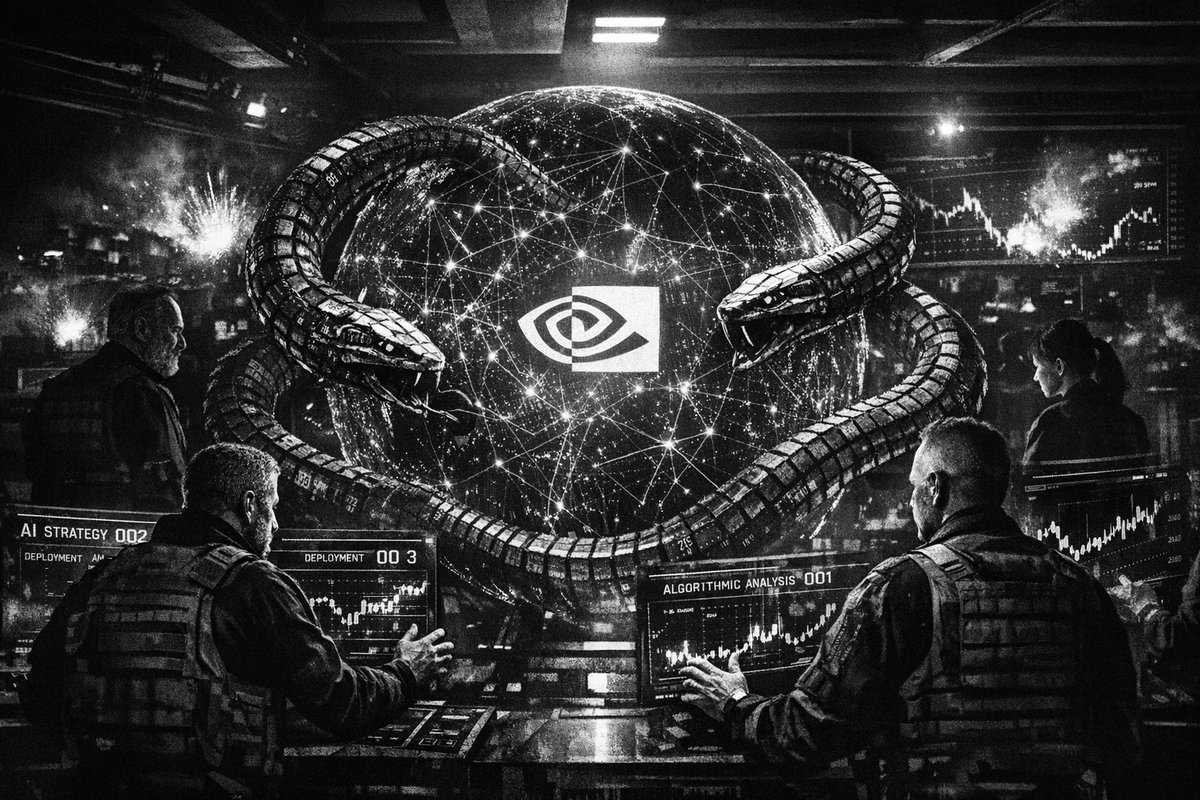
When Renaissance Technologies — the world’s most successful quantitative hedge fund — goes bullish on NVIDIA Corporation (NVDA), it’s not just another investment move. It’s a declaration that the future belongs to machines, algorithms, and mathematical precision. RenTech’s latest positioning on NVIDIA represents more than smart capital allocation; it’s a mirror reflecting the complete transformation of financial markets from human intuition to computational dominance.
The Mathematical Revolution That Changed Wall Street
James Simons and his team at Renaissance Technologies didn’t just build a hedge fund — they engineered a money-printing machine that has consistently outperformed human traders for decades. Their Medallion Fund has generated average annual returns of 66% before fees from 1988 to 2018, making it arguably the most successful investment vehicle in history. When this mathematical powerhouse takes a significant position in NVIDIA, the market should pay attention.
The parallel to the Manhattan Project is striking. Just as Los Alamos brought together the world’s brightest physicists to harness atomic energy, Renaissance assembled mathematicians, physicists, and computer scientists to weaponize market inefficiencies. The difference? Renaissance’s weapon generates wealth instead of destruction.
The trading community is starting to understand this shift. As one market observer noted:
“Your trading is just an expensive subscription to the casino. If you risk money ‘by eye’ or trade on ‘vibes,’ you aren’t a trader. You are a customer. The world’s top firms, like Renaissance Technologies, don’t play the cards. They play the math. They don’t ‘predict’ the future they hunt for fleeting anomalies and exploit them until they vanish.” — @0xrevayz
This brutal assessment captures the reality that retail traders clinging to technical analysis and gut feelings are fighting a losing battle against algorithmic precision.
NVIDIA: The Infrastructure Play of the Century
Renaissance’s bullish stance on NVIDIA isn’t about riding the AI hype train — it’s about recognizing NVIDIA as the foundational infrastructure of the algorithmic economy. Every GPU that powers machine learning models, every CUDA core that accelerates quantitative analysis, and every data center that processes real-time market data depends on NVIDIA’s technology.
Consider the historical precedent: Standard Oil didn’t just sell kerosene; it controlled the infrastructure that powered the industrial revolution. Intel didn’t just make chips; it enabled the personal computer revolution. Today, NVIDIA doesn’t just make graphics cards — it provides the computational backbone for AI-driven trading, research, and financial analysis.
The numbers tell the story:
- NVIDIA’s market cap has surpassed $5 trillion, representing approximately 7% of the entire U.S. stock market
- The company’s valuation exceeds double the entire cryptocurrency market
- NVIDIA has become more searched than major indices like the S&P 500
The Open Source Uprising: Democratizing Algorithmic Trading
While Renaissance Technologies operates behind a veil of secrecy, a parallel revolution is happening in plain sight. Open source trading infrastructure is rapidly evolving, making sophisticated quantitative tools accessible to anyone with programming skills.
Recent developments in the open source space reveal the scope of this transformation:
“Someone is building the next Renaissance Technologies in open source. And judging by this week’s numbers, there are already a lot of them. MoneyPrinterTurbo pulled +11,147 stars in a single week. TradingAgents (+2,000) - multi-agent LLM framework for financial research and trade execution. OpenBB (+1,500) - open-source Bloomberg for everyone.” — @wladwtf
This democratization creates both opportunity and risk. While retail traders gain access to institutional-grade tools, they also face competition from thousands of newly-minted algorithmic traders armed with the same weapons.
The Three Pillars of Systematic Success
Renaissance Technologies’ success — and their confidence in NVIDIA — rests on three fundamental principles that separate systematic traders from gambling:
- Sound Hypothesis: Every trade must have a mathematical foundation. If you can’t explain why an edge exists with statistical rigor, it’s speculation, not strategy.
- Statistical Proof: A 51% win rate can generate enormous wealth, but only with sufficient sample size. Renaissance demands evidence across thousands of trades before deploying capital.
- Execution Reality: Strategies must survive transaction costs, slippage, and market impact. Academic backtests mean nothing without real-world implementation.
These principles explain why Renaissance’s NVIDIA position carries weight. They don’t make emotional bets on hot stocks — they identify mathematical edges and exploit them systematically.
Historical Context: When Machines Replaced Humans
The financial markets have experienced technological revolutions before, but none as complete as the current algorithmic takeover. The NYSE trading floor, once bustling with hundreds of human traders making split-second decisions, now resembles a museum. High-frequency trading has compressed trade execution from seconds to microseconds.
Similarly, the London Metal Exchange abandoned its famous “ring trading” system in 2020, ending a tradition that dated back to 1877. Human market makers who once relied on relationships and intuition found themselves obsolete overnight.
Renaissance Technologies represents the logical endpoint of this evolution: a fund that treats markets as complex mathematical systems rather than human behavioral patterns.
The Network Effect: Why NVIDIA’s Moat Keeps Widening
NVIDIA’s competitive advantage mirrors Microsoft’s dominance in operating systems during the 1990s. Once developers commit to CUDA programming, switching costs become prohibitive. Every algorithm optimized for NVIDIA hardware, every machine learning model trained on their GPUs, and every trading system built on their infrastructure strengthens the company’s market position.
Renaissance Technologies understands network effects better than most. Their own success created a feedback loop: superior returns attracted top talent, which developed better models, which generated higher returns. They’re betting NVIDIA benefits from a similar dynamic in the AI infrastructure space.
The Future: Systematic Everything
Renaissance’s NVIDIA position signals more than confidence in one company — it represents a bet on the systematic approach conquering every aspect of finance. From portfolio optimization to risk management to trade execution, algorithms are replacing human judgment across the investment management industry.
The implications extend beyond trading. Credit scoring, insurance underwriting, regulatory compliance, and fraud detection are all becoming algorithmic processes. NVIDIA provides the computational power that makes this transformation possible.
Conclusion: The Algorithm Always Wins
Renaissance Technologies’ bullish stance on NVIDIA isn’t just an investment thesis — it’s a declaration that the future belongs to mathematical precision over human intuition. Jim Simons and his team have spent decades proving that markets are mathematical systems that yield to systematic analysis. Their confidence in NVIDIA reflects a deeper understanding: the company that powers the algorithms will capture outsized returns in an algorithmic world.
For individual investors, the message is clear. The age of stock picking based on gut feelings and chart patterns is ending. Systematic approaches, quantitative analysis, and algorithmic execution aren’t just institutional tools anymore — they’re survival requirements. Renaissance Technologies has shown the way forward, and NVIDIA provides the infrastructure to get there.
The machines have already won. The question isn’t whether to join them — it’s how quickly you can adapt to their mathematical reality.
Published in Stream · Dispatch #409 · May 30, 2026 · 6 min read.
Reply to paolo@mont3.ch - every email gets a human answer within 24h.