Know-Your-Client is our own product. It is for lawyers, fiduciaries and compliance teams, who have to check a person before they take them on: sanctions, politically exposed roles, registers, leaks, press.
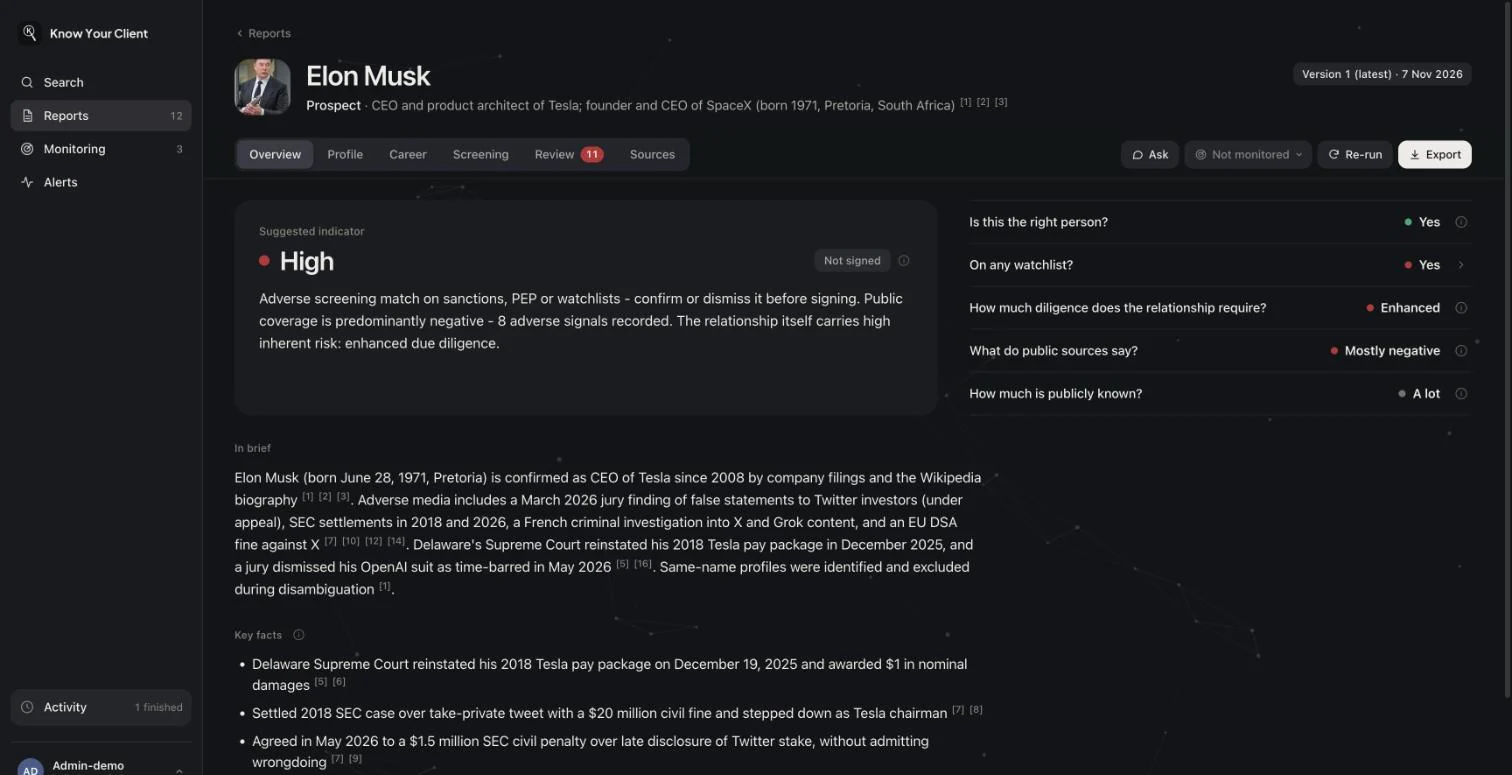
The analyst types a name. The product comes back with a dossier in which every statement links to the page it came from, every source says whether it answered, and the risk level is a suggestion until a person signs it.
Product
Know-Your-ClientMont3's own, for AML and KYC due diligence.
Live
Since June 2026At knowyourclient.ch, in English, German, French and Italian.
Editions
Cloud or localHosted for you, or installed on the firm's own machines.
What made it hard
- Every statement needs a source. A compliance officer cannot act on what a model believes. A statement without a source had to be dropped.
- Clear has to mean checked. A source that did not answer is not a clean result. The dossier had to say which sources were never screened.
- Same name, different people. The first job is to work out who the subject is, before reading anything about them.
- The decision belongs to a person. The analyst confirms or dismisses each finding, signs, and the record of that has to hold.
- Some firms cannot send a name anywhere. For them the product had to run on their own machines, with their own models.
What shipped
- Discovery. A name becomes a short list of candidate identities, each with how sure the match is.
- A deep-dive. The person's profile, digital footprint and a search of adverse media that cannot be skipped.
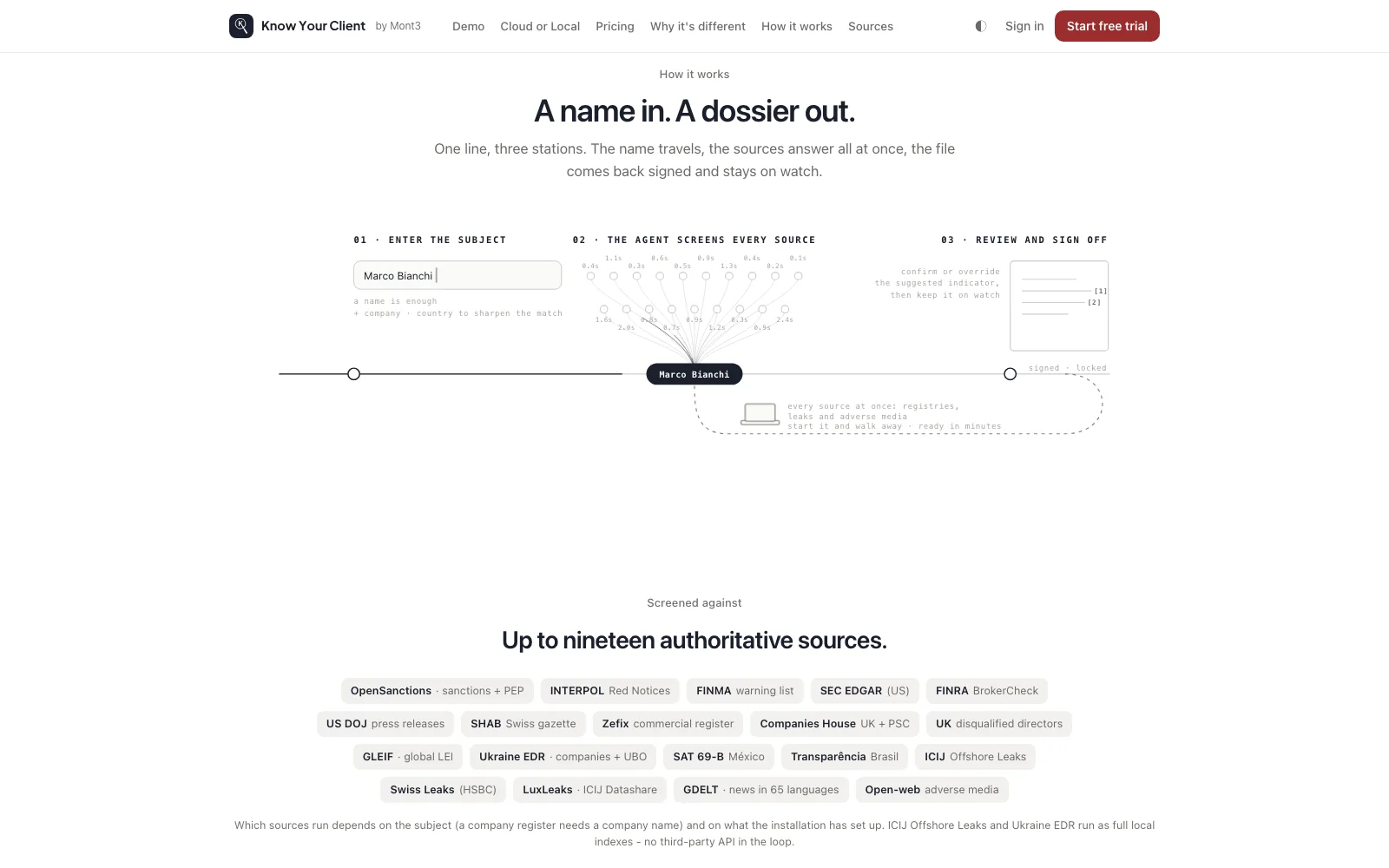
- Screening. Up to 19 sources at once: sanctions and PEP lists, INTERPOL, FINMA, Swiss and UK registers, the SEC, leaked-data archives, world news.
- Twelve compliance rules. Plain code that suggests a risk level from what was found.
- Sign-off. A report in seven tabs, a PDF, and an audit log in which every entry seals the one before it.
- Monitoring. Signed-off subjects are checked again, weekly by default, with an alert only when something changed.
How a check is assembled
- Who. The analyst types a name, with a company and a city if they know them. An AI agent proposes the people it could be. If nobody matches anywhere, the check stops there.
- What. One sub-agent per candidate reads the web, and every sentence it writes must cite a link.
- Where. At the same time, the official sources are queried directly, all together. A source that does not answer reads "not screened", never "clear".
- Checked by code. Sentences without a source are removed. Each fact is labelled as self-reported, corroborated or official.
- Decided by a person. The rules suggest a level: a sanctions hit means elevated, a leak or adverse press means review, an unclear identity means indeterminate. The analyst decides each finding, signs, and the case locks.
How we built it
- June 2026. First version, and in production on knowyourclient.ch within the month.
- July. Version 1.0: a local edition a firm can install and license.
- September. The hosted edition, open to sign up on your own.
- October. Production moved to a Swiss host.
- Every release. A labelled set of test subjects runs before shipping, and a single wrong answer stops the release.
Result
- A dossier in which nothing is unsourced: every claim links to where it was found.
- Up to 19 sources and more than 250 sanctions lists, screened in one check.
- The level is suggested by rules a person can read, and decided by a person who signs.
- Two ways to run it: hosted on a Swiss server, where the AI model runs at its provider, or installed on the firm's own machines with local models, where nothing leaves.
Stack
- Server. Node.js 22, a single service with no third-party packages.
- Storage. Encrypted files, one key per analyst. No database.
- AI. Claude with web search, or any compatible model, local ones included.
- Interface. Plain HTML and JavaScript, in four languages.
- Hosting. A Swiss server for the cloud edition; the firm's own machines for the local one.
Article 035 · 13 November 2026 · 4 min read.
Reply to paolo@mont3.ch.