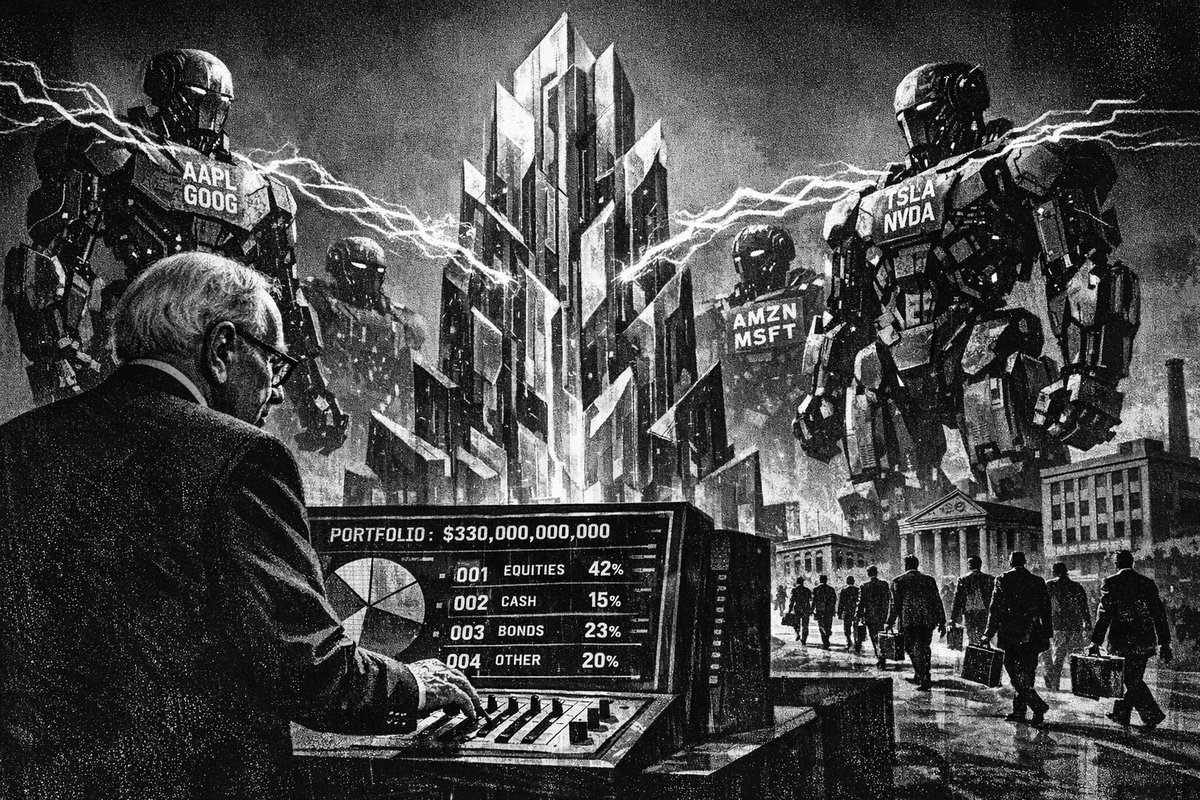
Warren Buffett has officially entered the artificial intelligence era, and he’s done it with characteristic precision and massive scale. Berkshire Hathaway’s latest portfolio reveals that 37.4% of its $330 billion in holdings—roughly $123 billion—is now concentrated in just three AI-focused companies. This represents one of the most dramatic strategic pivots in the Oracle of Omaha’s seven-decade investing career.
For an investor who famously avoided technology stocks for decades, calling them outside his “circle of competence,” this AI concentration signals something profound: the industrial revolution of our time has arrived, and even the most traditional value investors can’t ignore it.
The Historical Context: From Railroad Baron to AI Kingmaker
Buffett’s transformation mirrors that of John D. Rockefeller during the oil boom of the early 1900s. Just as Rockefeller recognized that petroleum would reshape civilization and concentrated his wealth accordingly, Buffett appears to have identified AI as the next civilization-altering technology. The numbers tell the story: 37.4% portfolio concentration in three AI stocks represents a level of focused betting we haven’t seen from Berkshire since its early days.
“In 1972, Berkshire Hathaway bought See’s Candies for $25 Million. See’s has made over $2 Billion in profits till date. ‘We were unwilling to pay last $10,000 but we faced criticism and went ahead to buy it. Berkshire is built partly on criticism’ 😂 - Charlie Munger. 2003” — @CAronitpereira
This historical perspective from Charlie Munger becomes particularly relevant today. Just as Berkshire faced criticism for overpaying for See’s Candies—a purchase that generated 80x returns—Buffett may be weathering similar skepticism for his aggressive AI positioning.
Breaking Down the $123 Billion AI Play
The magnitude of this AI investment becomes clearer when compared to Berkshire’s historical mega-positions:
- Apple: At its peak, represented roughly 40% of Berkshire’s portfolio
- Coca-Cola: Buffett’s longest-held major position, typically 6-8% of portfolio
- Bank of America: Usually 10-12% allocation
- AI Trio: Now commands 37.4% combined allocation
This concentration level puts the AI bet in rarefied air alongside Apple as one of Buffett’s most conviction-heavy plays. The $123 billion committed to these three positions exceeds the entire GDP of most countries and represents more capital than Tesla’s market cap for most of 2019-2020.
The Buffett Method Meets Silicon Valley Speed
What makes this AI pivot historically significant isn’t just the dollar amount—it’s how it represents the collision of two investing philosophies. Buffett built his fortune on:
- Predictable cash flows: Companies with moats and consistent earnings
- Long-term holding periods: “Our favorite holding period is forever”
- Understanding the business: Investing only within his circle of competence
- Value-based pricing: Buying wonderful companies at fair prices
AI stocks, by contrast, typically feature:
- Explosive but volatile growth: Revenue scaling 100%+ annually
- Uncertain profitability timelines: Many still prioritizing growth over profits
- Rapid technological change: Business models evolving quarterly
- Premium valuations: Trading on future potential rather than current earnings
“If you invested $1,000 in Berkshire Hathaway in 1965, by 2009 your investment would have been worth $4.3 million. If Buffett had set up Berkshire as a hedge fund, and charged a 2% annual fee plus 20% of any gains, the investor would have been left with only $300,000” — @DividendGrowth
This track record gives weight to Buffett’s AI thesis. If an investor who turned $1,000 into $4.3 million over four decades is betting big on AI, the market is paying attention.
The Industrial Revolution Parallel
Buffett’s AI concentration echoes the railroad investments of the 1800s. Cornelius Vanderbilt and other railroad barons didn’t just buy train companies—they bought the infrastructure that would define American commerce for a century. Similarly, Buffett appears to be betting that these three AI companies will provide the foundational infrastructure for the next economic era.
Consider the parallels:
- Railroad Era (1840s-1900): Transformed transportation, commerce, and communication
- Electricity Era (1880s-1940): Revolutionized manufacturing, urban development, and daily life
- Internet Era (1990s-2020s): Reshaped information, commerce, and human connection
- AI Era (2020s-2060s): Promises to transform decision-making, automation, and intelligence itself
In each case, early investors who identified and concentrated on the winners generated generational wealth. Andrew Carnegie’s steel empire, Thomas Edison’s electrical companies, and Bill Gates’ Microsoft all benefited from this pattern.
Risk Management in Uncharted Waters
Despite the aggressive AI allocation, Buffett hasn’t abandoned his risk management principles. The $330 billion portfolio still maintains diversification across:
- Financial services: Bank of America, American Express
- Consumer staples: Coca-Cola, Kraft Heinz
- Energy: Chevron, Occidental Petroleum
- Industrial: BNSF Railway (wholly owned subsidiary)
This structure provides a hedge against AI volatility while allowing maximum upside participation. It’s reminiscent of J.P. Morgan’s approach during the industrial revolution—betting heavily on emerging technologies while maintaining positions in established industries.
Market Implications and Investor Takeaways
“AI stocks outperformed the whole market this year. 90% of traders missed it. Dont miss the next ‘wave’” — @ScarfaceTrades_
The market has clearly taken notice. When Berkshire Hathaway commits $123 billion to any theme, institutional and retail investors follow. This creates several implications:
- Validation effect: Buffett’s AI bet legitimizes the sector for conservative investors
- Capital magnetism: More traditional funds will likely increase AI allocations
- Volatility cushioning: Berkshire’s long-term approach may stabilize AI stock prices
- Competition intensification: Other mega-funds must now compete for AI positions
The Verdict: Evolution, Not Revolution
Buffett’s $123 billion AI commitment represents evolution, not abandonment, of his core principles. He’s still buying businesses he believes he understands, still focusing on long-term competitive advantages, and still concentrating his bets when conviction is high.
The difference is that artificial intelligence has matured from speculative technology to essential infrastructure. Just as Buffett eventually embraced Apple—recognizing it as a consumer products company rather than a tech stock—he appears to view these AI companies as the utilities and railroads of the digital age.
For investors, the message is clear: when the world’s most successful long-term investor stakes 37.4% of his portfolio on artificial intelligence, it’s time to pay attention. The AI revolution isn’t coming—it’s here, and it’s being funded by the smartest money in the world.
Published in Stream · Dispatch #374 · May 23, 2026 · 5 min read.
Reply to paolo@mont3.ch - every email gets a human answer within 24h.