The entry-level job market has transformed into something unrecognizable from just five years ago. According to recent HR industry analysis, productivity expectations for new hires have skyrocketed since AI tools became mainstream workplace fixtures. This isn’t just about learning faster—it’s about fundamental shifts in what employers consider “basic competency” for workers entering the labor force.
The implications are staggering: we’re witnessing the most dramatic recalibration of workplace productivity standards since the Industrial Revolution introduced assembly lines and time-motion studies in the early 1900s.
The New Productivity Baseline: From Training Wheels to Racing Speed
AI-enhanced productivity has become the silent benchmark reshaping hiring managers’ expectations. Where entry-level positions once included 6-12 months of ramp-up time, employers now expect new hires to achieve meaningful output within weeks or even days. This shift mirrors the transition from apprenticeship systems to factory work during industrialization—except the timeline has compressed from decades to mere years.
The data reveals a troubling pattern:
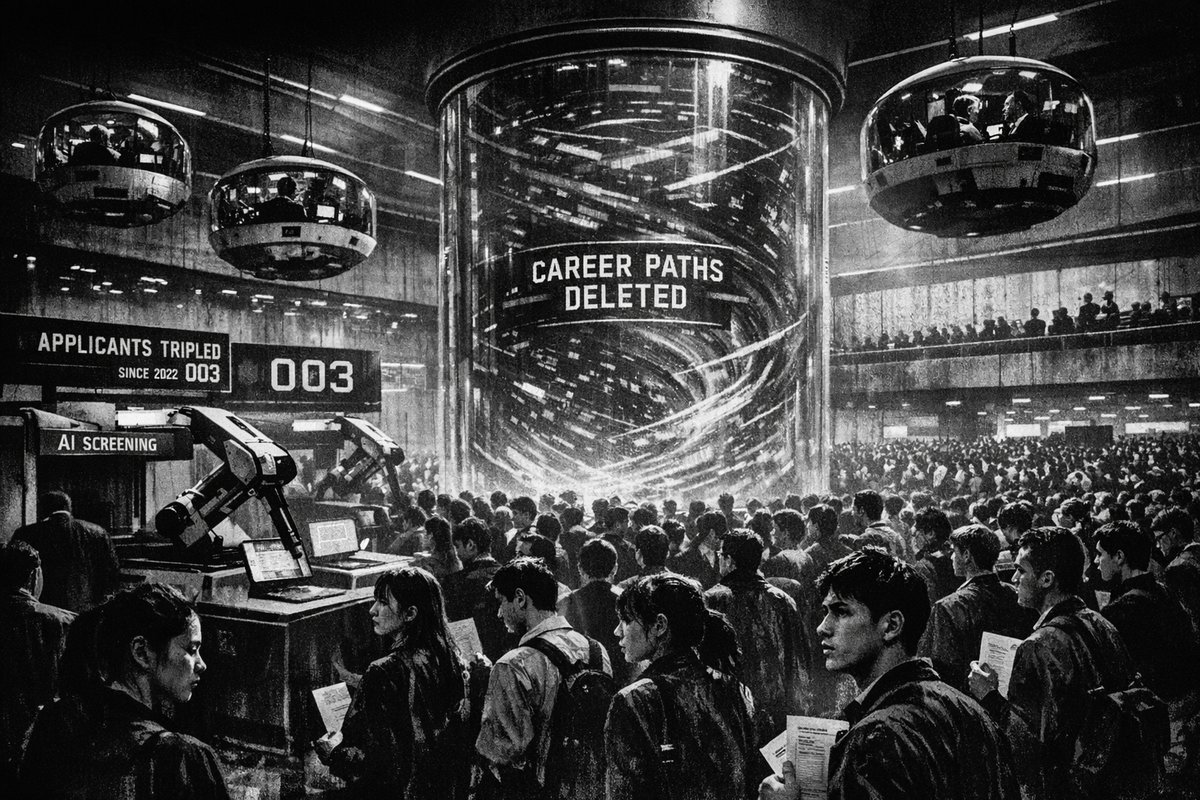
“The applicant pool for entry-level jobs has nearly tripled since 2022” — @NeetNewsClips
This explosion in candidates isn’t just about economic uncertainty—it reflects how AI tools have made it theoretically possible for anyone to appear “qualified” on paper, while simultaneously raising the bar for what constitutes actual performance.
Historical Parallels: When Technology Outpaced Human Development
The closest historical comparison is the 1920s manufacturing boom, when scientific management principles fundamentally altered worker expectations. Frederick Taylor’s time-and-motion studies didn’t just optimize existing work—they created entirely new productivity standards that workers had to meet or face unemployment.
Today’s AI productivity revolution operates similarly but with exponential acceleration. Consider these key parallels:
- Standardization of output: Just as assembly lines standardized manufacturing, AI tools are standardizing knowledge work output
- Skill obsolescence: Like craftsmen displaced by machines, traditional “learning on the job” approaches are becoming extinct
- Productivity measurement: Real-time performance tracking through AI systems mirrors the stopwatch studies of industrial engineers
The critical difference? The 1920s transformation took decades to fully implement. The current shift is happening in real-time, leaving workers and educational institutions scrambling to adapt.
The Career Ladder Crisis: When Bottom Rungs Disappear
Perhaps the most concerning aspect of this transformation is what industry observers call the “missing rung problem.” Entry-level positions traditionally served as training grounds where workers developed both technical skills and workplace competencies. Now, those positions require pre-existing expertise that can only be gained through… entry-level positions.
“These standards were designed to fix a closed-loop problem where new talent couldn’t get the entry-level jobs or internships needed to build a career in the first place.” — @PalwinderCFA
This creates a catch-22 scenario reminiscent of the post-World War II job market, when returning veterans found that wartime technological advances had made their pre-war skills obsolete. However, the GI Bill and massive infrastructure investments provided alternative pathways. Today’s workers face similar displacement without equivalent societal safety nets.
The Automation Paradox: Training Tomorrow’s Workforce
The most sobering question emerging from this shift concerns intergenerational knowledge transfer. Historical precedent suggests that technological revolutions typically create new categories of work even as they eliminate others. The computer revolution of the 1980s-90s eliminated typing pools and filing clerks but created IT support, database administrators, and software developers.
Current trends suggest a different pattern:
“Dystopian is right. We’re automating away entry-level jobs that people use to build careers. Who trains the next generation?” — @Daniell64334313
This concern reflects a broader systemic issue: unlike previous technological transitions, AI doesn’t just change how work gets done—it changes who can do the work. The apprenticeship model that sustained skilled trades through industrialization may be fundamentally incompatible with AI-accelerated workplaces.
Key Implications for Workers and Employers
The current transformation demands immediate strategic responses from multiple stakeholders:
- Educational institutions must redesign curricula to focus on AI collaboration rather than AI replacement
- Employers need to develop hybrid training programs that combine AI proficiency with traditional mentorship
- Workers must treat continuous AI upskilling as essential career maintenance, not optional enhancement
- Policymakers should consider regulatory frameworks that prevent AI-driven productivity standards from creating permanent employment barriers
The Road Ahead: Adaptation or Elimination
The fundamental question isn’t whether AI will continue reshaping productivity expectations—that trajectory is irreversible. The question is whether human-centered solutions can evolve quickly enough to prevent widespread economic displacement.
Unlike the Industrial Revolution, which unfolded over generations, the AI productivity revolution is compressing similar changes into months and years. Organizations and individuals who recognize this compressed timeline and adapt accordingly will thrive. Those who don’t will find themselves competing for an ever-shrinking pool of opportunities in an economy that has moved beyond their capabilities.
The stakes couldn’t be higher: we’re not just reshaping individual careers, but determining whether technological progress continues to expand human opportunity or begins systematically constraining it.
Published in Stream · Dispatch #333 · May 15, 2026 · 4 min read.
Reply to paolo@mont3.ch - every email gets a human answer within 24h.