The agricultural revolution that tech evangelists have been promising is happening—but not where you’d expect. According to Bushel’s 2026 State of the Farm report, only 14% of farmers are actively using artificial intelligence, while another 11% aren’t even sure if they’re using AI tools. More tellingly, those who have adopted AI are primarily using it for document editing and business analysis rather than the precision agriculture applications that dominated industry headlines for years.
This data reveals a critical disconnect between Silicon Valley’s vision of AI-powered farming and the practical realities facing agricultural operations today.
The Unexpected AI Use Cases in Agriculture
Julia Eberhart, Bushel’s Director of Marketing, highlighted a surprising trend in the survey results. Farmers aren’t reaching for AI to optimize yield prediction or agronomic decision-making—applications that researchers and agtech companies have spent billions developing. Instead, they’re turning to tools like ChatGPT, Gemini, and CoPilot for mundane but essential business tasks.
“Interestingly, it’s a lot more on like editing documents, helping with business and financial analysis,” Eberhart noted. “We have yield prediction in agronomy is like the last selectable available answer.”
This mirrors historical technology adoption patterns in agriculture. When tractors first appeared in the early 1900s, farmers initially used them primarily for stationary work like powering threshing machines rather than field cultivation. It took decades before tractors displaced horses for primary fieldwork. Similarly, the internet’s first major agricultural application wasn’t precision farming—it was commodity price tracking and weather forecasting.
Breaking Down Current AI Applications
The survey revealed that among the 14% of farmers using AI, applications break down as follows:
- Document editing and writing assistance: Highest adoption rate
- Business and financial analysis: Second most common use
- Input planning decision-making: 36% of AI-using farmers
- Yield prediction and agronomy: Lowest adoption rate
This hierarchy tells a story about accessibility versus complexity. Writing assistance through ChatGPT requires minimal technical knowledge and delivers immediate value. A farmer can draft a loan application, edit safety protocols, or generate marketing content within minutes. Conversely, agronomic AI applications often require extensive data integration, sensor networks, and technical expertise that many operations lack.
“DroneMate is about getting ahead of bird problems before they turn into expensive ones. Prevention always beats damage control. Get in front of the problem now.” — @CH_Cloudtronics
This perspective from an agtech company illustrates the preventive mindset driving some AI adoption, though specialized applications like drone-based pest management remain niche compared to general-purpose AI tools.
The 75% Who Haven’t Adopted AI
The most significant finding isn’t about AI adopters—it’s about the 75% of farmers who haven’t tried AI at all. This resistance isn’t necessarily technological conservatism. Agriculture has consistently been an early adopter of proven technologies, from GPS-guided tractors to satellite imagery. The hesitation around AI likely stems from several factors:
Cost-benefit uncertainty: Unlike GPS guidance systems that deliver measurable fuel and seed savings, many AI applications promise future benefits that are difficult to quantify upfront. A GPS system can demonstrably reduce overlap and save on inputs within a single season. AI yield prediction models require multiple seasons of data to prove value.
Integration complexity: Modern farming operations already juggle multiple software platforms for field management, financial tracking, and compliance reporting. Adding AI tools that don’t seamlessly integrate with existing workflows creates operational friction.
Data ownership concerns: Farmers increasingly understand that their operational data has value. Many AI solutions require uploading sensitive information about yields, input costs, and field performance to external platforms.
Historical Context: Technology Adoption in Agriculture
This cautious AI adoption pattern reflects agriculture’s practical approach to innovation. The Green Revolution of the 1960s succeeded because it offered tangible, measurable benefits: higher-yielding crop varieties, synthetic fertilizers that doubled production, and pesticides that dramatically reduced crop losses. Farmers could see results within a single growing season.
Similarly, the precision agriculture revolution of the 1990s and 2000s gained traction because GPS guidance systems delivered immediate, quantifiable value. Reduced input costs, decreased operator fatigue, and improved field efficiency were evident from day one.
AI applications face a higher adoption bar because many promise optimization rather than transformation. A farmer using ChatGPT to edit documents sees immediate value, but AI-powered soil analysis might only show benefits after multiple seasons of data collection and algorithm refinement.
“The future of farming isn’t just tractors and paddocks anymore. It’s robotics. It’s software. It’s AI. It’s electronics, fabrication, logistics, customer support, marketing and manufacturing.” — @SwarmFarm
The Platform Leaders: ChatGPT Dominates Agricultural AI
The survey’s finding that ChatGPT leads AI adoption in agriculture over specialized agricultural AI platforms reveals something important about user behavior. Farmers are gravitating toward tools that solve immediate problems rather than industry-specific solutions that require significant learning curves.
ChatGPT’s dominance makes sense from a practical standpoint: - No specialized training required - Immediate applicability to daily tasks - Low cost compared to enterprise agricultural software - No data integration requirements - Versatile applications across business functions
This mirrors how Microsoft Office became ubiquitous in agriculture not because it was designed for farming, but because it solved universal business communication and documentation needs.
Looking Forward: The Slow Revolution
The 14% adoption rate shouldn’t be viewed as failure—it represents the early stages of a technology transition that will likely accelerate as AI tools become more integrated into existing agricultural workflows. The focus on business applications rather than agronomic uses suggests that AI will first transform the business of farming before revolutionizing farming practices themselves.
The agricultural AI revolution is happening, but it’s following agriculture’s historical pattern of adopting technologies that deliver clear, immediate value first. As AI tools become more seamlessly integrated into existing farm management platforms and demonstrate measurable agronomic benefits, adoption will likely accelerate beyond the current 14% of early adopters.
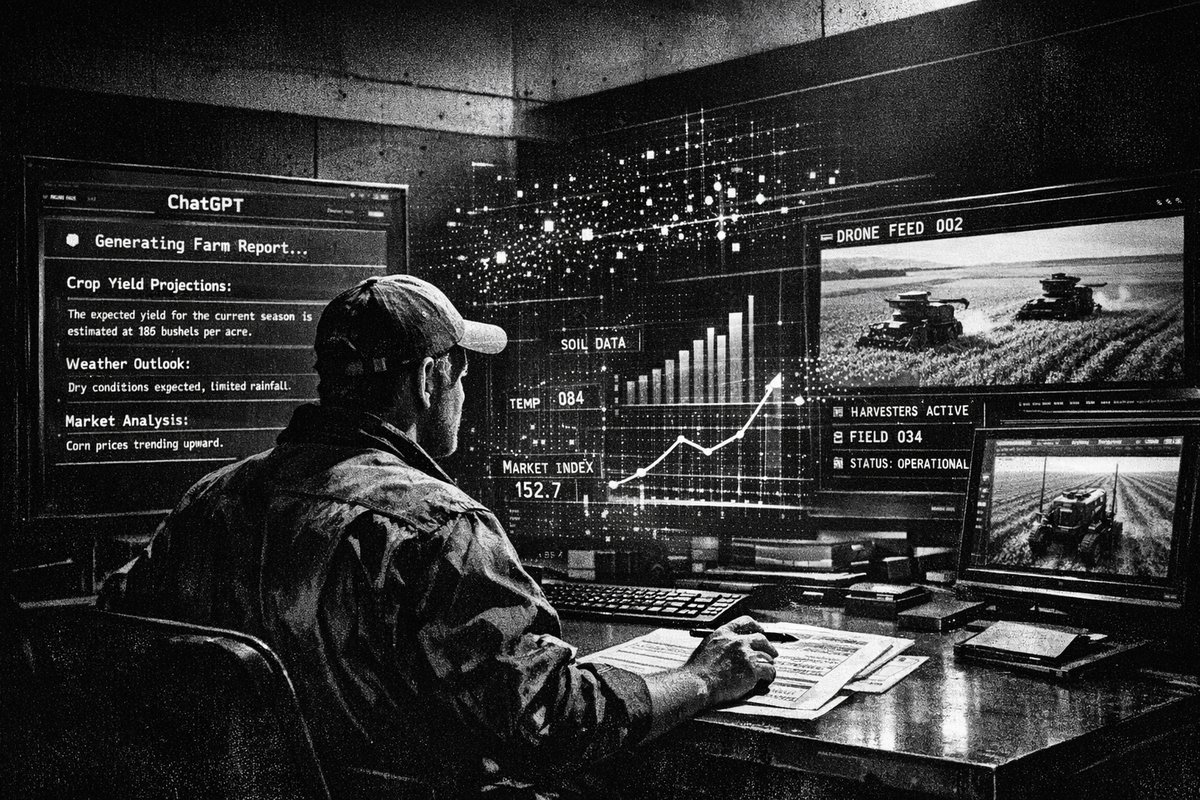
For now, the most significant AI impact in agriculture isn’t happening in the field—it’s happening in the farm office, where ChatGPT is quietly helping farmers manage the increasingly complex business of modern agriculture.
Published in Stream · Dispatch #385 · May 26, 2026 · 5 min read.
Reply to paolo@mont3.ch - every email gets a human answer within 24h.