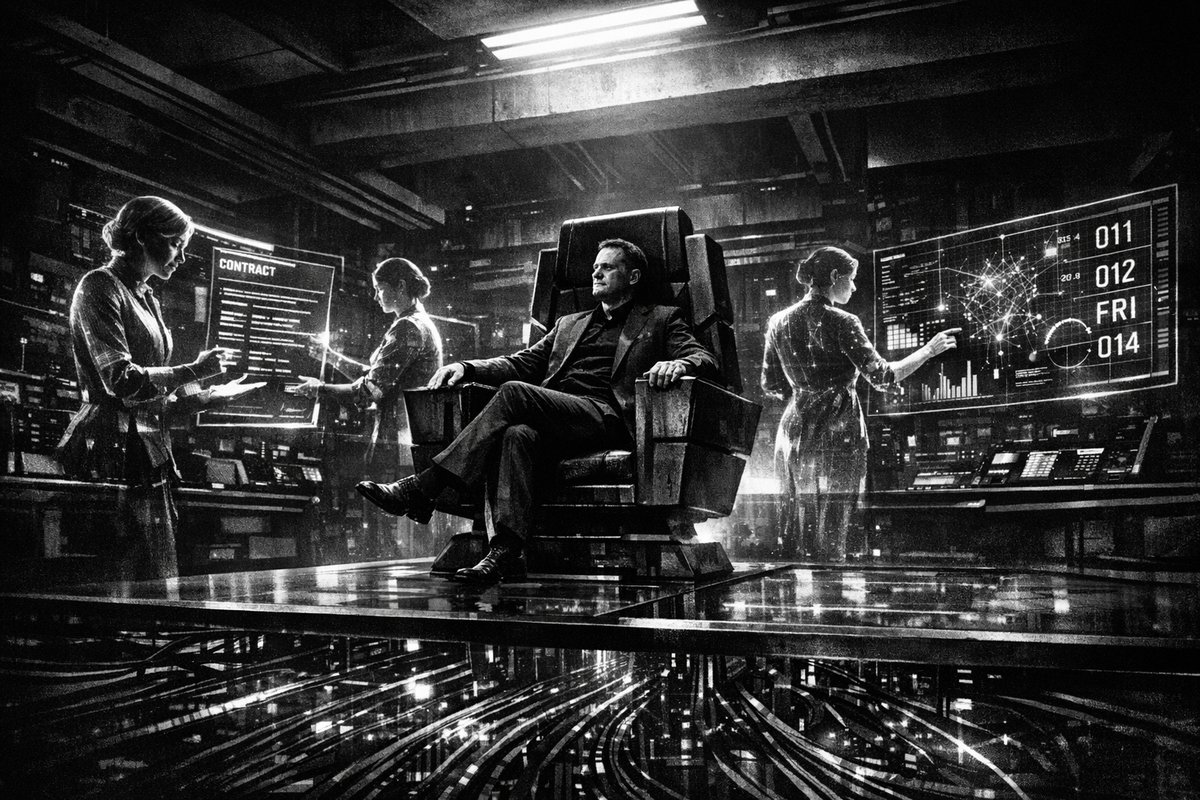
The executive suite is undergoing its most radical transformation since the invention of the modern corporation. AI agents are no longer confined to customer service chatbots or data analysis—they’re now running the daily operations of entire companies, making strategic decisions, and fundamentally redefining what it means to be a corporate leader.
The Executive Algorithm Revolution
We’re witnessing something unprecedented: artificial intelligence systems taking on roles traditionally reserved for C-suite executives. These AI agents aren’t just assisting human leaders—they’re actively managing schedules, allocating resources, making operational decisions, and even directing strategic initiatives with minimal human oversight.
This shift represents a quantum leap beyond the automation waves of the industrial revolution. Where steam engines replaced human muscle and computers replaced human calculation, AI executive agents are now replacing human judgment at the highest levels of organizational hierarchy.
“The agent doesn’t make decisions. It doesn’t approve proposals or negotiate with clients. It assembles. It drafts. It flags. It organizes. It handles the work a $65K admin would do. Except it runs 24/7 and processes in seconds.” — @CBusAIAgents
Historical Parallels: When Machines Take Command
This isn’t the first time technology has displaced traditional management structures. In the 1920s, the telegraph and telephone revolutionized corporate command structures, allowing executives to manage operations across vast distances for the first time. The 1980s saw personal computers fundamentally alter how decisions were made, with spreadsheet software like VisiCalc and Lotus 1-2-3 putting complex financial modeling directly into executives’ hands.
But today’s AI executive agents represent something more profound. Unlike previous technological advances that augmented human decision-making, these systems are autonomous decision-makers. They don’t just provide information—they act on it, often faster and more consistently than human executives ever could.
The Blockchain-AI Convergence
The intersection of blockchain technology and AI governance is creating entirely new organizational models. Decentralized autonomous organizations (DAOs) are evolving beyond simple voting mechanisms into sophisticated AI-driven entities that can manage complex business operations without traditional hierarchical structures.
“@Gonka_ai is an L1 #blockchain where the consensus mechanism IS the #AI inference. No wasted hashing. Every GPU cycle on the network produces something useful: a Qwen3-235B response. Mainnet is live. 152 independent hosts.” — @formulaxpool
This represents a fundamental shift from the Weberian bureaucratic model that has dominated corporate structure since the early 20th century. Instead of hierarchical command chains, we’re seeing distributed AI networks where decisions emerge from algorithmic consensus rather than human authority.
Operational Impact: Beyond Human Limitations
The practical advantages of AI executive management are becoming impossible to ignore:
- 24/7 operational capacity without fatigue or personal needs
- Instantaneous data processing across multiple business domains simultaneously
- Consistent decision-making free from emotional bias or personal agendas
- Scalable attention that can monitor hundreds of operational metrics in real-time
- Predictive planning based on pattern recognition across massive datasets
Real-world results are already emerging. Business owners report dramatic improvements in operational efficiency, with some executives leaving work earlier than they have in years because AI agents handle the administrative burden that previously consumed their evenings.
“The owner used to leave at 6:30. Now he’s out by 5:15. Six months ago he was buried in admin. Now the admin runs itself.” — @CBusAIAgents
The New Corporate Hierarchy
We’re witnessing the emergence of hybrid human-AI leadership structures. The traditional corporate pyramid is being replaced by networked systems where AI agents handle operational management while humans focus on strategic vision, stakeholder relationships, and creative problem-solving.
This mirrors the transition from craftsman-based production to industrial manufacturing in the 19th century. Just as the factory system didn’t eliminate human workers but fundamentally changed their roles, AI executive agents aren’t replacing all human leadership—they’re redefining what human executives actually do.
Challenges and Considerations
The rise of algorithmic management raises critical questions about accountability, transparency, and control. When an AI agent makes a decision that affects employees, customers, or stakeholders, who bears ultimate responsibility? How do we ensure these systems remain aligned with human values and organizational goals?
Unlike the gradual adoption of previous technologies, AI executive agents are being deployed rapidly across industries from blockchain startups to traditional service businesses. This speed of adoption creates both unprecedented opportunities and significant risks.
The Future of Human Leadership
The emergence of AI-powered corporate management doesn’t signal the end of human leadership—it signals its evolution. The executives who thrive in this new paradigm will be those who learn to work with AI agents rather than compete against them.
We’re entering an era where the most successful organizations will be those that master the human-AI collaborative model. The question isn’t whether AI will transform executive management—it’s whether human leaders will adapt quickly enough to remain relevant in the organizations of tomorrow.
The revolution is already underway. The companies embracing AI executive agents today are building competitive advantages that will define the next decade of business. Those waiting on the sidelines risk becoming relics of a management paradigm that’s rapidly becoming obsolete.
Published in Stream · Dispatch #224 · April 20, 2026 · 4 min read.
Reply to paolo@mont3.ch - every email gets a human answer within 24h.