The financial markets are at a critical inflection point. Three powerful forces are converging to create what could be the most significant investment landscape shift since the 2008 financial crisis: Nvidia’s AI dominance, surging bond yields, and the emergence of a new commodity supercycle. Understanding how these elements interact isn’t just academic—it’s essential for anyone with skin in the game.
Nvidia’s Astronomical Rise: The New Gold Standard
Nvidia’s performance over the past five years reads like financial fiction. The numbers are staggering:
“Over the last 5 years (roughly May 2021 to mid-May 2026), Tesla (TSLA) stock is up about +119%, while NVIDIA (NVDA) is up about +1,508%. Key Details (approximate total returns, price-only, adjusted for splits where applicable): • TSLA: ~119% cumulative return (e.g., $10,000 invested → ~$21,920). • NVDA: ~1,494–1,508% cumulative return (e.g., $10,000 invested → ~$159,000+).” — @Doug53885327250
This 1,508% return isn’t just impressive—it’s historically unprecedented for a company of Nvidia’s scale. To put this in perspective, during the dot-com boom, Cisco Systems peaked at a market cap of roughly $500 billion before crashing. Nvidia has not only sustained but accelerated its growth well beyond those levels, driven by genuine technological disruption rather than speculative fervor.
The artificial intelligence revolution has created what economists call a “winner-take-all” market dynamic. Just as Standard Oil dominated the industrial age and Microsoft ruled the PC era, Nvidia has positioned itself as the infrastructure backbone of the AI economy. Every major tech company—from Google to Meta to OpenAI—depends on Nvidia’s chips to train their models.
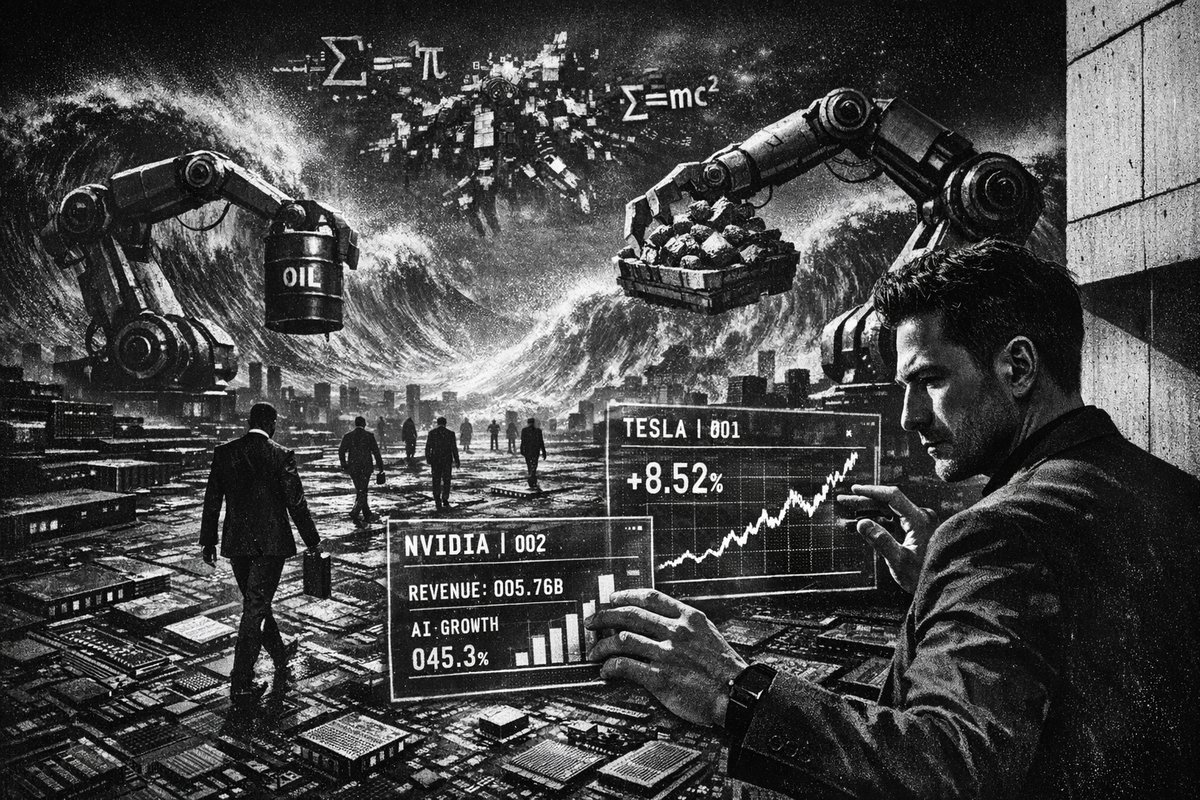
Bond Market Turbulence: The Canary in the Coal Mine
While investors celebrate Nvidia’s meteoric rise, a more ominous story is unfolding in the bond markets. Rising yields are sending shockwaves through the global financial system, and the implications extend far beyond government debt.
US 10-year yields hitting 4.63% represents more than just numbers on a screen. When bond yields rise this rapidly, it signals that investors are demanding higher compensation for risk—either because they expect inflation to accelerate or because they’re questioning the government’s ability to service its debt. Both scenarios spell trouble for risk assets.
The situation becomes even more complex when we examine the Japanese market, which experienced a devastating $95 billion wipeout in a single trading session. This isn’t just a local Japanese phenomenon; it’s a warning sign that the era of ultra-low interest rates and easy money may be ending globally.
“$95 billion wiped out in Japan in a single day is a proper reminder that global markets can still move violently. Bond yields ripping higher is the kind of macro shit that eventually spills over everywhere. You seeing this as a localised Japan thing or the start of something broader?” — @BenjHanson1991
Historically, when Japanese markets experience this level of volatility, it often precedes broader global market stress. Remember the 1998 Asian Financial Crisis or the 2008 carry trade unwind—both began with seemingly isolated events in Asian markets before spreading worldwide.
The Commodity Supercycle: History’s Longest Economic Wave
Perhaps the most significant yet underappreciated force reshaping markets is the emerging commodity supercycle. These aren’t ordinary market cycles—they’re generational shifts that can last decades and reshape entire economies.
Commodity supercycles typically follow predictable patterns:
- Phase 1: Demand growth outstrips supply capacity
- Phase 2: Prices rise, spurring investment in new capacity
- Phase 3: Peak prices and maximum investment
- Phase 4: New supply comes online, prices collapse
The most recent supercycle ran from approximately 2000 to 2014, driven primarily by China’s industrialization. Now, multiple factors are aligning for the next wave:
“If the 18 year commodity cycle holds true, then we’re still in the 1st inning of the current commodities supercycle that won’t peak until the mid 2030’s to early 2040’s.” — @krugman87
The Convergence: Why These Trends Matter Together
These three forces aren’t operating in isolation—they’re creating powerful feedback loops that could amplify market volatility and reshape investment strategies for the next decade.
The AI infrastructure boom requires massive amounts of raw materials: rare earth elements for semiconductors, copper for data centers, lithium for backup power systems. As Nvidia and its competitors scale up production, they’re adding significant demand pressure to already tight commodity markets.
Meanwhile, rising bond yields make it more expensive for mining companies to finance new projects, potentially constraining supply just as demand accelerates. This creates what economists call a “supply-demand scissors”—rising demand meeting constrained supply.
Key market implications include:
- Technology stocks may face headwinds from higher discount rates
- Commodity-producing nations could experience currency strength
- Traditional value investing may outperform growth strategies
- Infrastructure and materials sectors could see sustained outperformance
- Emerging markets with commodity exposure may attract capital flows
Strategic Positioning for the New Paradigm
Smart investors are already repositioning for this new reality. The old playbook of buying growth stocks and hoping for multiple expansion may not work in an environment of higher rates and commodity inflation.
The parallels to the 1970s are striking: technology disruption (the microprocessor revolution), commodity price spikes (oil crises), and rising interest rates created a challenging environment for traditional growth stocks while rewarding value investors and commodity producers.
However, today’s landscape also offers unique opportunities. Unlike the 1970s, we’re witnessing genuine technological breakthroughs that could drive productivity gains sufficient to offset inflationary pressures—if investors can identify the right companies and sectors.
The convergence of Nvidia’s AI dominance, rising bond yields, and an emerging commodity supercycle represents more than just market noise. These are tectonic shifts that will define investment returns for the next decade. Success will require abandoning conventional wisdom and embracing a more nuanced understanding of how technology, monetary policy, and resource cycles interact in our interconnected global economy.
Published in Stream · Dispatch #346 · May 18, 2026 · 5 min read.
Reply to paolo@mont3.ch - every email gets a human answer within 24h.