The workplace transformation is no longer coming—it’s here. Stanford HAI and Google DeepMind just concluded a massive research competition that attracted 200+ academic teams from 156 universities, all racing to decode how artificial intelligence will fundamentally rewire human collaboration. This isn’t incremental change. This is organizational evolution at breakneck speed.
The stakes couldn’t be higher. Every company deploying AI today is essentially conducting a live experiment on their workforce, with little scientific understanding of the consequences. The AI for Organizations Grand Challenge represents the first systematic attempt to map this uncharted territory before it’s too late.
The Grammar Revolution: Decoding Team DNA
Yankai Wang and Amir Goldberg from Stanford didn’t just win the $100,000 grand prize—they cracked the fundamental code of human coordination. Their breakthrough concept of studying the “grammar of coordination” mirrors how computational linguistics revolutionized natural language processing in the 1950s.
Just as Noam Chomsky identified universal grammar patterns that govern all human languages, Wang and Goldberg are building a “large coordination model” that can predict which sequences of human actions will succeed or fail in specific organizational contexts. They’re applying transformer architecture—the same technology powering ChatGPT—to decode the hidden patterns in emails, meetings, and document collaboration.
Think of it as Google Translate for team dynamics. Instead of converting French to English, this system translates chaotic human coordination into optimized workflow sequences.
The Four Pillars of Future Organizations
The competition finalists revealed four critical areas where AI will reshape workplace collaboration:
- Lean Curation: Filtering AI-generated ideas using manufacturing principles to prevent cognitive overload
- Collective Intelligence Measurement: Real-time assessment of team cognitive capacity and decision-making quality
- Expertise Discovery: Breaking down organizational silos by surfacing hidden internal knowledge
- Multimodal Team Analysis: Using AI to analyze voice, video, and behavioral data for collaboration optimization
Each approach tackles a different organizational failure mode that traditional management theory never anticipated. We’re not just automating existing processes—we’re inventing entirely new forms of human cooperation.
Historical Parallel: The Telegraph’s Organizational Earthquake
This transformation echoes the 1840s telegraph revolution that destroyed distance-based business models overnight. Before the telegraph, information moved at the speed of horses and ships. Companies were organized around physical proximity and hierarchical communication chains.
Samuel Morse’s invention didn’t just speed up communication—it enabled entirely new organizational structures. Railroad companies could suddenly coordinate across thousands of miles. Financial markets became interconnected. The modern corporation as we know it was born.
Today’s AI revolution is triggering a similar organizational earthquake. The fundamental constraints that shaped 20th-century management—information scarcity, cognitive limitations, coordination costs—are evaporating.
The Interface Revolution: Beyond Chat Boxes
The public reaction reveals another critical shift happening simultaneously. Google DeepMind’s experimental AI-enabled pointer represents a fundamental interface evolution:
“Google DeepMind is experimenting with an AI-enabled mouse pointer that lets Gemini understand what you are pointing at on your screen. Instead of giving long, detailed prompts, users could point, hover, highlight, or gesture at something, then say simple commands like ‘summarize this,’ ‘make this a chart,’ ‘fix this,’ or ‘double these ingredients.’” — @WesRoth
This seemingly simple innovation represents a massive shift from explicit instruction to contextual intention. Instead of describing what you want, you simply point and speak. The cognitive overhead of human-AI interaction plummets.
The Measurement Problem: Tracking Invisible Work
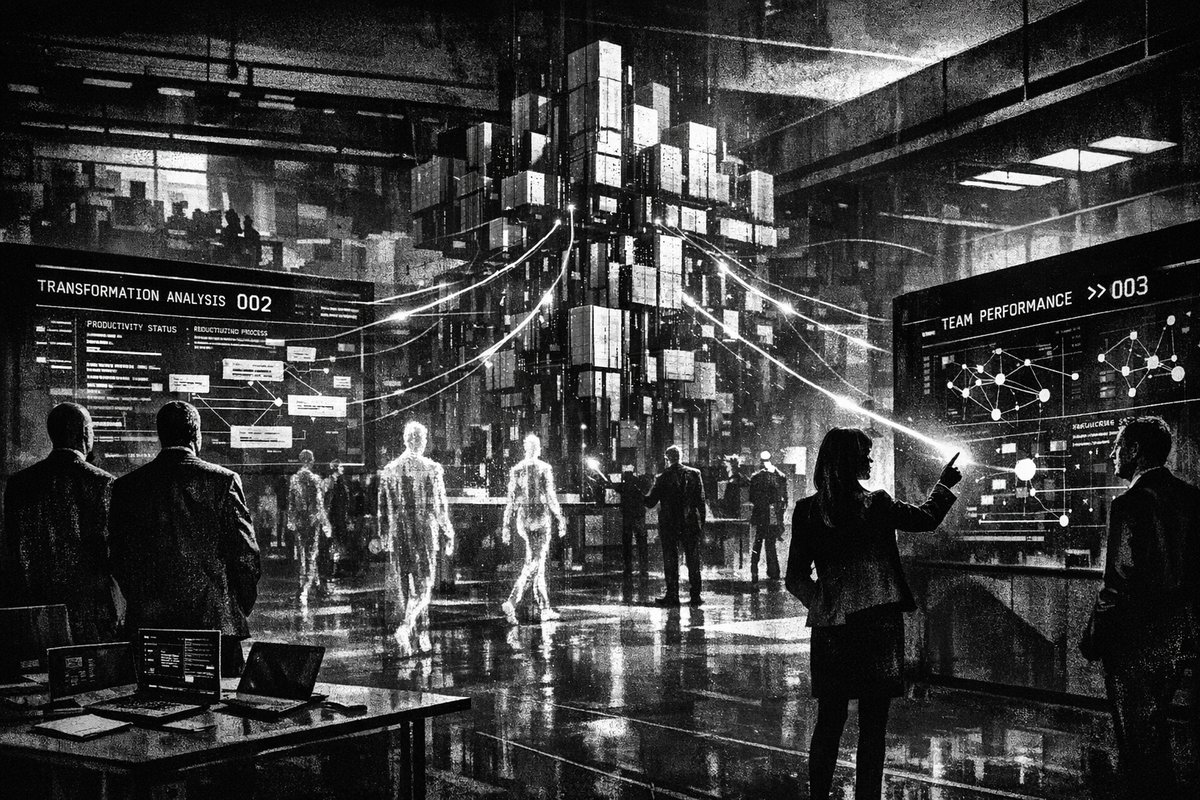
Traditional organizational metrics—hours worked, meetings attended, emails sent—become meaningless when AI handles routine cognitive tasks. Northwestern’s TeamLens project tackles this measurement crisis by developing multimodal large language models that can analyze team behavior at unprecedented scale.
This mirrors the challenge faced by Frederick Winslow Taylor during the industrial revolution. Taylor’s scientific management principles emerged from the need to measure and optimize physical labor. Today’s challenge is exponentially more complex: measuring and optimizing cognitive collaboration enhanced by artificial intelligence.
The Human-Centered Imperative
Melissa Valentine, Stanford HAI senior fellow, emphasizes the critical importance of human-centered design in this transformation: “This competition marks the beginning of a broad, public conversation about how organizations are changing.”
The research isn’t just academic—it’s defensive. Companies deploying AI without understanding organizational consequences risk creating dysfunctional hybrid systems where humans and machines work against each other rather than together.
Google DeepMind’s commitment to implementing the winning research within their own offices demonstrates unprecedented corporate transparency. They’re not just funding research—they’re volunteering as test subjects.
The Speed of Scientific Revolution
Simon Bouton, Google DeepMind’s Chief Experience Officer, makes a crucial observation: “The field of organizational science is moving faster than most people realize.” This acceleration creates both opportunity and danger.
Unlike previous technological transitions that unfolded over decades, AI transformation is happening in months. The gap between technological capability and organizational understanding is widening dangerously fast.
Conclusion: Redesigning Human Collaboration
The AI for Organizations Grand Challenge isn’t just academic research—it’s an early warning system for the most profound workplace transformation in human history. The winning teams aren’t predicting the future; they’re building the scientific framework that will guide organizations through an unprecedented transition.
The question isn’t whether AI will reshape human collaboration, but whether we’ll understand and control that reshaping before it controls us. The research emerging from this challenge represents our best hope for maintaining human agency in an AI-augmented world.
Every organization deploying AI today should be watching these results closely. The alternative is stumbling blindly into a future where technology dictates human behavior rather than enhancing human potential.
Published in Stream · Dispatch #320 · May 13, 2026 · 5 min read.
Reply to paolo@mont3.ch - every email gets a human answer within 24h.