The 0G Foundation and Alibaba Cloud just dropped a nuclear bomb on the traditional AI infrastructure model. Their collaboration brings Qwen large language models directly onto blockchain infrastructure, eliminating the bureaucratic nightmare of API-based access that has strangled AI agent development for years.
This isn’t just another partnership announcement. This is the moment when AI infrastructure finally caught up with the autonomous future we’ve been building toward.
The Death of API Hell
For years, developers have been trapped in what I call API hell — a labyrinth of account setups, fiat billing systems, and manual configurations that were designed for humans, not autonomous systems. AI agents operating at scale need seamless, real-time access to compute power, not the bureaucratic overhead of traditional cloud services.
The 0G-Alibaba integration solves this by implementing tokenized access to Qwen models directly on-chain. Instead of wrestling with centralized APIs, AI agents can now invoke Qwen models using blockchain-based token mechanisms. It’s like replacing a manual switchboard with direct dial — the friction just evaporates.
This architectural shift mirrors what happened during the transition from mainframe computing to personal computers in the 1980s. IBM’s centralized model gave way to distributed systems that put computing power directly into users’ hands. Today’s collaboration represents a similar paradigm shift, moving from centralized AI gatekeepers to decentralized, programmable access.
“0G has collaborated with @alibaba_cloud to bring Qwen LLMs onchain. Tokenized access. No centralized APIs. Built for autonomous AI agents. This is the infrastructure the agentic economy needs” — @0G_labs
Why Traditional AI Access is Fundamentally Broken
The current AI infrastructure landscape is a relic of the pre-agent era. Large language models like GPT-4, Claude, and yes, even Qwen, remain locked behind centralized APIs that require:
- Manual account creation and management
- Fiat-based billing systems incompatible with autonomous operations
- Rate limiting and access controls designed for human users
- Complex authentication workflows that break autonomous agent loops
These barriers aren’t just inconvenient — they’re architecturally incompatible with the high-frequency, autonomous interactions that define modern AI agent workflows. When an AI agent needs to process thousands of queries per minute across multiple decision trees, traditional API bottlenecks become system-killing constraints.
The 0G-Alibaba Technical Revolution
0G Foundation has engineered a solution that fundamentally rewrites how AI agents access compute power. By procuring Qwen tokens via API and embedding access directly into blockchain infrastructure, they’ve created what amounts to a programmable AI compute layer.
Here’s what this actually means in practice:
- Direct on-chain invocation: AI agents can query Qwen models using blockchain transactions
- Token-based access control: No more account management or billing headaches
- Programmatic scalability: Agents can dynamically scale their AI compute usage
- Verification layer: 0G provides cryptographic proof of AI inference operations
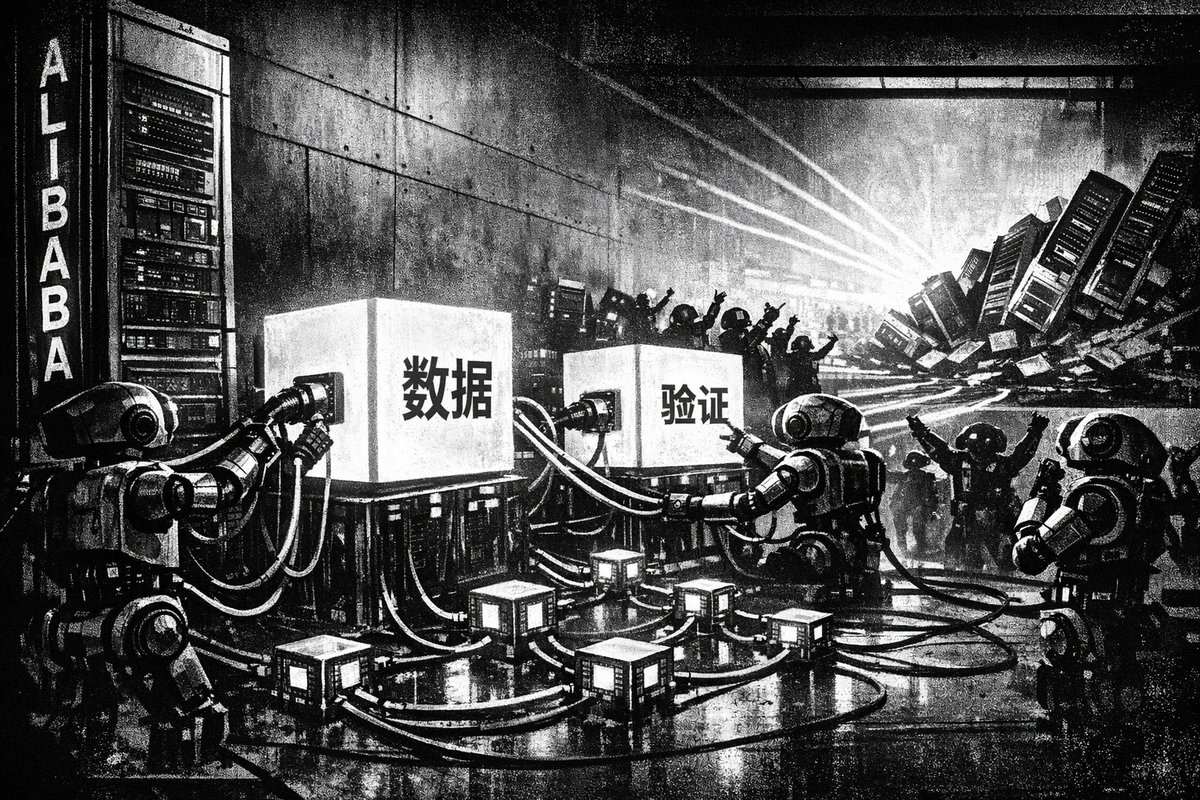
The division of labor is elegant: Qwen handles intelligence, while 0G guarantees trust. Inference runs on Alibaba’s proven language models, while verification runs on 0G’s blockchain infrastructure.
Historical Parallels: The Internet’s Infrastructure Wars
This development reminds me of the early internet’s transition from proprietary networks to open protocols. In the 1990s, companies like AOL and CompuServe tried to maintain walled gardens around internet access. They failed because open, interoperable protocols (HTTP, TCP/IP) proved more powerful than centralized control systems.
The 0G-Alibaba collaboration represents a similar inflection point for AI infrastructure. Instead of forcing developers to work within the constraints of centralized AI providers, this approach makes world-class language models programmable infrastructure — accessible to any agent with the right tokens.
“0G Foundation 与 Alibaba Cloud 合作,将 Qwen 系列模型引入链上调用体系,支持 AI agent 直接按需访问大模型能力。” — @BlockFocus11
The Chinese developer community clearly recognizes the significance: this collaboration enables auditable multi-step agent workflows that cover the complete loop of inference, execution, and verification.
The Agentic Economy Unleashed
What we’re witnessing is the birth of true agentic infrastructure — systems designed from the ground up for autonomous operation rather than human oversight. AI agents can now operate with the same seamless access to intelligence that they have to blockchain-based financial rails.
Consider the implications:
- Autonomous trading agents can access Qwen’s analytical capabilities while executing on-chain transactions
- Content generation agents can produce and verify text without human intermediaries
- Research agents can query, analyze, and cross-reference information autonomously
- Decision-making agents can access state-of-the-art reasoning while maintaining full auditability
This isn’t speculative. The infrastructure exists today.
Beyond the Hype: Real Technical Innovation
While the crypto space is littered with partnerships that amount to glorified press releases, the 0G-Alibaba integration delivers concrete technical innovation. Qwen models are already among the world’s most widely adopted language models, proving their capabilities across coding, reasoning, and multilingual tasks.
0G’s blockchain infrastructure adds the missing piece: verifiable, programmable access that works at agent speed and scale. This combination creates something genuinely new — AI infrastructure that’s both powerful and trustless.
The timing couldn’t be better. As AI agent capabilities explode and autonomous systems become mainstream, the bottleneck has shifted from AI intelligence to AI accessibility. This collaboration eliminates that bottleneck.
The Infrastructure Revolution Starts Now
The 0G-Alibaba partnership represents more than a technical integration — it’s the opening shot in the war between centralized AI gatekeepers and decentralized, programmable infrastructure.
For developers building the next generation of autonomous systems, this changes everything. No more begging for API access, wrestling with billing systems, or architecting around centralized failure points. Just direct, tokenized access to world-class AI capabilities.
The agentic economy isn’t coming — it’s here. And it’s built on infrastructure that finally matches the ambition of the applications we’re creating.
Published in Stream · Dispatch #239 · April 23, 2026 · 5 min read.
Reply to paolo@mont3.ch - every email gets a human answer within 24h.