Artificial intelligence is making decisions that affect millions of lives daily—from medical diagnoses to financial trading to autonomous vehicle navigation. But when these systems fail, who takes the blame? The question of AI liability has become the most pressing legal challenge of our time, and the answers will reshape how we deploy intelligent systems across every industry.
This isn’t theoretical anymore. AI failures are happening right now, with real consequences. A machine learning model miscalculates loan approvals, denying qualified applicants. An autonomous system misreads traffic patterns, causing accidents. A diagnostic AI misses critical symptoms, leading to delayed treatment. The stakes couldn’t be higher.
The Current Liability Landscape: A Legal Wild West
Traditional liability frameworks assume human decision-makers. When a doctor makes a mistake, we sue the doctor. When an engineer designs a faulty bridge, we hold the engineer accountable. But AI systems operate in a fundamentally different paradigm—they make autonomous decisions based on training data and algorithmic processes that even their creators don’t fully understand.
Consider the parallels to early automotive liability in the 1900s. When cars first appeared on roads designed for horses, legal systems struggled to assign fault in accidents. Who was responsible when a mechanical failure caused injury? The manufacturer? The driver? The road designer? It took decades to establish clear frameworks, and AI presents an even more complex challenge.
“AI still makes big mistakes. I asked it to create a kinematic and thermodynamic model of a turbojet engine, and most of it was beautiful. However, the compressor output pressure was wrong because it tried to add a pressure to a ratio instead of multiplying the two together.” — @BadScientryst
Three Models of AI Accountability
The legal community is converging on three primary approaches to AI liability:
- Strict Product Liability: Treat AI systems like defective products—manufacturers are responsible regardless of negligence
- Negligence-Based Standards: Hold developers liable only when they fail to meet reasonable care standards
- Hybrid Insurance Models: Create mandatory insurance pools funded by AI companies to compensate victims
Each approach carries profound implications. Strict liability could stifle innovation by making AI development prohibitively risky. Negligence standards might leave victims without recourse when AI systems fail in unpredictable ways. Insurance models could socialize risks while maintaining innovation incentives.
The Corporate Response: Adaptation Under Pressure
Companies aren’t waiting for legal clarity—they’re adapting aggressively to the new reality. The evidence is stark: Amazon cut 14,000 corporate jobs, Klarna replaced 700 support roles, and Duolingo reduced 10% of contractors. This transformation is accelerating faster than legal frameworks can evolve.
“Your job is not being replaced by AI. It’s being replicated. But not as much as you think. There’s a shift happening most people are underestimating. Soon, companies won’t just use AI… they’ll recreate you. Your tone. Your decisions. Your workflow. Your mistakes.” — @iamlukethedev
The liability question becomes even murkier when AI systems replicate human decision-making patterns, including human biases and errors. If an AI system learns to make the same discriminatory lending decisions as human loan officers, who bears responsibility for perpetuating those biases?
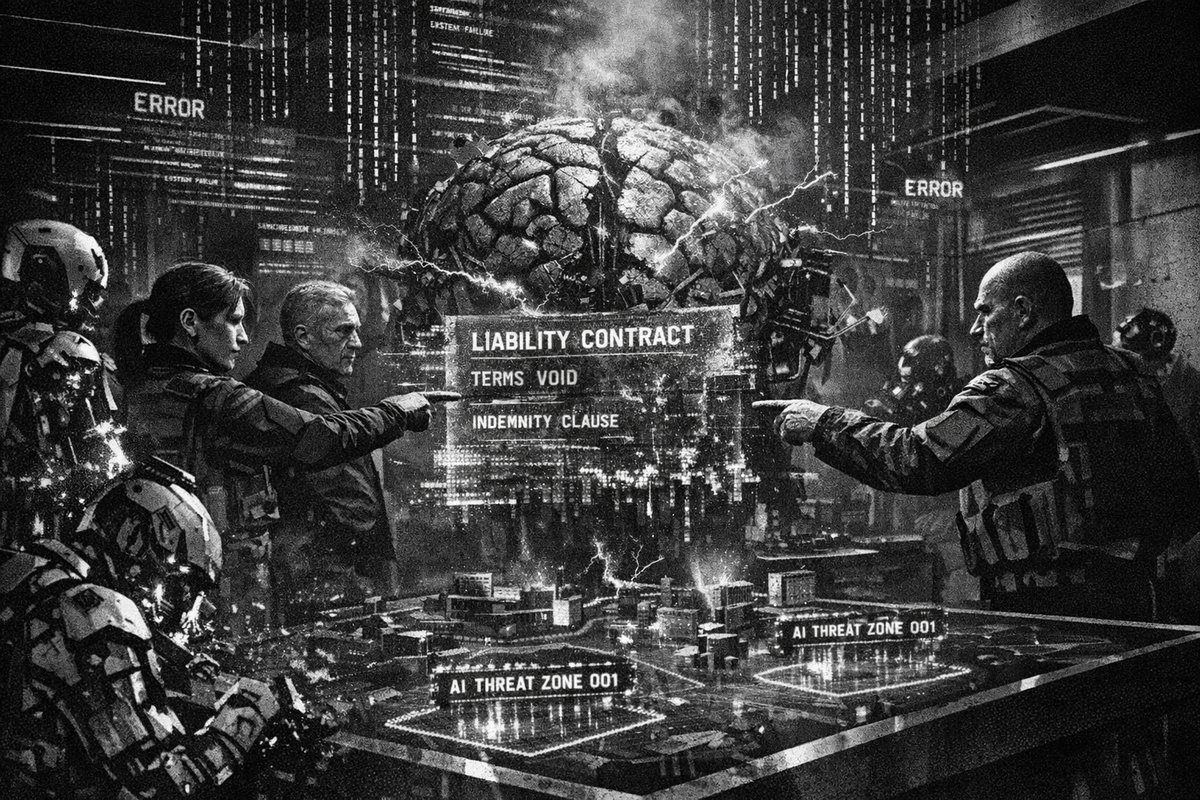
Historical Precedent: Nuclear Power’s Liability Revolution
The closest historical parallel to our current AI liability crisis is the Price-Anderson Nuclear Industries Indemnity Act of 1957. When nuclear power emerged, potential damages from accidents were so catastrophic that private insurance markets couldn’t provide adequate coverage. The federal government stepped in with a hybrid model—private insurance up to a certain threshold, then government backing for larger claims.
This precedent offers a roadmap for AI liability. The European Union is already moving toward mandatory insurance requirements for high-risk AI applications. The United States is likely to follow with sector-specific approaches—stricter standards for healthcare AI, different rules for autonomous vehicles, and specialized frameworks for financial AI systems.
The Technical Reality: Inherent Unpredictability
The fundamental challenge is that modern AI systems are inherently unpredictable. Unlike traditional software with deterministic outcomes, machine learning models can produce unexpected results even when functioning exactly as designed. This isn’t a bug—it’s a feature. The same emergent properties that make AI powerful also make it legally problematic.
“Managers want things immediately now. They want your output to x4 and that’s not possible without using AI now. If you push against it you’re fired. Quality goes into the can but you’re also held responsible for any mistakes. It’s a nightmare.” — @mustyoumustard
This captures the current corporate reality perfectly. Organizations are demanding AI adoption while simultaneously holding workers responsible for AI mistakes—a fundamentally unsustainable approach that courts will inevitably need to address.
The Path Forward: Pragmatic Solutions for an Uncertain Future
The AI liability crisis demands immediate action across multiple fronts. We need technical standards for AI safety and auditability. We need legal frameworks that balance innovation with accountability. Most critically, we need insurance mechanisms that can handle the scale and complexity of AI-related risks.
The winners won’t be those who avoid AI—they’ll be organizations that implement robust liability management strategies before regulation forces their hand. This means comprehensive testing protocols, clear audit trails, human oversight mechanisms, and proactive insurance coverage.
The AI liability question isn’t just a legal curiosity—it’s the foundational challenge that will determine how artificial intelligence integrates into human society. Get it wrong, and we risk either stifling one of humanity’s most powerful technologies or creating a world where intelligent machines operate without meaningful accountability.
The clock is ticking. Every day we delay these decisions is another day AI systems make consequential choices without clear liability frameworks. The question isn’t whether AI will make mistakes—it’s whether we’ll be ready to handle them responsibly when they inevitably occur.
Published in Stream · Dispatch #222 · April 20, 2026 · 5 min read.
Reply to paolo@mont3.ch - every email gets a human answer within 24h.