The artificial intelligence revolution is devouring electricity at an unprecedented rate. Data centers are projected to consume 12 percent of total U.S. electricity by 2028, according to Lawrence Berkeley National Laboratory—a staggering figure that puts AI’s energy appetite on par with entire nations. Now, MIT researchers have developed a game-changing tool called EnergAIzer that transforms how we measure and manage AI’s power consumption, delivering accurate estimates in seconds instead of days.
The Energy Crisis Hidden in Plain Sight
To understand the magnitude of this challenge, consider that modern data centers house thousands of powerful GPUs running continuously to train and deploy AI models. Each GPU’s power consumption fluctuates dramatically based on workload and configuration, making energy prediction a complex puzzle that has stumped operators for years.
Traditional energy estimation methods break down AI workloads into individual steps, emulating each GPU module’s utilization one operation at a time. This brute-force approach can take hours or even days to produce a single estimate—an eternity in the fast-moving world of AI deployment.
“As an operator, if I want to compare different algorithms or configurations to find the most energy-efficient manner to proceed, if a single emulation is going to take days, that is going to become very impractical,” explains Kyungmi Lee, MIT postdoc and lead author of the research.
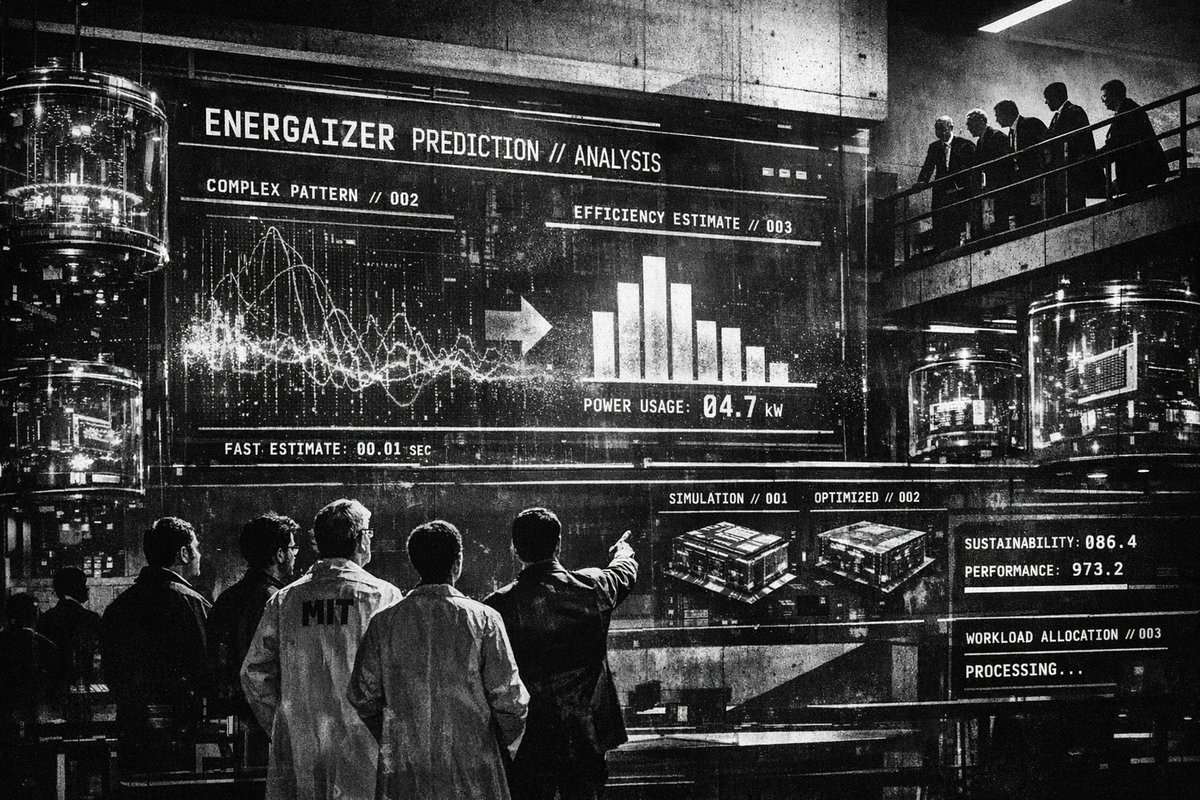
EnergAIzer: Speed Meets Precision
The MIT team’s breakthrough lies in recognizing that AI workloads contain repeatable patterns. Instead of simulating every microscopic operation, EnergAIzer identifies and leverages the regular structures created by software optimizations that distribute work across parallel processing cores.
This lightweight estimation model captures GPU power usage patterns with remarkable efficiency. But speed without accuracy is worthless—so the researchers incorporated real-world correction factors to account for:
- Fixed energy costs for program setup and configuration
- Variable operational costs for processing data chunks
- Hardware fluctuations and bandwidth limitations that affect performance
- Memory access conflicts that can slow operations and increase energy draw
The result? EnergAIzer achieves approximately 8 percent error rates—matching traditional methods’ accuracy while delivering results in seconds instead of days.
Historical Context: Learning from Past Resource Revolutions
This energy estimation breakthrough echoes previous technological inflection points where resource management became critical. During the 1970s oil crisis, automakers scrambled to develop fuel efficiency standards and measurement tools. The semiconductor industry faced similar challenges in the 1990s when power consumption became a limiting factor in chip design, leading to innovations in low-power computing architectures.
The parallel is striking: just as automotive fuel economy standards drove innovation in engine efficiency, AI’s energy crisis is spurring development of sophisticated power management tools. EnergAIzer represents the kind of foundational infrastructure needed to navigate this transition responsibly.
Public Reaction: Growing Concerns Over AI’s Energy Appetite
The broader implications haven’t escaped public attention. Social media discussions reveal mounting concern about AI’s resource consumption:
“Can someone tell me how a data center will improve the lives of Americans? Explain to me the benefits that we will receive worth trillions of dollars, billions of gallons of fresh water, millions of acres of farm land, and more energy than our biggest cities.” — @HarrisonHSmith
This sentiment reflects a growing skepticism about AI’s cost-benefit ratio, particularly as energy infrastructure struggles to keep pace with demand.
“A 10 gigawatt data center is equivalent to the energy of EIGHT million people! Wtf!!!!” — @midwestunity555
Meanwhile, investors are positioning for the energy bottleneck:
“Going to start positioning more into the energy sector moving forward. I believe a real bottleneck presents itself with energy now. — from AI datacenters needing basically nuclear reactors to power them and energy consumption expected to double by 2030.” — @SharesGem
Real-World Applications and Impact
Data center operators can immediately apply EnergAIzer to optimize resource allocation across multiple AI models and processors. Instead of running energy-intensive workloads blindly, they can now make informed decisions about:
- Which processors to assign specific AI tasks
- How to configure GPU settings for maximum efficiency
- Whether to deploy new models based on their energy footprint
- Real-time adjustments to operating speeds and configurations
Algorithm developers gain unprecedented visibility into their models’ energy consumption before deployment, enabling them to optimize for efficiency during the design phase rather than after the fact.
Looking Forward: Scaling the Solution
The MIT team plans to test EnergAIzer on cutting-edge GPU configurations and scale the model to handle collaborative multi-GPU workloads—the backbone of modern AI training operations. This expansion could provide system-wide energy visibility across entire data centers.
“To really make an impact on sustainability, we need a tool that can provide a fast energy estimation solution across the stack, for hardware designers, data center operators, and algorithm developers, so they can all be more aware of power consumption,” Lee emphasizes.
The Sustainability Imperative
EnergAIzer arrives at a critical juncture. As AI capabilities expand exponentially, the technology’s environmental footprint threatens to outpace its benefits. Fast, accurate energy estimation isn’t just a technical convenience—it’s an essential tool for ensuring AI development remains sustainable and socially responsible.
The research, funded by the MIT-IBM Watson AI Lab, represents more than an incremental improvement in measurement tools. It’s a foundational technology that could reshape how the entire AI industry approaches energy efficiency, making power consumption a first-class consideration in algorithm design and deployment decisions.
With AI’s energy demands projected to double by 2030, tools like EnergAIzer aren’t just helpful—they’re absolutely critical for navigating the intersection of technological progress and environmental responsibility.
Published in Stream · Dispatch #257 · April 27, 2026 · 5 min read.
Reply to paolo@mont3.ch - every email gets a human answer within 24h.