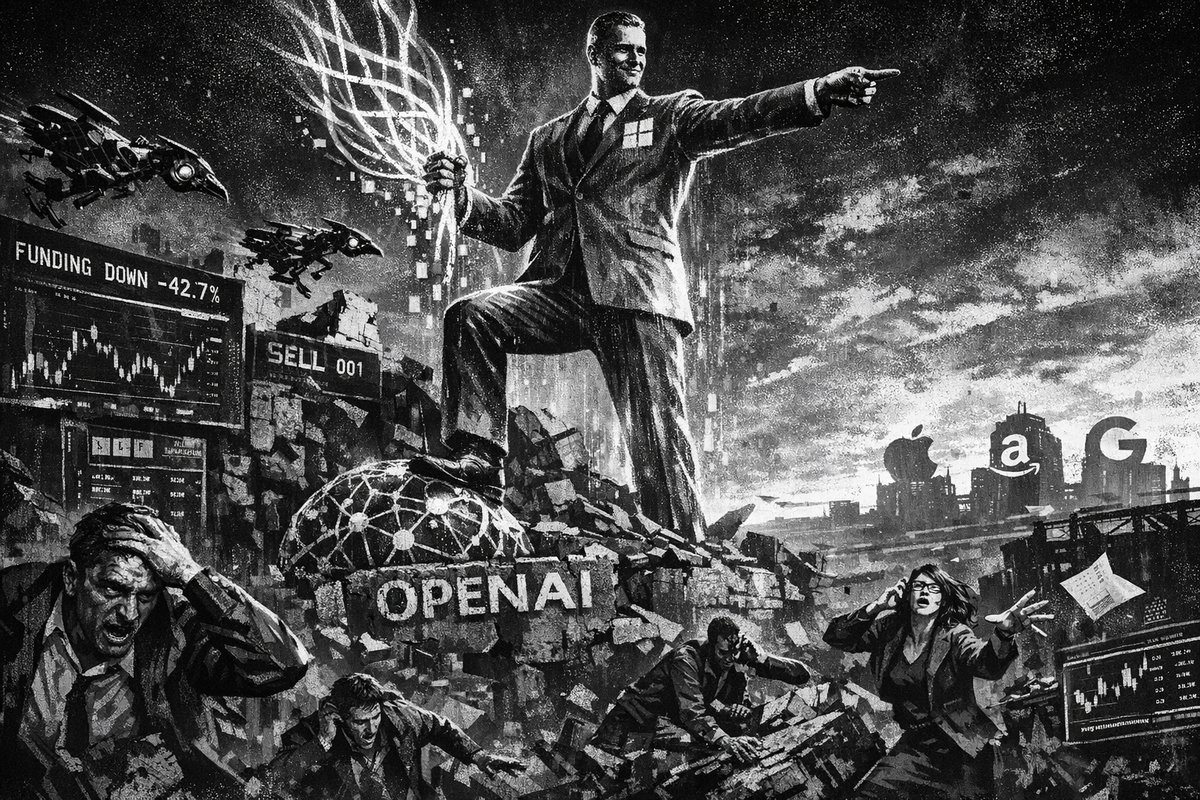
The dust is settling on one of the most audacious corporate partnerships in tech history, and Microsoft is walking away the clear winner. While the AI financing landscape faces mounting scrutiny and capital constraints, Microsoft’s strategic positioning in the OpenAI deal demonstrates exactly how to navigate the treacherous waters of artificial intelligence investment.
This isn’t just another tech deal gone right—it’s a masterclass in strategic patience that rivals the most successful corporate partnerships of the past century.
The Microsoft Playbook: Strategic Patience Over Quick Wins
Microsoft’s approach to the OpenAI partnership mirrors the calculated moves of Standard Oil in the early 1900s or IBM’s positioning during the mainframe era. While competitors scrambled for flashy AI acquisitions and venture capital poured billions into speculative startups, Microsoft methodically built an integrated ecosystem that now appears virtually unassailable.
The numbers tell the story: $13 billion invested over multiple rounds, with Microsoft securing not just equity but exclusive cloud computing rights, API access, and integration capabilities that competitors can’t replicate overnight. This wasn’t venture capital gambling—it was infrastructure monopolization disguised as partnership.
“AI is a tsunami, not a wave. The capital requirements are unlike anything finance has seen before.” — @sang_wen
That observation from industry insiders perfectly captures why Microsoft’s methodical approach is paying dividends while others struggle with the massive capital requirements.
The Financing Reality Check: Where Dreams Meet Mathematics
While Microsoft celebrated its strategic victory, the broader AI financing ecosystem is experiencing a brutal reality check. The $539.5 billion global AI market projected for 2026 sounds impressive until you examine the underlying mathematics:
- Training costs: Single large language models now require $100+ million just for initial training
- Infrastructure demands: Data centers consuming entire power grids
- Talent acquisition: AI engineers commanding $500K+ annual packages
- Ongoing inference costs: Real-time processing expenses that scale exponentially
This capital intensity makes the dot-com bubble look like a lemonade stand operation. Unlike previous tech booms where companies could bootstrap with minimal infrastructure, AI requires massive upfront investment before generating a single dollar of revenue.
Historical Parallels: The Railroad Baron Playbook
Microsoft’s OpenAI strategy bears striking resemblance to Cornelius Vanderbilt’s railroad consolidation in the 1860s. Instead of competing on individual routes, Vanderbilt bought the infrastructure that everyone else needed to use. Microsoft essentially did the same thing—they didn’t just invest in AI, they controlled the pipes through which AI flows.
Consider the strategic elements:
- Exclusive cloud hosting: OpenAI runs on Azure, generating massive recurring revenue
- API monetization: Every ChatGPT query generates Microsoft revenue
- Enterprise integration: Seamless Office 365 and Teams integration creates switching costs
- Data advantage: Access to training data and usage patterns competitors can’t match
The Venture Capital Bloodbath Nobody’s Talking About
While Microsoft’s disciplined approach paid off, the broader AI venture landscape tells a different story. Hundreds of AI startups that raised at astronomical valuations in 2021-2023 are now facing the harsh mathematics of sustainable business models.
The fundamental problem: AI infrastructure costs don’t scale linearly with revenue. A startup might spend $10 million on GPU clusters to generate $1 million in revenue. Traditional venture metrics collapse under these economics.
“The infrastructure is being financed. The models are being trained. The products that turn all of that into values for millions of human beings directly? That’s us.” — @sang_wen
This perspective from industry participants reveals the growing disconnect between infrastructure investment and profitable applications. The money is flowing into picks and shovels, but the gold miners are struggling.
Why Microsoft’s Win Signals Broader Market Consolidation
Microsoft’s success in the OpenAI deal isn’t an isolated victory—it’s a preview of inevitable market consolidation. Just as the early internet era saw thousands of ISPs consolidate into a handful of dominant players, AI is following the same pattern.
The barriers to entry are simply too high for sustainable competition:
- Computational resources: Only hyperscale cloud providers can afford the infrastructure
- Talent concentration: Top AI researchers gravitate toward well-funded platforms
- Data network effects: Larger platforms generate better training data
- Enterprise trust: Corporate customers prefer established technology partners
This creates a winner-take-most dynamic that Microsoft recognized early and positioned to exploit.
The Broader Implications: What This Means for Innovation
Microsoft’s OpenAI victory raises uncomfortable questions about innovation in the AI era. When the cost of entry requires billions in capital and years of infrastructure development, does innovation become the exclusive domain of tech giants?
The historical precedent isn’t encouraging. AT&T’s Bell Labs produced incredible innovations for decades, but the monopolistic structure ultimately stifled competition and slowed progress. Microsoft’s AI infrastructure dominance could follow a similar trajectory.
“AI infrastructure is a generational investment opportunity, and we’re still in the early innings of how institutional capital gets deployed.” — @sang_wen
This institutional perspective suggests we’re witnessing the early stages of massive capital deployment, with Microsoft already positioned as the primary beneficiary.
The Strategic Lesson: Infrastructure Always Wins
Microsoft’s OpenAI triumph reinforces a fundamental business principle: control the infrastructure, control the market. From railroads to telephone networks to cloud computing, the companies that own the underlying infrastructure ultimately capture the most value.
The AI revolution is following the same playbook, and Microsoft executed it flawlessly. While competitors chase the next breakthrough algorithm or novel application, Microsoft built the foundation that everyone else depends on.
This strategic positioning ensures that regardless of which AI applications succeed, Microsoft profits from the underlying infrastructure—a lesson that will define the next decade of technology competition.