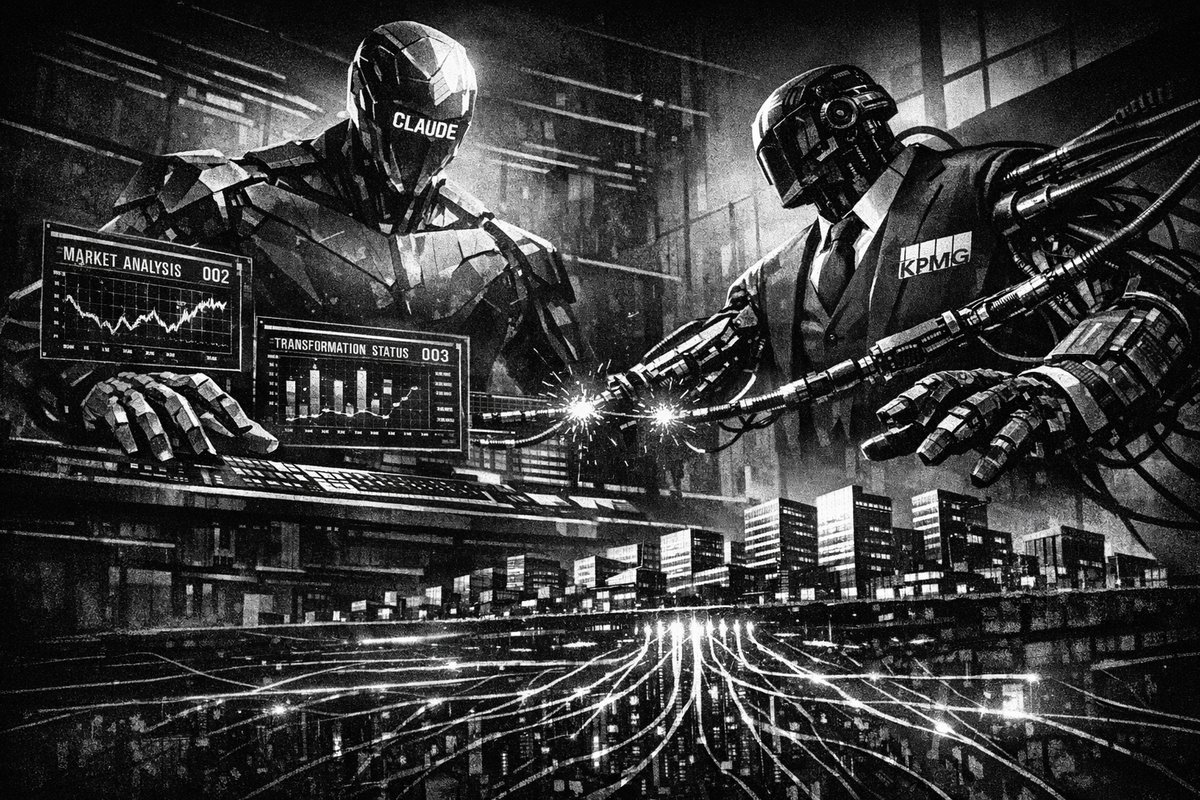
The consulting world just witnessed a seismic shift. KPMG’s alliance with Anthropic isn’t another corporate handshake—it’s a declaration of war against traditional service delivery. When a Big Four firm arms 276,000 professionals globally with Claude AI and embeds it directly into client workflows, we’re looking at the most aggressive AI deployment in professional services history.
The Digital Gateway Revolution: From Weeks to Minutes
KPMG’s Digital Gateway powered by Claude represents more than technological integration—it’s operational metamorphosis. The platform consolidates tax expertise, proprietary tools, and client data into a unified environment where tasks previously requiring weeks now complete within minutes.
This isn’t incremental improvement. It’s process compression at enterprise scale. Consider the historical parallel: when McKinsey & Company pioneered structured problem-solving methodologies in the 1960s, they fundamentally altered how consulting operated. KPMG’s Claude integration follows that playbook, but with digital acceleration that makes the McKinsey revolution look glacial.
The technical architecture tells the story. Claude Co-Work and managed AI agents integrate directly into existing workflows, enabling agentic workflows that clients can build in real-time. This isn’t about replacing human expertise—it’s about amplifying it exponentially.
“KPMGの全世界276,000人超の従業員にもClaudeへのアクセスを提供する。AnthropicはKPMGをPE(プライベートエクイティ)顧客・投資先企業向けの優先コンサルタントにも指定した。” — @LangChainJP
Private Equity Focus: Strategic Positioning for High-Value Clients
KPMG’s selection as Anthropic’s preferred consultant for private equity solutions reveals calculated market positioning. Private equity firms demand speed, accuracy, and confidentiality—requirements that align perfectly with Claude’s capabilities.
The partnership structure creates a competitive moat. While competitors scramble to build AI capabilities, KPMG gains exclusive access to co-develop Claude-powered products for portfolio companies. This isn’t just service delivery—it’s product development at the intersection of consulting expertise and frontier AI.
Historically, consulting firms have struggled to scale expertise consistently. Ernst & Young’s AI investments in the 2010s and Deloitte’s cognitive computing initiatives showed promise but lacked the unified platform approach. KPMG’s Claude integration solves the scaling problem by embedding AI directly into service delivery infrastructure.
Enterprise Security: The Trust Infrastructure Challenge
Daniela Amodei’s emphasis on accuracy, accountability, and trust highlights the partnership’s most critical differentiator. Enterprise AI deployments typically fail on security and compliance—areas where Big Four firms excel.
KPMG’s integration of cybersecurity, risk management, and AI assurance into system design addresses enterprise concerns that pure-play AI companies often underestimate. This mirrors how IBM’s enterprise focus historically differentiated it from pure technology plays—clients pay premiums for integrated risk management.
Key security advantages include:
- Unified risk framework combining AI governance with traditional audit standards
- Real-time vulnerability detection through Claude’s security applications
- Compliance automation for regulated industries
- Enterprise-grade data protection leveraging KPMG’s existing security infrastructure
Global Rollout Strategy: Vietnam as Market Test Case
Warrick Cleine’s Vietnam market comments reveal KPMG’s rollout strategy: advanced AI capabilities translated into practical, secure, and trusted solutions for local markets. This approach reflects lessons from failed global technology deployments.
Vietnam’s emerging market dynamics provide an ideal testing ground for AI-powered consulting services. The market demands cost efficiency while maintaining service quality—exactly what AI amplification delivers. Success in Vietnam validates the model for similar markets across Asia-Pacific.
The historical parallel is Microsoft’s Windows localization strategy in the 1990s—prove the model in challenging markets, then scale globally with confidence.
Industry Transformation: Beyond Incremental Change
This partnership signals consulting industry transformation comparable to the 1980s computer revolution that eliminated armies of analysts armed with calculators and ledger books. But the scale differs dramatically—276,000 professionals simultaneously gaining AI capabilities represents unprecedented workforce augmentation.
Competitive implications are immediate:
- PwC, Deloitte, and EY must accelerate AI integration or face client defection
- Boutique consulting firms gain potential advantages through nimble AI adoption
- In-house corporate teams face pressure to match AI-enhanced external capabilities
- Legal and regulatory frameworks must evolve to address AI-powered professional services
The Broader AI Services Revolution
KPMG’s Claude deployment extends beyond consulting into fundamental questions about professional service delivery. When AI can compress weeks of analysis into minutes, traditional billing models collapse. When 276,000 professionals gain superhuman analytical capabilities, competitive dynamics shift permanently.
Anthropic’s positioning as the enterprise AI partner through this alliance validates their strategy against OpenAI’s consumer focus and Google’s platform approach. Enterprise AI adoption requires exactly what this partnership delivers: integrated risk management, regulatory compliance, and proven professional expertise.
The transformation has begun. KPMG’s Digital Gateway powered by Claude isn’t just another technology implementation—it’s the blueprint for AI-native professional services. Competitors can copy the technology, but rebuilding decades of client trust and regulatory expertise takes time they may not have.
The question isn’t whether AI will transform consulting—it’s whether traditional firms can transform fast enough to survive the revolution.
Published in Stream · Dispatch #380 · May 25, 2026 · 4 min read.
Reply to paolo@mont3.ch - every email gets a human answer within 24h.