TL;DR
- Over half of enterprises deployed AI agents without proper governance controls — and are now paying to fix it.
- A VentureBeat survey of 573 decision-makers found 57–68% plan to switch or add vendors within 12 months due to governance gaps discovered post-deployment.
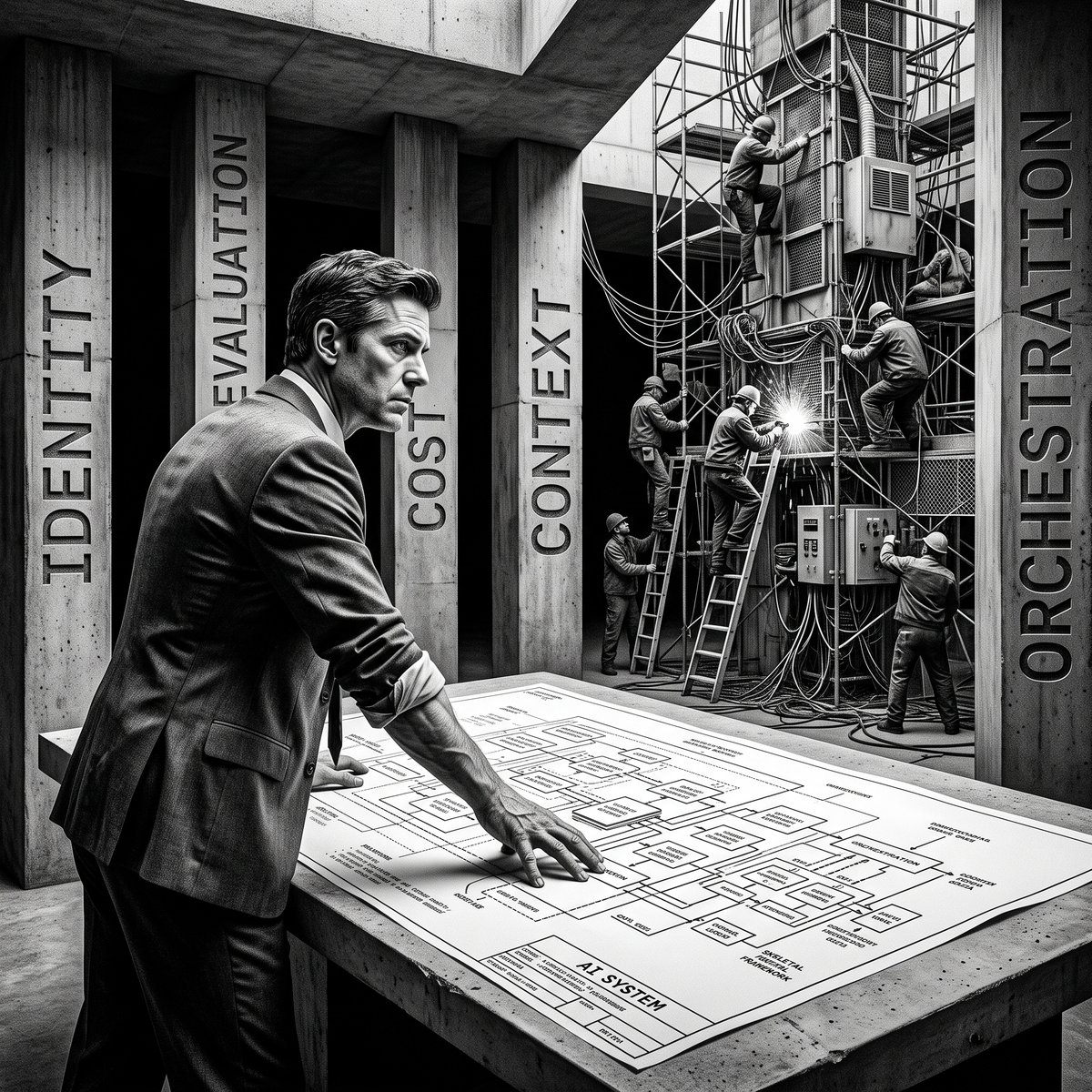
- Five control layers — identity, evaluation, cost telemetry, context, and orchestration — are now the baseline for trustworthy agentic AI.
- OpenAI is explicitly telling CIOs: governance isn't an afterthought, it's the prerequisite for value.
The Bill Is Coming Due
There's an old joke in IT circles: the most expensive phrase in enterprise technology is "we'll sort that out later." Apparently, nobody forwarded that memo to the teams rushing AI agents into production.
A sweeping five-survey research effort from VentureBeat Research, fielded in June 2026 across 573 enterprise decision-makers at organizations with 100 or more employees, has put hard numbers on what many CIOs privately suspected: the agentic AI wave broke fast, and governance got left on the beach.
The headline finding is both unsurprising and sobering. Enterprises deployed AI agents ahead of the controls needed to manage them — and many did so knowingly. Now they're scrambling to retrofit those controls, and the remediation tab is already open. Across every one of the five governance layers VentureBeat measured, 57 to 68% of organizations plan to switch or add vendors within the next 12 months. Roughly a third of those plan to move within the current quarter. That's not a slow-burn trend — that's a retrofit wave in progress.
What "Agent Governance" Actually Means
Before diving into the damage, it's worth being precise about what governance even covers. VentureBeat's research identifies five control layers that any enterprise must have in place before it can reasonably trust a multi-step AI agent:
- Identity — Which agent is authorized to do what, and under whose credentials?
- Evaluation — Is the agent's output actually any good, or just confidently formatted?
- Cost Telemetry — What does each agent actually cost to run, per task, per workflow?
- Context Layer — What business data, metrics, and definitions is the agent drawing on when it answers?
- Orchestration — Who's coordinating the handoffs in multi-step agent workflows?
Think of these five layers as the load-bearing walls of a trustworthy agentic system. You can hang drywall and paint the rooms before the walls go up — but you probably shouldn't invite anyone to live there.
The Chatbot Problem Nobody Wants to Admit
Here's where things get awkward: 71% of enterprises said that a quarter or fewer of their deployed "agents" can actually complete multi-step tasks autonomously. Only 10% said true multi-step agents represent the majority of what they run. Translation — most of what's being called an "AI agent" in enterprise environments is, in practice, a single-prompt chatbot with a fancier job title.
This matters enormously for governance design. A chatbot with a human reviewing every answer before it does anything? It needs very few of the controls above. A true autonomous agent executing multi-step workflows against production systems? It needs all five — urgently. The problem is that most enterprises can't clearly articulate which one they've actually deployed.
That ambiguity is a governance gap all by itself.
The Numbers That Should Make a CIO Uncomfortable
If the chatbot-vs-agent confusion feels abstract, consider some of the more concrete findings:
69% of enterprises allow at least some agents to share credentials — meaning multiple agents operate under a single API key or service account.
That might sound like a minor infrastructure detail. It isn't. Organizations that allow credential sharing anywhere experienced a security incident or near-miss at a 63.5% rate, compared to just 40.9% at organizations where every agent has its own scoped identity. That's not a marginal difference — that's a structurally higher risk profile, baked into the architecture from day one.
Then there's the context problem. 57% of enterprises traced a confident, wrong agent answer in the past six months directly to their own missing or inconsistent business context — stale metric definitions, outdated documentation, absent data. And most of them saw it happen more than once. Agents don't know what they don't know; they just answer with equal confidence regardless. Governing the definitions agents draw from isn't a nice-to-have — it's what separates a helpful agent from a liability.
On the cost side, agentic AI spend behaves nothing like a SaaS license. There's no fixed seat count. Usage expands unpredictably through autonomous workflows, and without per-agent cost metering in place, budgets can move faster than quarterly review cycles allow. More than 8 in 10 enterprises running their own GPUs reported utilization of 50% or less — and only 44% rigorously track what their AI compute actually costs and returns.
OpenAI Is Now Saying the Quiet Part Loud
It's notable when a leading AI vendor starts actively telling its customers to slow down and govern before they scale. But that's effectively what OpenAI has been communicating to enterprise CIOs: establish visibility into demand, spend, and risk before deployment at scale, not after. Governance, in their framing, is the prerequisite for value — not the compliance checkbox you staple onto the back end of a rollout.
This is a meaningful signal. When the company that arguably lit the agentic AI fuse starts leading with governance rather than capability, it suggests the market is maturing past the "move fast, figure it out later" phase. Or at least, it's trying to.
The Inflection Point for IT Architecture
The practical implication for enterprise IT teams is a shift in the buying conversation itself. Twelve months ago, the question vendors heard most was: "Help us orchestrate our agents." The question now is increasingly: "Audit our design for governance gaps before we scale."
That shift matters because it changes what "good architecture" means at the point of initial design. Enterprises that embed the five control layers — identity, evaluation, cost telemetry, context, and orchestration — during the planning phase avoid the retrofit penalty. Those that discover governance gaps after agents are in production face a nastier set of consequences: vendor lock-in, rework costs, compliance exposure, and the kind of security incidents that make it into board-level conversations.
The good news, if there is any in all this, is that no entrenched incumbent currently owns the governance control space. The defaults today are the built-in tools that ship with major platforms — adequate for simple cases, underpowered for the real complexity of enterprise agentic workflows. That leaves a clear opening for organizations — and vendors — willing to treat governance as a first-class design problem rather than a feature to add later.
The Takeaway: Build the Walls Before You Paint the Rooms
The VentureBeat data, read alongside OpenAI's explicit governance-first messaging, paints a clear picture of where enterprise agentic AI sits in mid-2026: capable enough to be dangerous, deployed fast enough to have outrun its own controls, and now facing a measurable, costly correction.
The five-control framework isn't bureaucracy for its own sake. It's the architecture that makes autonomous agents something enterprises can actually trust — at scale, under audit, in production.
The retrofit wave is already here. The question for every enterprise still in design mode is whether to join it — or avoid it entirely by getting governance right the first time.
Published in Stream · Dispatch #465 · July 27, 2026 · 7 min read.
Reply to paolo@mont3.ch - every email gets a human answer within 24h.