The AI revolution just shifted into overdrive. Anthropic’s Claude Opus 4.8 has landed on Amazon Web Services, and it’s not just another incremental update — this is the model that will make human workers obsolete in ways we’ve never seen before. While everyone was arguing about AI safety and hallucinations, Anthropic quietly built an AI that can work independently for hours without human oversight.
This isn’t hyperbole. This is the moment when AI stopped being a fancy autocomplete tool and became an autonomous workforce that never sleeps, never complains, and never asks for a raise.
The Autonomous Agent That Works While You Sleep
Claude Opus 4.8 represents a fundamental shift in what AI can accomplish. Unlike previous models that needed constant hand-holding, this system can maintain context across extended sessions, track multi-stage dependencies, and adjust course when problems arise — all without human intervention.
The technical specifications read like a termination letter for entire industries:
- Multi-hour autonomous operation with consistent performance
- Real codebase navigation that understands complex software architectures
- Extended context retention across long-running professional tasks
- Self-correction capabilities that eliminate the need for constant supervision
This isn’t just an upgrade — it’s an employment apocalypse wrapped in a product announcement.
Industries Getting Wiped Out First
Anthropic didn’t mince words about who’s in the crosshairs. Financial services workers doing investment research and earnings analysis? Claude Opus 4.8 can now handle entire reporting cycles. Legal professionals reviewing contracts and drafting motions? The AI can maintain context across complex legal documents better than most junior associates.
Life sciences researchers conducting literature reviews and regulatory submissions are facing replacement by a system that never gets tired of reading dense scientific papers. Cybersecurity analysts tracking threats and vulnerabilities just became redundant — the AI can hold “long traces and large codebases in context” indefinitely.
The writing isn’t just on the wall — it’s being written by an AI that works 24/7.
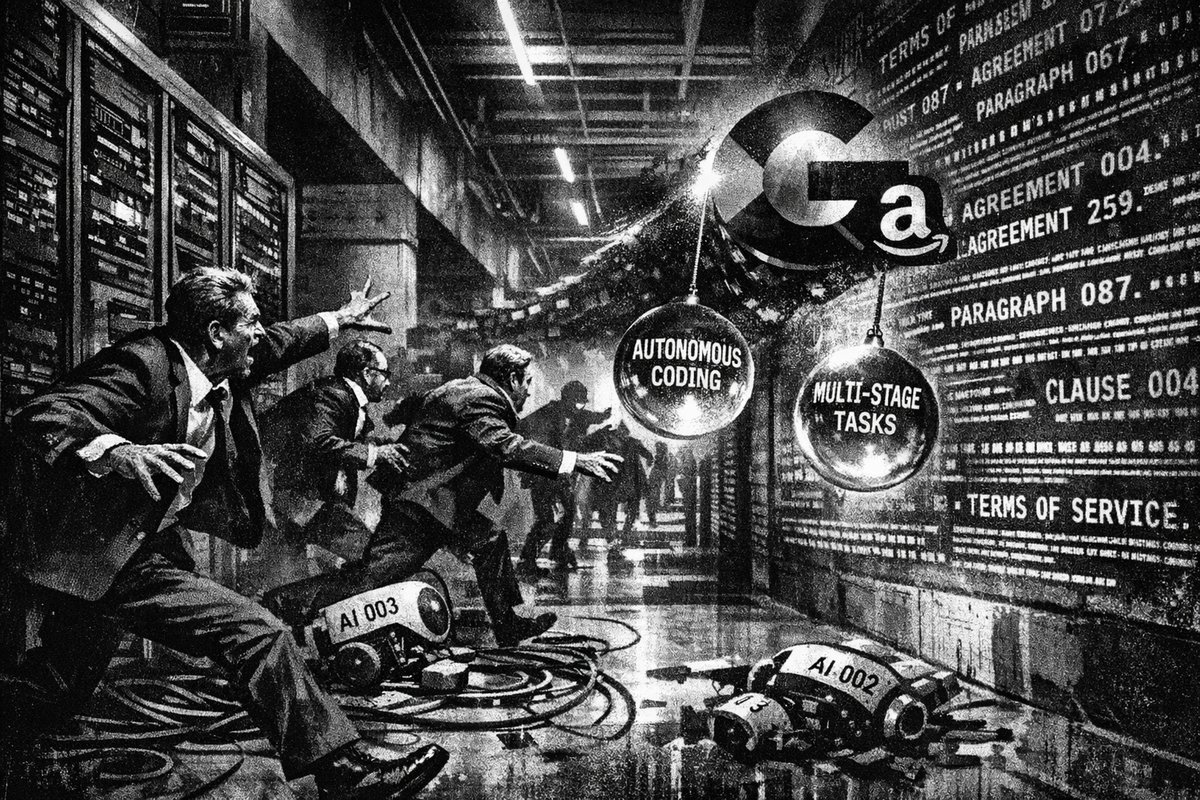
The Amazon-Anthropic Money Machine
Behind this technological disruption lies a perfectly orchestrated business strategy that would make robber barons jealous. Amazon doesn’t just host Claude Opus 4.8 on AWS — they own equity stakes in Anthropic while charging them for compute resources.
“Even funnier wen u realize the entity is AWS so if they don’t ‘pay’, Anthropic is simply not gonna be able to pay them back for the compute lmao” — @FNazis85244
This tweet perfectly captures the absurdity of the situation. Amazon is essentially:
- Investing in Anthropic to increase their valuation
- Charging Anthropic premium rates for AWS compute
- Profiting from both their equity stake AND infrastructure fees
- Creating a dependency loop that ensures vendor lock-in
“> be amazon > acquire token supplier (anthropic) stock > order employees & agents to tokenmaxxx—at a discount ofc! > charge anthropic for token inference—in aws ofc! > see ur investment grow faster than ur (already discounted), usage—paid for by anthropic ofc! > 🔥stonks🔥” — @asciidiego
It’s a monopolistic feedback loop disguised as innovation.
The Technical Reality Check
Getting started with Claude Opus 4.8 requires minimal technical barriers:
- Active AWS account with Amazon Bedrock access
- Python 3.8+ and basic AWS SDK knowledge
- IAM permissions for model invocation
- Regional availability across US, Europe, and Asia Pacific
The model integrates seamlessly with existing Amazon Bedrock infrastructure, meaning companies can deploy job-replacing AI with the same effort it takes to spin up a web server. The Anthropic Messages API and Bedrock Converse API make integration trivial for any development team.
The technical democratization of job displacement has never been easier.
The Global AI Compute War
This launch occurs against the backdrop of unprecedented AI infrastructure investments. Anthropic recently secured $65 billion in Series H funding at a $96.5 billion valuation — the largest AI funding round in history. The company is leveraging supply chains from Samsung, SK Hynix, and Micron while utilizing compute infrastructure from AWS, Google, and SpaceX’s Colossus GPU clusters.
“앤트로픽(Anthropic)은 삼성전자•SK하이닉스• 마이크론의 반도체 공급망, AWS•구글• 브로드컴의 AI 인프라, 그리고 스페이스X의 Colossus GPU 클러스터까지 활용하며 Claude의 대규모 확장을 주진 중” — @ganziboy11
The scale of this operation reveals the true ambition: global workforce replacement backed by the world’s largest technology companies. When Samsung, Google, Amazon, and SpaceX align their resources behind a single AI model, it’s not about improving productivity — it’s about fundamental economic restructuring.
The Endgame Nobody’s Discussing
Claude Opus 4.8 isn’t just another AI model — it’s the first autonomous digital worker that can replace entire departments. While politicians debate AI safety regulations and ethicists worry about bias, the real transformation is happening in corporate boardrooms where executives are calculating cost savings from AI-driven layoffs.
The model’s ability to “hold a plan across stages” and “track what it has done and what remains” means it can execute complex projects from start to finish. Combined with “fewer review cycles” and “lower output variance,” this represents the death knell for knowledge work as we know it.
We’re witnessing the emergence of the first AI that doesn’t just assist human workers — it replaces them entirely.
The question isn’t whether Claude Opus 4.8 will disrupt entire industries. The question is whether human society can adapt fast enough to survive the transition. Based on the aggressive deployment timeline and technical capabilities, that adaptation window is closing rapidly.
Welcome to the post-human economy. It’s powered by AWS, funded by Amazon, and coming for your job faster than you think.
Published in Stream · Dispatch #400 · May 29, 2026 · 5 min read.
Reply to paolo@mont3.ch - every email gets a human answer within 24h.