The AI boom isn’t just about algorithms and silicon anymore—it’s about raw power. Literally. BlockchAIn Digital Infrastructure (NYSE: AIB) just locked down a 15-year, 65 MW electric service agreement for their CLT-01 data center campus, expanding from 40 MW and positioning themselves as a serious player in the infrastructure arms race that’s reshaping modern computing.
This isn’t just another corporate expansion announcement. It’s a blueprint for how smart operators are solving the fundamental bottleneck choking AI development: reliable, scalable power at industrial scale.
The Power Problem That’s Strangling AI Growth
Let’s cut through the noise. The constraint on AI development isn’t talent, funding, or even GPU availability anymore—it’s electrical infrastructure. Modern AI training workloads consume energy at rates that would make a small city blush. A single large language model training run can burn through 10-20 megawatts continuously for months.
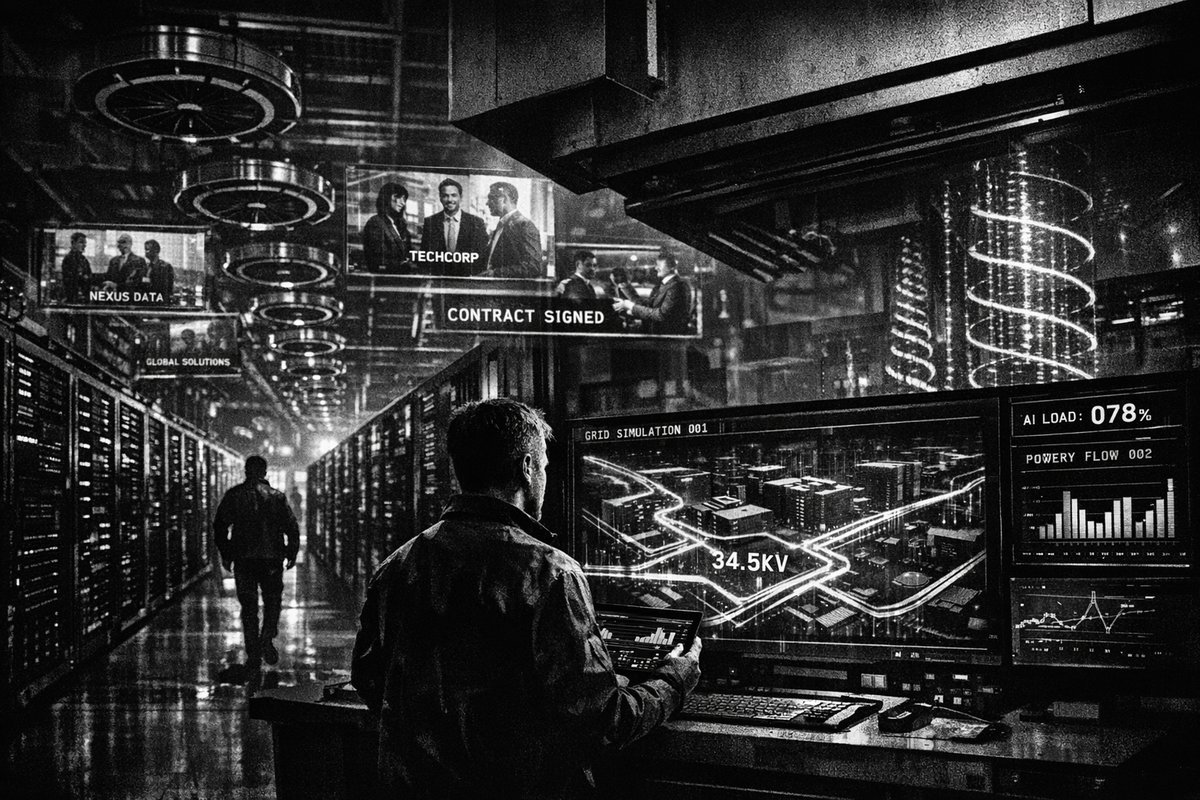
BlockchAIn’s expansion to 65 MW puts this in perspective. That’s enough power to supply roughly 50,000 homes, all dedicated to feeding the computational hunger of AI systems. The company’s existing 34.5 kV onsite infrastructure means this capacity is immediately available—no waiting, no construction delays, no permitting hell.
Historically, this echoes the early days of the internet when bandwidth was the chokepoint. Companies like Level 3 Communications and Worldcom built empires by solving connectivity bottlenecks in the 1990s. Today’s equivalent is power infrastructure for AI workloads, and BlockchAIn is positioning itself as a picks-and-shovels play in this new gold rush.
Market Reality Check: Why The Stock Dropped 10%
Here’s where things get interesting. Despite announcing what appears to be unambiguously good news, AIB shares dropped 9.96% following the announcement. This isn’t unusual in infrastructure plays—investors often focus on execution risk rather than announced capacity.
The market’s skepticism might stem from several factors:
- Capital intensity concerns: Even with their project-finance model, scaling infrastructure requires massive upfront investment
- Customer concentration risk: The 25 MW in letters of intent represents significant dependency on a small number of large clients
- Competitive pressure: Hyperscalers like Amazon, Microsoft, and Google are building their own capacity
“BlockchAIn Digital Infrastructure Inc. (NYSE American: $AIB) announced a 15-year Electric Service Agreement expanding contracted utility load at CLT-01 from 40 MW to 65 MW. According to the release, the full 65 MW is available through existing onsite 34.5 kV infrastructure.” — @blockch91615
The Talent Factor: Building vs. Buying Expertise
BlockchAIn’s leadership roster reads like a who’s who of infrastructure veterans. Christopher Iannacone, their project lead, brings 25+ years of experience managing 3+ gigawatts of data center capacity from his time at Amazon. Eyal Rozen, their COO, comes from Nebius, while VP of Sales Gary Heitz has Google and Dell on his resume.
This matters more than typical corporate posturing suggests. Data center infrastructure at this scale isn’t commodity construction—it’s specialized engineering that requires deep institutional knowledge. The difference between a properly designed facility and an expensive mistake often comes down to experience with thermal management, power distribution, and failover systems at massive scale.
Compare this to the early days of cloud computing. Amazon’s advantage wasn’t just having servers—it was having people who understood how to run infrastructure at scale. Andy Jassy and his team’s experience managing Amazon’s own infrastructure became the foundation for AWS’s dominance.
The Economics of AI Infrastructure
Let’s talk numbers. BlockchAIn’s customer pipeline includes letters of intent for 25 MW from an AI company and a financial institution. At typical colocation rates of $100-200 per kilowatt per month, that translates to $2.5-5 million monthly revenue at full utilization.
The 15-year term structure is crucial. It provides:
- Revenue predictability for long-term planning and debt service
- Cost certainty for customers making multi-year AI infrastructure investments
- Barrier to switching once customers build their operations around specific facilities
This model mirrors successful infrastructure plays throughout history. American Tower Corporation built a $50+ billion market cap by securing long-term contracts for cell tower space. The principle is identical: control scarce infrastructure, lock in long-term contracts, collect predictable cash flows.
“Real power. Real pipeline. Real operators. Early stage but the infrastructure foundation is in place.” — @StocksDaily
Strategic Positioning: The Conversion Advantage
BlockchAIn’s approach—converting existing cryptocurrency mining infrastructure to AI/HPC workloads—represents a fascinating strategic pivot. The company is essentially recycling stranded power infrastructure from the crypto winter into the AI boom.
This conversion strategy offers several advantages:
- Existing power infrastructure: No need to wait years for utility connections
- Proven site operations: The facility already has operational history and regulatory approvals
- Speed to market: Nine-month timeline for the new AI-optimized shell versus 2-3 years for greenfield development
The parallel to industrial history is striking. During World War II, automobile manufacturers converted assembly lines to produce aircraft. General Motors became one of the largest aircraft engine producers not by building new factories, but by repurposing existing manufacturing infrastructure.
Risk Assessment: What Could Go Wrong
No infrastructure play is without substantial risk. BlockchAIn faces several potential challenges:
Customer concentration: Heavy reliance on a few large customers creates vulnerability if contracts don’t materialize or are terminated
Technology obsolescence: AI workload requirements evolve rapidly—today’s optimized infrastructure might be inadequate for tomorrow’s models
Regulatory pressure: Data center power consumption is increasingly scrutinized by regulators and environmental groups
Capital requirements: Despite the project-finance model, scaling will require substantial capital deployment with long payback periods
The company’s $9.9 billion planned CapEx through 2030 for their 715 MW pipeline represents massive execution risk. Success requires flawless project management across multiple simultaneous developments.
The Broader Context: AI’s Infrastructure Moment
BlockchAIn’s expansion reflects a broader shift in how AI development is constrained. We’re moving from a software-limited regime to a hardware-limited one, and increasingly to an infrastructure-limited regime.
The companies that solve infrastructure bottlenecks often capture disproportionate value during technology transitions. Intel dominated the PC era by solving processor constraints. Cisco built a networking empire during the internet buildout. Today’s equivalent might be companies like BlockchAIn that solve the power and cooling challenges of AI-scale computing.
The 65 MW commitment positions BlockchAIn to serve this demand without the multi-year lead times plaguing greenfield development. In a market where time-to-deployment can determine competitive advantage, this speed matters.
Conclusion: Infrastructure as Competitive Moat
BlockchAIn’s 15-year power commitment isn’t just about adding capacity—it’s about building sustainable competitive advantages in an infrastructure-hungry industry. The combination of immediate power availability, experienced management, and strategic customer relationships creates a platform for capturing value from the AI infrastructure buildout.
The question isn’t whether AI will continue demanding massive infrastructure investment—it’s which companies will build the picks and shovels that make that growth possible. BlockchAIn’s power play suggests they’re serious about claiming that territory, even if the market remains skeptical about execution risk.
For investors, this represents a classic infrastructure bet: high capital requirements, long payback periods, but potentially substantial and predictable cash flows for operators who execute successfully. The AI boom needs someone to keep the lights on—BlockchAIn is positioning itself to be exactly that company.
Published in Stream · Dispatch #392 · May 27, 2026 · 6 min read.
Reply to paolo@mont3.ch - every email gets a human answer within 24h.