The business intelligence revolution isn’t coming—it’s already here, and it’s powered by AI agents. OPLOG, a fulfillment powerhouse processing millions of items across Turkey, the UK, and Germany, just proved that autonomous AI can obliterate the manual drudgery that plagues modern B2B operations. Their results? A 35% reduction in sales cycles, 91% improvement in CRM data completeness, and a staggering 98% reduction in manual research time.
This isn’t incremental improvement—it’s a complete paradigm shift that echoes the industrial automation revolutions of the past, except this time, it’s cognitive work getting the full automation treatment.
The Data Fragmentation Crisis That’s Killing Modern Businesses
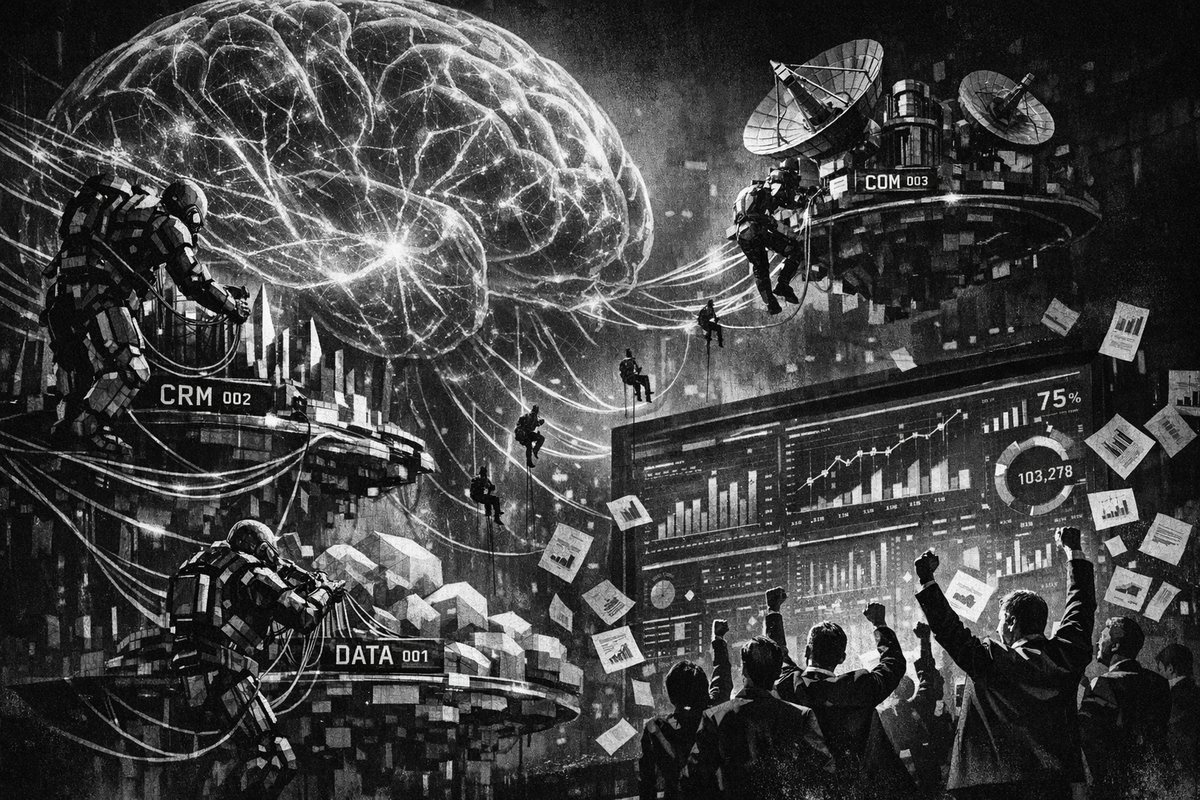
OPLOG’s challenge mirrors what countless companies face today: data silos. Their critical business intelligence was scattered across Hubspot CRM, Microsoft Teams, Databricks warehouses, and communication systems like digital shrapnel. Sales managers burned hours daily manually accessing reports, synthesizing information, and preparing updates. By the time insights arrived, 60% of opportunities had already moved or stalled.
This fragmentation problem isn’t new—it’s the modern equivalent of the pre-telegraph era when businesses operated on delayed, incomplete information. Just as the telegraph revolutionized commerce in the 1840s by enabling real-time communication, AI agents are now revolutionizing business intelligence by eliminating the lag between data generation and actionable insights.
“Well I cooked up a @zioscala library for AI inference with Amazon Bedrock. Took quite a bit of churning to get to an API that I like.” — @JamesWard
The developer community is clearly energized by these new capabilities, with engineers building custom integrations and frameworks to harness Amazon Bedrock’s power.
Three AI Agents, Three Knockout Punches to Manual Work
OPLOG’s solution centers on three specialized AI agents, each designed to eliminate specific operational pain points:
- Deal Analyzer Agent: Runs scheduled analysis of Hubspot deals, validating them against OPLOG’s sales methodology and reporting completion status to Microsoft Teams
- Sales Coach Agent: Responds to real-time Hubspot webhook events when deal stages change, enforcing data quality standards and preventing incomplete deals from advancing
- Lead Insight Agent: Triggers when new marketing leads arrive, analyzing digital presence across six social media platforms and applying qualification methodology
What makes this architecture brilliant is its non-communicative design. Unlike traditional systems where components must coordinate, these agents operate independently, processing specific data sources and delivering targeted intelligence. This approach mirrors the Unix philosophy of “do one thing and do it well”—each agent has a single, focused responsibility.
The Technical Stack: Where Cloud Meets Cognitive Power
Amazon Bedrock AgentCore serves as the deployment environment, leveraging the Strands Agents SDK for agent development. Each agent uses Anthropic’s Claude Sonnet for inference, analyzing data, reasoning through business rules, and generating insights. Amazon Bedrock Knowledge Bases implements Retrieval-Augmented Generation (RAG), allowing agents to pull context from sales playbooks and methodology documents stored in Amazon S3.
The integration layer relies on AWS Lambda functions to connect agents with external systems, while Amazon EventBridge handles scheduling for the Deal Analyzer Agent. Real-time triggers from Hubspot webhooks activate the Sales Coach and Lead Insight Agents instantly.
AgentCore’s serverless architecture means OPLOG pays only for agent executions—no infrastructure management required. The platform scales automatically from zero to thousands of sessions based on workload, with deployment updates happening without downtime.
“Building multi-tenant agents with Amazon Bedrock AgentCore: This post explores design considerations for architecting multi-tenant agentic applications and the framework needed to address SaaS architecture challenges with Amazon Bedrock AgentCore.” — @TheCloudSensei
The Results: Numbers That Speak Louder Than Buzzwords
OPLOG’s implementation delivered measurable business impact across three critical dimensions:
- Sales Velocity: 35% reduction in sales cycles through automated pipeline analysis and real-time deal validation
- Data Quality: 91% improvement in CRM completeness by enforcing standards at each stage transition
- Research Efficiency: 98% reduction in manual prospect research time via automated social media analysis
These improvements represent more than operational efficiency—they’re competitive advantages in markets where speed and data quality determine winners and losers.
Historical Context: The Latest Chapter in Automation’s March
This AI agent revolution parallels previous automation waves that transformed industries. The 1970s factory automation eliminated manual assembly line tasks. The 1990s ERP systems automated back-office processes. The 2000s CRM platforms automated customer relationship management.
Now, AI agents are automating cognitive work—the analysis, reasoning, and decision-making that previously required human intelligence. OPLOG’s success demonstrates that we’re entering the age of cognitive automation, where machines don’t just execute predefined processes but actively analyze, learn, and adapt.
“The demand for agentic market will be born out insane token-based bills. It’s hard to track ROI when everyone uses raw token inference. Instead if it’s intent-based you can specify the outcome you expect and let specialized agents compete for best price.” — @ilblackdragon
This observation highlights a crucial shift—moving from raw computational billing to outcome-based pricing, where businesses pay for results rather than processing cycles.
The Competitive Implications: Adapt or Fall Behind
OPLOG’s transformation isn’t just a technology story—it’s a preview of competitive dynamics across industries. Companies still relying on manual business intelligence processes face the same disadvantage that hand-weavers faced against mechanized textile mills in the Industrial Revolution.
The economics are stark: while competitors burn hours on manual reporting and reactive decision-making, AI-augmented organizations operate with real-time intelligence and proactive responses. This isn’t about replacing human workers—it’s about amplifying human capability by eliminating cognitive drudgery.
Looking Forward: The Age of Autonomous Business Intelligence
Amazon Bedrock AgentCore represents infrastructure for the autonomous enterprise—organizations where AI agents handle routine cognitive tasks, freeing humans for strategic thinking and creative problem-solving. OPLOG’s success proves this vision isn’t science fiction—it’s operational reality delivering measurable business value today.
The transformation has begun. The question isn’t whether AI agents will reshape business intelligence—it’s how quickly organizations will adapt to this new reality. OPLOG chose to lead. The rest of us get to choose whether to follow or fall behind.
Published in Stream · Dispatch #363 · May 21, 2026 · 5 min read.
Reply to paolo@mont3.ch - every email gets a human answer within 24h.