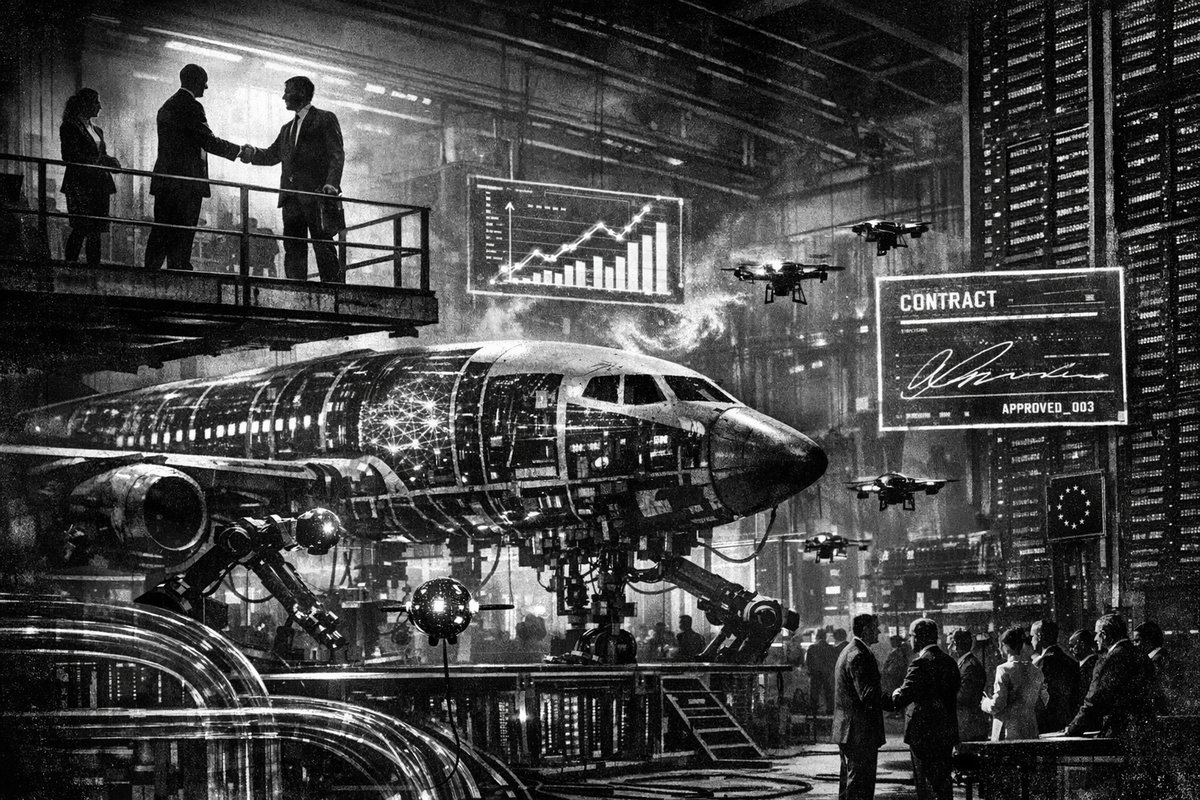
Europe just fired a shot across the bow of American AI hegemony. Airbus, the aerospace giant, has inked a strategic partnership with Mistral AI, France’s rising AI powerhouse, to embed sovereign artificial intelligence across commercial aircraft, defense systems, and space operations. This isn’t just another tech deal—it’s a declaration of technological independence.
The Strategic Imperative: Why Sovereignty Matters in AI
The partnership addresses a critical vulnerability that has haunted European industry since the dawn of the digital age: dependence on foreign technology for mission-critical operations. Just as Europe learned painful lessons about energy dependence during the Ukraine crisis, the aerospace sector recognizes that AI sovereignty isn’t optional—it’s existential.
Catherine Jestin, Executive Vice President Digital at Airbus, made the stakes crystal clear: this partnership will deploy “high-impact, high-value use cases of trusted and responsible AI in aerospace.” The emphasis on trust and responsibility isn’t corporate speak—it’s a direct challenge to the often opaque AI systems emanating from Silicon Valley.
Historically, Europe has struggled to compete with American tech titans. Remember how Nokia dominated mobile phones until Apple and Google redefined the game? Or how European search engines withered against Google’s algorithmic supremacy? This partnership represents Europe’s determination not to repeat those mistakes in the AI era.
Four Pillars of AI-Driven Aerospace Innovation
The Airbus-Mistral collaboration targets four strategic areas that will fundamentally reshape how aircraft are designed, built, and operated:
- Industrial Operations: Automating technical documentation for commercial aircraft and helicopters, streamlining workflows that currently consume thousands of engineering hours
- Engineering and Design: AI-driven simulations for aircraft part optimization, accelerating innovation cycles that traditionally take years
- Next-Generation Products: Edge AI deployment on spacecraft and aircraft for real-time object recognition and enhanced flight safety
- Sovereign Defense Applications: Military-grade AI for cyber investigation and coding assistance through ultra-secure on-premise deployments
Timothée Lacroix, Mistral AI’s Chief Technology Officer, emphasized their commitment to “accelerate innovation, contribute to improve flight safety, and deliver greater value for customers.” This isn’t hyperbole—when AI failures in aerospace can mean catastrophic loss of life, the stakes couldn’t be higher.
The Historical Parallel: Europe’s Aerospace Renaissance
This partnership echoes one of Europe’s greatest industrial triumphs: the creation of Airbus itself in the 1970s. Back then, European nations recognized that Boeing’s dominance threatened their aerospace sovereignty. They pooled resources, overcame national rivalries, and built a consortium that eventually challenged American supremacy in commercial aviation.
Today’s AI landscape mirrors that earlier era. OpenAI, Google, and Microsoft dominate global AI development much like Boeing once dominated aerospace. But just as Airbus proved that coordinated European innovation could compete with American industrial might, the Mistral AI partnership signals Europe’s refusal to cede AI leadership without a fight.
The technical specifications of this partnership reveal its ambition. Airbus will acquire full Mistral AI product suite licenses, enabling deployment across on-premises systems, trusted clouds, and edge computing environments. More importantly, Airbus gains direct access to Mistral’s researchers and influence over the AI product roadmap—ensuring that European aerospace needs drive AI development rather than Silicon Valley priorities.
“Mistral signe des contrats à tout-va. Avant tout, on va s’intégrer dans leurs équipes pour comprendre leur business” — @bfmbusiness
Edge AI: The Next Frontier in Flight Safety
Perhaps the most revolutionary aspect of this partnership lies in edge AI deployment—embedding artificial intelligence directly into aircraft and spacecraft systems. This represents a quantum leap from current aerospace AI applications, which typically involve ground-based data analysis.
Edge AI enables real-time decision-making without relying on ground communication or cloud connectivity. Imagine an aircraft that can instantly recognize and respond to weather patterns, detect mechanical anomalies before they become critical, or optimize flight paths in real-time based on changing conditions.
This capability becomes especially crucial for space operations, where communication delays with Earth can span minutes or hours. Mars rovers already demonstrate primitive autonomous decision-making, but integrating advanced AI models like Mistral’s could enable spacecraft to conduct complex scientific investigations without constant ground control.
“Airbus et BMW s’allient à la start-up française Mistral AI pour développer des systèmes d’IA, des technologies de défense aux simulations de crash.” — @euronewsfr
Defense Applications: AI Meets National Security
The partnership’s defense applications deserve special attention. In an era where cyber warfare threatens national infrastructure and military systems require instantaneous threat assessment, AI becomes a force multiplier for European defense capabilities.
Mistral AI’s commitment to highly secure on-premise deployments for military applications addresses legitimate concerns about AI security. Unlike cloud-based AI systems that transmit sensitive data across networks, on-premise deployment keeps military intelligence completely within sovereign control.
This approach contrasts sharply with American AI companies that often require data sharing or cloud connectivity. For European defense ministries still reeling from revelations about NSA surveillance programs, the appeal of truly sovereign AI cannot be overstated.
The Broader European AI Ecosystem
This partnership doesn’t exist in isolation. Mistral AI has rapidly emerged as Europe’s most credible challenger to American AI dominance, securing partnerships with major European corporations beyond Airbus. The company’s success reflects broader European determination to build indigenous AI capabilities rather than accepting permanent technological dependence.
Compare this to Europe’s earlier struggles with digital sovereignty. GDPR represented a regulatory response to American tech dominance, but regulations can only constrain—they cannot create. The Airbus-Mistral partnership represents something more powerful: European companies building world-class AI capabilities that compete on technical merit rather than regulatory protection.
“Mistral signe avec BMW et Airbus. La startup française se positionne encore plus comme un acteur central de l’IA en Europe.” — @JournalDuGeek
What This Means for Global AI Competition
The implications extend far beyond aerospace. If Mistral AI can successfully deliver enterprise-grade AI solutions for Airbus’s demanding applications, it validates Europe’s broader AI strategy. Success here could catalyze similar partnerships across automotive, energy, and telecommunications—sectors where European companies still maintain global leadership.
For American AI companies, this partnership represents a wake-up call. The assumption that European companies would inevitably adopt American AI solutions no longer holds. When Airbus chooses Mistral AI over OpenAI or Google, it signals that technical capabilities, security considerations, and sovereignty concerns now outweigh first-mover advantages.
The Airbus-Mistral AI partnership marks a pivotal moment in the global AI race. Europe has finally moved beyond defensive regulations to offensive capability building. Whether this partnership succeeds in delivering transformative aerospace applications will determine not just the future of European AI, but the broader question of whether technological sovereignty remains possible in an interconnected world.
The stakes couldn’t be higher—and Europe is finally ready to compete.
Published in Stream · Dispatch #398 · May 28, 2026 · 6 min read.
Reply to paolo@mont3.ch - every email gets a human answer within 24h.