The convergence of artificial intelligence and cryptocurrency has reached a critical inflection point. With $23.8 billion in market capitalization according to CoinGecko, the AI x Crypto sector has evolved beyond speculative trading into something that resembles the early days of the internet—messy, promising, and absolutely crucial to understand.
This isn’t just another crypto narrative cycle. Unlike previous waves of blockchain hype, AI x Crypto addresses fundamental infrastructure problems that exist today, not theoretical use cases that might emerge tomorrow.
The Resource Problem: Why AI Actually Needs Crypto
AI systems are resource-hungry beasts. They devour compute power, demand massive data sets, require seamless payment systems, and need trust mechanisms to operate at scale. Traditional centralized systems struggle with these demands because they create bottlenecks, single points of failure, and gatekeeping mechanisms that limit innovation.
Crypto networks solve these problems through decentralized coordination. When an AI model needs processing power, blockchain networks can connect buyers with sellers of compute resources globally. When AI agents need to make transactions, crypto wallets enable autonomous economic activity without human intervention.
This dynamic mirrors the early relationship between the internet and e-commerce in the 1990s. Just as websites needed payment systems, security protocols, and global connectivity to unlock their potential, AI systems need the infrastructure that crypto provides to operate independently and at scale.
Real Utility Beyond the Buzzwords
The market has identified three core areas where AI x Crypto creates genuine value:
- Decentralized Compute Networks: Projects that connect AI developers with distributed processing power
- AI Agents with Economic Capabilities: Autonomous software that can transact, pay for services, and interact with blockchain applications
- DePIN (Decentralized Physical Infrastructure): Blockchain-incentivized networks that reward people for providing real-world resources like wireless coverage, storage, and energy
Decentralized compute represents the clearest path to utility. AI training and inference require expensive hardware that most developers cannot afford. Crypto networks can aggregate spare computational resources from around the world, creating a global marketplace for AI processing power. This isn’t theoretical—it’s happening now.
AI agents with crypto wallets transform software from passive tools into economic actors. The $3.23 billion market cap for AI agent tokens reflects growing recognition that autonomous software needs financial capabilities to be truly useful. An AI agent that can pay for data, purchase compute resources, and compensate human workers operates fundamentally differently than traditional software.
“Everyone is chasing ‘the next AI agent.’ Few are asking: what infrastructure do ALL AI agents need to survive onchain? Agents that can’t transact are just chatbots. Agents with become economic actors.” — @VannDough
The Scam Problem: Learning from History
Every transformative technology attracts bad actors, and AI x Crypto is no exception. TRM Labs reported a 500% increase in AI-enabled scam activity, including sophisticated phishing attacks, fake projects, and automated fraud schemes.
This pattern repeats throughout crypto history. The DeFi summer of 2020 produced both revolutionary financial protocols and countless “yield farming” scams. The NFT boom created new forms of digital ownership alongside worthless profile picture collections. The Layer 1 wars delivered scalable blockchain infrastructure but also dozens of “Ethereum killers” that killed nothing but investor capital.
The difference with AI x Crypto lies in the sophistication of the scams. Artificial intelligence can generate convincing websites, create fake founder profiles, and automate social media engagement at unprecedented scale. The barrier to creating professional-looking fraud has never been lower.
Separating Signal from Noise: A Framework for Evaluation
Smart investors need clear criteria to distinguish genuine AI x Crypto projects from sophisticated marketing campaigns:
- Real Users: Projects should demonstrate actual usage, not just social media followers or token holders
- Clear Token Utility: The cryptocurrency should have a specific function within the product ecosystem
- Blockchain Necessity: The project should explain why decentralization is required, not just convenient
- Measurable Activity: Revenue, compute demand, network fees, or other quantifiable metrics should be publicly available
- Technical Clarity: AI features should be explained simply, without hiding behind buzzwords or vague promises
“crypto spent years obsessing over faster chains and cheaper gas meanwhile almost nobody asked what happens when wallet security itself becomes outdated that’s why @quipnetwork caught my attention they’re not only building decentralized compute infrastructure, they’re wrapping existing wallets into quantum resistant accounts before quantum risk becomes an emergency narrative” — @MasterX093
This framework becomes crucial as traditional financial systems begin integrating crypto infrastructure. The convergence isn’t limited to AI—traditional markets are bleeding into crypto exchanges, creating hybrid platforms where users can trade everything from Bitcoin to defense contractor stocks on the same interface.
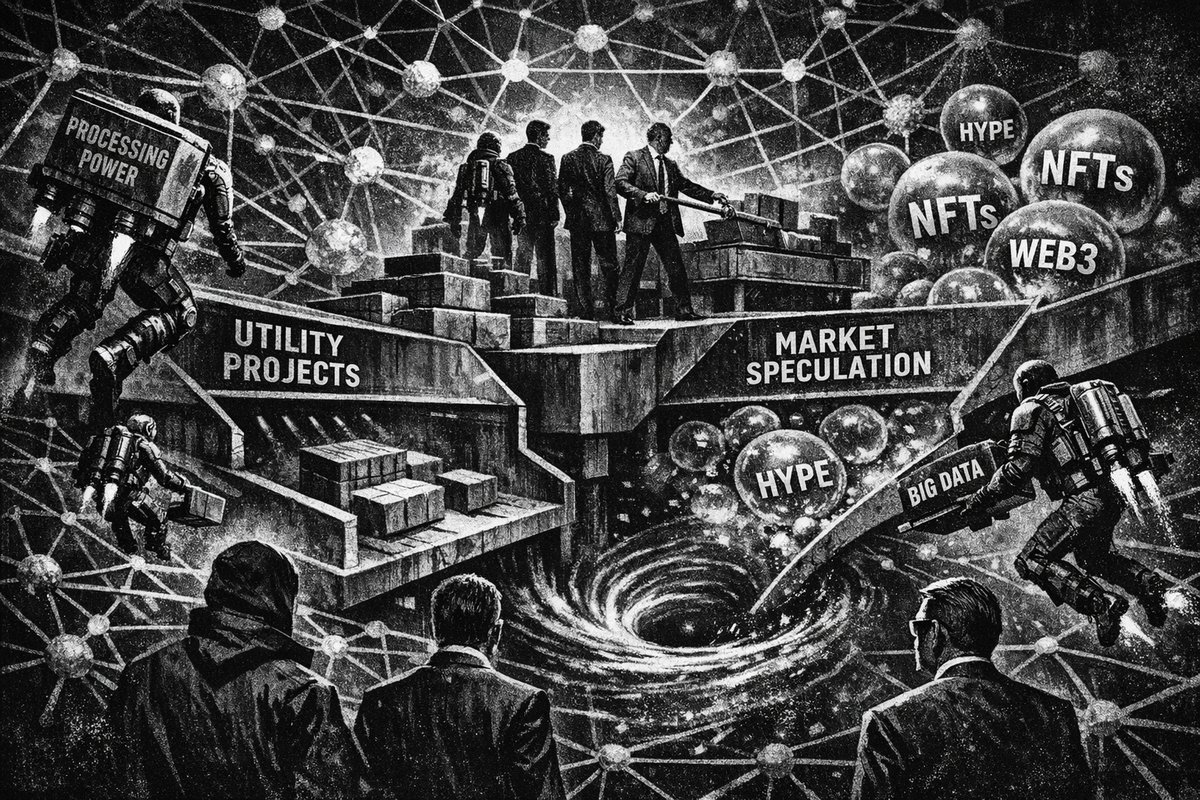
The Infrastructure vs. Speculation Balance
AI x Crypto occupies a unique position in the market cycle. Unlike pure speculation plays, these projects address real technical problems. Unlike pure infrastructure plays, they benefit from powerful narrative momentum that attracts capital and talent.
The 20.4% decline in total crypto market cap to $2.4 trillion during Q1 2026 demonstrates that even strong narratives cannot overcome broader market forces. However, projects with genuine utility tend to survive market downturns better than those riding pure hype.
This dynamic resembles the dot-com crash of 2000-2002. Speculative internet companies disappeared overnight, but infrastructure providers like Cisco, Oracle, and Amazon used the downturn to build the foundation for the next growth phase. The companies that survived weren’t necessarily the most hyped—they were the ones solving real problems for real users.
“Bitcoin whales are accumulating while AI trading bots dominate 70%+ of volume. Retail is trading against machines now.” — @0xcypher65
The Path Forward: Infrastructure Wins
The future of AI x Crypto will be determined by infrastructure, not speculation. Projects that successfully connect AI demand with crypto supply mechanisms will create sustainable value. Those that simply add “AI” labels to existing tokens will disappear when attention shifts elsewhere.
The smart money is positioning for infrastructure plays that solve fundamental problems. Decentralized compute networks that can reliably serve AI workloads. Agent frameworks that enable autonomous economic activity. DePIN networks that incentivize real-world resource provision. These aren’t sexy trades, but they’re the foundation for everything else.
The $23.8 billion market capitalization represents just the beginning. As AI systems become more sophisticated and autonomous, their need for decentralized infrastructure will only grow. The question isn’t whether AI x Crypto will succeed—it’s which projects will build the rails for that success.
Investors who focus on utility over narrative, infrastructure over speculation, and long-term value creation over short-term price movements will position themselves for the next phase of this convergence. The intersection of AI and crypto isn’t just another market cycle—it’s the foundation for how intelligent systems will interact with the global economy.
Published in Stream · Dispatch #372 · May 23, 2026 · 6 min read.
Reply to paolo@mont3.ch - every email gets a human answer within 24h.