Bexar County Sheriff’s Office just dropped a bombshell that should have every law enforcement agency and civil liberties group paying attention. They’re rolling out AI-powered real-time translation on body-worn cameras, and the implications are staggering. This isn’t just another tech upgrade—it’s a fundamental shift in how police interact with non-English speaking communities.
The Technology That Changes Everything
Sheriff Javier Salazar announced that Axon body cameras now come equipped with Translate Assistant—an AI system capable of translating 60 languages and counting. The process is brutally simple: deputies press a button, the AI detects the language or prompts for selection, and real-time translation begins.
The speed advantage is undeniable. Instead of waiting 20-30 minutes for a bilingual deputy to arrive in unincorporated areas, officers get translation in seconds. This echoes the communication revolution that occurred during World War II when the U.S. military deployed Navajo Code Talkers—except now we’re using artificial intelligence instead of human linguists to bridge language barriers in crisis situations.
“Looking beyond crypto what breakthrough tech excites you for 2026? AI agents that can buy, plan and act on our behalf ? Humanoid robots replacing repetitive tasks ? Real‑time translation making languages optional ? Or satellite to. phone networks reshaping telecom ? Share your thoughts!” — @s_nakotomo
Beyond Translation: AI Takes Over Police Work
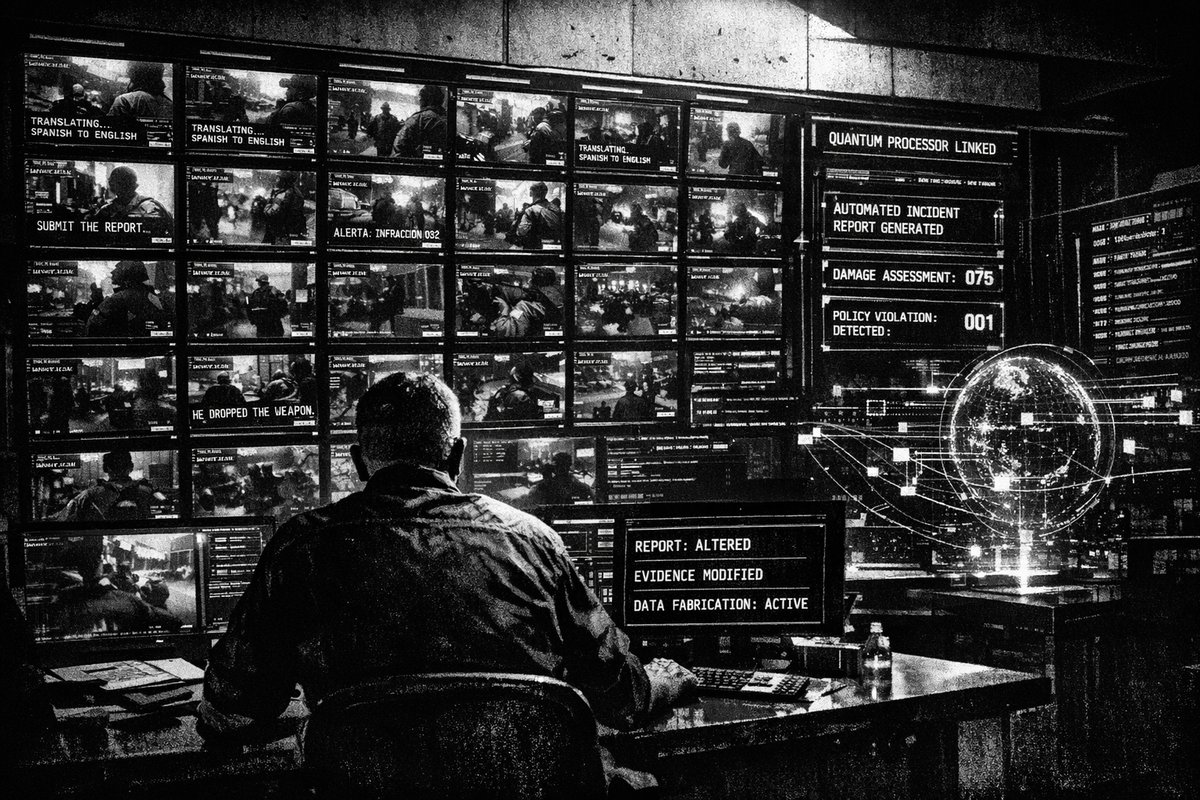
But translation is just the beginning. Bexar County is implementing AI for monetary damage assessment and policy reference. Deputies will soon use AI to determine the value of damaged property and access department policies through voice commands to their body cameras.
This expansion mirrors the industrial automation of the early 20th century, when assembly lines replaced craftsmen. Now we’re seeing cognitive automation replace human judgment in law enforcement. The question isn’t whether this technology works—it’s whether we want machines making these decisions.
The Critical Applications
Human trafficking victims represent the most compelling use case. Salazar specifically mentioned helping victims from Arab and Asian countries who have endured trauma and need immediate assistance. In these scenarios, every second counts, and language barriers can mean the difference between life and death.
Consider the Berlin Airlift of 1948-1949, when American pilots had to communicate with German civilians despite language barriers during a humanitarian crisis. They relied on hand signals and basic phrases. Today’s deputies have 60 languages at their fingertips.
The Implementation Strategy
The rollout follows a tactical approach:
- Patrol deputies trained first (highest public interaction)
- Recent graduates serve as test cases
- All deputies will eventually receive training
- Progressive expansion to damage assessment and policy reference
Patrol deputies were prioritized because they handle initial contact situations—traffic stops, domestic calls, and emergency response. This mirrors military doctrine where forward-deployed units get new technology first, then it filters back to support personnel.
The Privacy and Accuracy Concerns
Here’s where things get murky. Real-time AI translation involves processing sensitive conversations through cloud-based systems. Every word spoken gets analyzed, stored, and potentially accessed by third parties. The East German Stasi would have killed for this level of surveillance capability.
Translation accuracy presents another challenge. Medical interpreters require years of training and certification because mistranslation can be fatal. Now we’re trusting algorithms to handle life-or-death communications between police and civilians.
“@ArmstrongEcon The police will no longer need body cameras They will create all the evidence via google & Palantir They already alter footage with their AXON body cameras and create crimes for their masters I have already been subjected to this in 2017 when my son was killed by a gov employee” — @AGcorruption
Historical Context: Technology and Policing
Law enforcement has always been an early adopter of communication technology. Police radio systems emerged in the 1930s, transforming response times and coordination. Computer-aided dispatch revolutionized the 1970s. Body cameras themselves represent the latest wave, and now AI integration marks the next evolution.
But each technological leap brings unintended consequences. Radio communications enabled faster response but also centralized control. Computer systems improved efficiency but created digital surveillance networks. Body cameras promised transparency but also generated massive data collection.
The Broader Implications
Bexar County’s implementation isn’t happening in isolation. This represents a beta test for nationwide deployment. If successful, expect every major police department to demand similar capabilities within 12-18 months.
The cost-benefit analysis is compelling for departments. Reduced need for bilingual officers, faster emergency response, and improved community relations with non-English speakers. But the trade-offs include technological dependence, privacy erosion, and potential AI bias in translation algorithms.
What This Means Moving Forward
Sheriff Salazar is betting that AI efficiency outweighs human accuracy in most police encounters. That’s a calculated gamble with significant implications for constitutional rights and community trust.
The technology exists. The implementation is underway. The question isn’t whether AI translation will transform policing—it’s whether we’re prepared for the consequences. Bexar County just made that decision for all of us, and there’s no going back.
Published in Stream · Dispatch #255 · April 26, 2026 · 4 min read.
Reply to paolo@mont3.ch - every email gets a human answer within 24h.