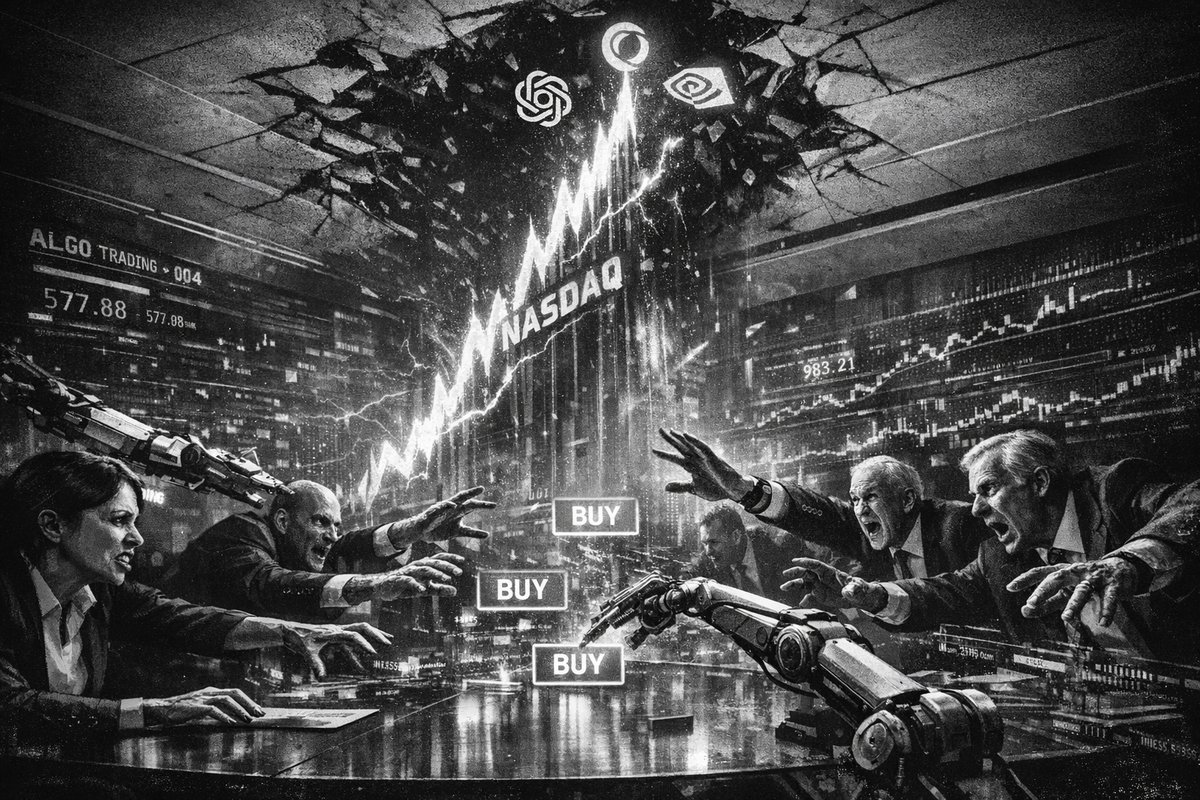
The artificial intelligence revolution isn’t coming—it’s already here, and it’s about to demolish every prediction you’ve heard about market performance. While financial pundits debate whether AI stocks are overvalued, smart money is positioning for what could be the most explosive wealth creation event since the internet boom of the 1990s.
But here’s the brutal truth: most investors are completely missing the real story. They’re focused on surface-level metrics while ignoring the seismic shifts happening beneath their feet. The same patterns that drove the railroad boom of the 1860s, the automotive revolution of the 1920s, and the tech explosion of the 1990s are playing out again—except this time, the stakes are exponentially higher.
The Intel Catalyst That Changes Everything
The recent market action tells a stark story. Intel’s 24% surge following their $13.6 billion quarterly revenue isn’t just another earnings beat—it’s a signal flare indicating that the semiconductor infrastructure powering AI is finally hitting critical mass. This mirrors the moment in 1995 when Netscape’s IPO didn’t just create a successful company; it validated an entire ecosystem.
“America’s S&P 500 and NASDAQ indexes closed at record highs on Friday, rising by 0.8% and 1.6% respectively. Both were boosted by hopes of talks to end the Iran war, and by a surge in Intel’s shares. The American chipmaker’s stocks rose by 24% on Friday, up to a record high, after it posted strong first-quarter revenues of $13.6bn.” — @Ajay_Bagga
The geopolitical noise around Iran talks is temporary. The fundamental shift in semiconductor demand driving Intel’s performance? That’s permanent. Companies aren’t just buying chips for incremental improvements anymore—they’re building the computational backbone for an entirely new economic paradigm.
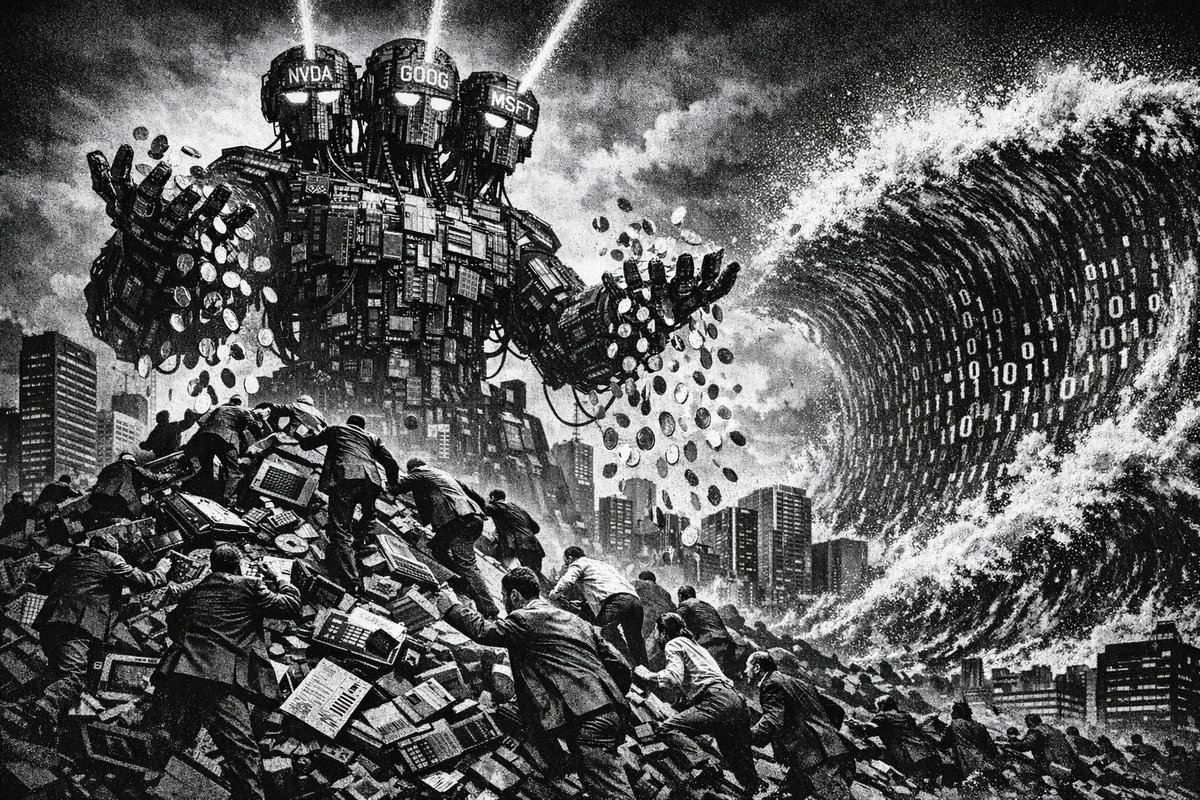
The Three Market Forces Creating Perfect Storm Conditions
First: Infrastructure Demand Explosion
Every major corporation is scrambling to build AI capabilities. This isn’t optional anymore—it’s survival. Companies that don’t adapt will face the same fate as Blockbuster when Netflix emerged. The infrastructure requirements are massive, creating sustained demand for semiconductor companies, cloud providers, and specialized AI hardware manufacturers.
Second: The Productivity Multiplier Effect
AI isn’t just replacing human tasks—it’s amplifying human capabilities in ways that create entirely new markets. This is fundamentally different from previous automation waves. When the printing press was invented, it didn’t just replace scribes; it created the publishing industry, journalism, and mass education. AI is following the same pattern but across every industry simultaneously.
Third: The Winner-Take-All Network Effects
AI companies benefit from data network effects that become stronger over time. The more data they process, the better their models become. The better their models, the more customers they attract. This creates virtually unbreakable competitive moats for early leaders.
Why the Bears Are Wrong (And Why That Matters)
Even legendary skeptics are capitulating. The market dynamics have shifted so dramatically that short-sellers and value investors—traditionally the harshest critics of speculative bubbles—are acknowledging the inevitable.
“So in the same week we had: Citron - notable short seller - state you can make more money longing AI stocks even if they are scams. Michael Burry - big short legend - state that AI stocks are going higher. (Slightly nervous that the most cynical bears are bullish)” — @FarmerJoe0x
This capitulation moment is crucial. When Michael Burry—the man who predicted the 2008 financial crisis—and Citron Research—known for devastating short reports—both turn bullish on AI stocks, you’re witnessing a fundamental shift in market psychology.
Historically, these moments mark the transition from early adoption to mass acceptance. It’s the equivalent of when traditional banks started offering online services in the late 1990s, or when established retailers launched e-commerce platforms in the early 2000s.
The NVIDIA Factor: More Than Just a Stock
The market has essentially turned NVIDIA into a proxy for the entire AI revolution, and for good reason. This isn’t just about one company’s performance—it’s about the entire technological infrastructure that enables artificial intelligence.
“Why NVIDIA specifically? Because it’s not just a stock. It’s the backbone of the AI narrative 🤖 Every move in NVIDIA = ripple across: • AI tokens • Tech stocks • Global indices You’re not trading a stock. You’re trading a macro story.” — @Vivek_verse1
This analysis hits the core truth: NVIDIA has become what Intel was to personal computers in the 1990s, what Standard Oil was to automobiles in the 1920s, and what railroad companies were to westward expansion in the 1860s. They’re not just participating in the revolution—they’re enabling it.
The Three Categories of AI Investment Winners
Smart investors need to think beyond individual stock picks and focus on structural market positions:
- Infrastructure Players: Companies providing the computational backbone (semiconductors, cloud services, specialized hardware)
- Platform Companies: Businesses creating the tools and frameworks that other companies use to build AI solutions
- Application Leaders: Organizations successfully deploying AI to create sustainable competitive advantages in traditional industries
The key insight is that all three categories will likely succeed simultaneously. This isn’t a zero-sum game where one approach wins and others lose. The market expansion is so massive that multiple strategies can coexist and thrive.
What History Teaches Us About Revolutionary Technologies
Every transformative technology follows predictable adoption patterns. The telegraph didn’t just speed up communication—it created modern financial markets by enabling real-time price discovery across vast distances. The railroad didn’t just move people faster—it unified regional economies into national markets.
AI is following the same pattern but with exponentially greater scope and speed. We’re witnessing the early stages of a transformation that will touch every industry, every business model, and every investment thesis.
The investors who recognize this pattern—and position accordingly—will capture the majority of wealth creation over the next decade. Those who dismiss it as hype will watch from the sidelines as the largest wealth transfer in human history unfolds without them.
The Bottom Line: Adaptation or Extinction
The AI revolution isn’t a prediction anymore—it’s a reality that’s reshaping markets in real-time. The companies that understand this shift and position aggressively will dominate the next economic cycle. Those that don’t will become footnotes in business history.
The choice is binary: adapt to the new reality or get crushed by it. The market has already made its decision. The question is whether you’ll make yours before the opportunity disappears.