The energy sector is witnessing a brutal efficiency revolution, and artificial intelligence is the weapon of choice. Collide, an AI-powered platform, just demonstrated how machine intelligence can annihilate traditional workflows by reducing regulatory filing times from 4 hours to 30 minutes — a 87.5% time reduction that should terrify anyone still pushing paper in the oil patch.
The Regulatory Nightmare Gets an AI Exorcism
Winn Resources partnered with Collide to automate the soul-crushing process of filing monthly W-10 and G-10 forms with the Railroad Commission of Texas. This isn’t just incremental improvement — it’s complete workflow destruction and reconstruction. What once consumed 2-4 hours monthly for approximately 50 wells now takes under 30 minutes.
This transformation mirrors the Industrial Revolution’s mechanization of textile production in the 1700s, when water-powered looms replaced hand-weaving and obliterated traditional craft workflows. Just as those mechanical innovations made hand-weavers obsolete overnight, AI platforms like Collide are making manual data processing jobs disappear at algorithmic speed.
Todd Bush, Collide’s Chief Operating Officer, operates from a position of calculated transparency: “We identify their back office — the use of spreadsheets to review leases and drilling agreements. We structure that into the workflow to make their job easier.” Translation: AI systematically identifies and eliminates human inefficiencies.
Beyond Paperwork: AI’s Expanding Energy Dominance
Collide’s platform extends far beyond regulatory compliance into critical operational domains:
- Drilling report analysis and data extraction
- Lease contract review for obligation compliance
- Investment decision support for gathering lines and distribution points
- Saltwater disposal and gas processing regulatory compliance
The 80/20 customization model Bush describes represents industrial-grade AI deployment: 80% standardized AI platform with 20% client-specific customization. This approach echoes Henry Ford’s assembly line methodology — standardize the core process, customize the final product.
“With limited newbuilds ahead, #GulfofMexico #drilling contractors are increasingly focused on extending the safe, productive life of existing #rigs through disciplined #maintenance and targeted #automation upgrades.” — @offshoremgzn
The Human-AI Workflow Reality
Bush’s assertion that “AI does not remove humans from the process” requires scrutiny. While humans still validate AI-generated data, the fundamental power dynamic has shifted. Humans now serve as quality control checkpoints in AI-driven workflows rather than primary decision-makers.
This parallels the air traffic control evolution from the 1960s to today. Early air traffic controllers manually tracked aircraft positions on paper strips. Modern controllers monitor radar systems and automated conflict detection algorithms — they validate machine decisions rather than making independent calculations. The job title remained the same, but the core competency requirements changed completely.
“The rise of the autonomous mine. The future of mining is not just automated, it is informed. Deep underground, mines are starting to rely less on instinct and more on data to decide where to drill, what to mine, and how to operate.” — @Cdn_Mining_Jrnl
Market Forces Driving AI Acceleration
The cost containment pressures Bush identifies as AI adoption drivers represent survival economics, not innovation luxury. Energy companies face:
- Regulatory compliance costs consuming operational budgets
- Labor shortages in technical positions
- Data processing bottlenecks slowing investment decisions
- Competition from automated operations
Collide’s 25-person Houston team with satellite offices in Austin, Midland, and Oklahoma City demonstrates strategic geographic positioning across major energy hubs. This distributed structure mirrors early telecommunications companies that positioned switching centers at transportation intersections.
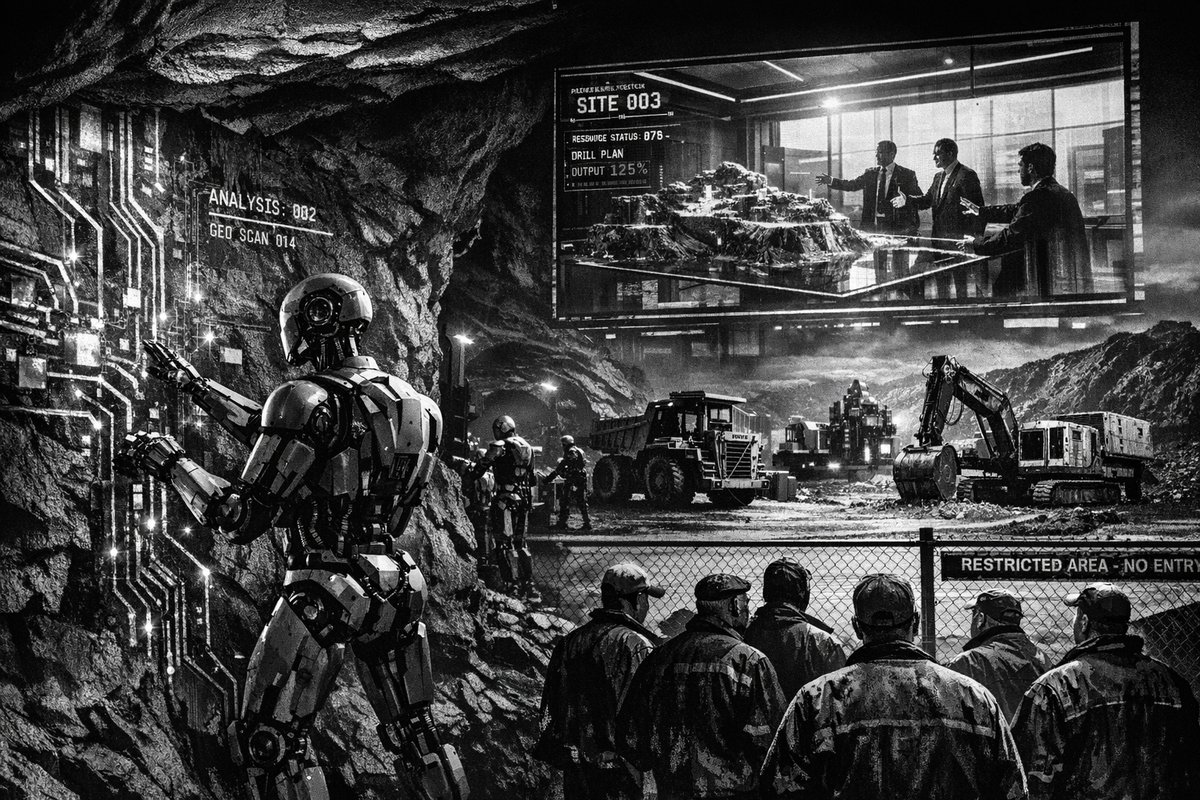
The Historical Context: Automation Waves in Energy
The energy sector has experienced three major automation waves:
- 1950s-1970s: Rotary drilling automation replaced cable tool drilling
- 1980s-2000s: SCADA systems automated pipeline monitoring and control
- 2020s-Present: AI-powered workflow automation targeting administrative and analytical tasks
Each wave eliminated specific job categories while creating new technical roles. However, AI automation differs fundamentally — it targets cognitive tasks traditionally requiring human judgment, not just physical processes.
The Brutal Economics of AI Transformation
Winn Resources’ monthly filing process improvement from 4 hours to 30 minutes represents $3,000-6,000 annual labor cost savings per filing type (assuming $75/hour loaded labor costs). Multiply this across multiple operators and filing requirements, and Collide’s platform delivers six-figure annual savings for mid-sized operators.
This economic pressure creates an AI adoption cascade: early adopters gain competitive advantages, forcing competitors to implement similar solutions or face operational obsolescence. The dynamic resembles containerization’s impact on shipping — ports that failed to adopt container handling technology lost market share permanently.
What’s Coming Next: AI’s Energy Sector Expansion
Collide’s current capabilities represent first-generation energy AI applications. The logical progression includes:
- Real-time drilling optimization based on geological data analysis
- Predictive maintenance scheduling for production equipment
- Automated environmental compliance monitoring
- AI-driven reservoir management and production forecasting
The technical infrastructure and data processing capabilities Collide has developed for regulatory compliance create the foundation for these advanced applications. Companies that establish AI workflows now position themselves for next-generation energy operations.
The question isn’t whether AI will dominate energy sector workflows — it’s whether traditional operators will adapt quickly enough to survive the transition.
Published in Stream · Dispatch #270 · May 2, 2026 · 4 min read.
Reply to paolo@mont3.ch - every email gets a human answer within 24h.