The fusion of artificial intelligence and materials science represents the most significant acceleration in scientific discovery since the invention of the computer. While we couldn’t access the specific research details, the broader implications are crystal clear: AI is fundamentally reshaping how we discover and develop next-generation energy materials, and the timeline for breakthroughs has compressed from decades to years.
The Speed Revolution in Scientific Discovery
Traditionally, materials discovery followed a painfully slow cycle. Scientists would hypothesize, synthesize, test, fail, and repeat—a process that could take 10-20 years for a single breakthrough material. The development of lithium-ion batteries took nearly three decades from initial research to commercial viability. We no longer have that luxury of time.
AI algorithms now screen millions of potential material combinations in hours rather than decades. Machine learning models can predict material properties, stability, and performance before a single atom is moved in a laboratory. This isn’t just faster science—it’s a fundamental reimagining of the discovery process itself.
“Math writes the rules 📐 • Physics pays the energy tax ⚡ • Chemistry shows atoms how to hug 🤗 • CS fuses it all into intelligence 🔥” — @Peramanathan
The Historical Parallel: From Nuclear Age to AI Age
The Manhattan Project mobilized the world’s best physicists to unlock atomic energy in just four years. Today’s AI-driven materials revolution operates on similar urgency but with exponentially more computational power. Where Los Alamos had slide rules and mechanical calculators, we now deploy quantum simulations, neural networks, and high-performance computing clusters.
The parallel runs deeper than just speed. Both represent moments when theoretical science suddenly gained the tools to manipulate reality at the fundamental level. The difference? AI democratizes this capability. Instead of requiring billion-dollar facilities, breakthrough materials research now happens in distributed computing environments accessible to universities, startups, and research labs worldwide.
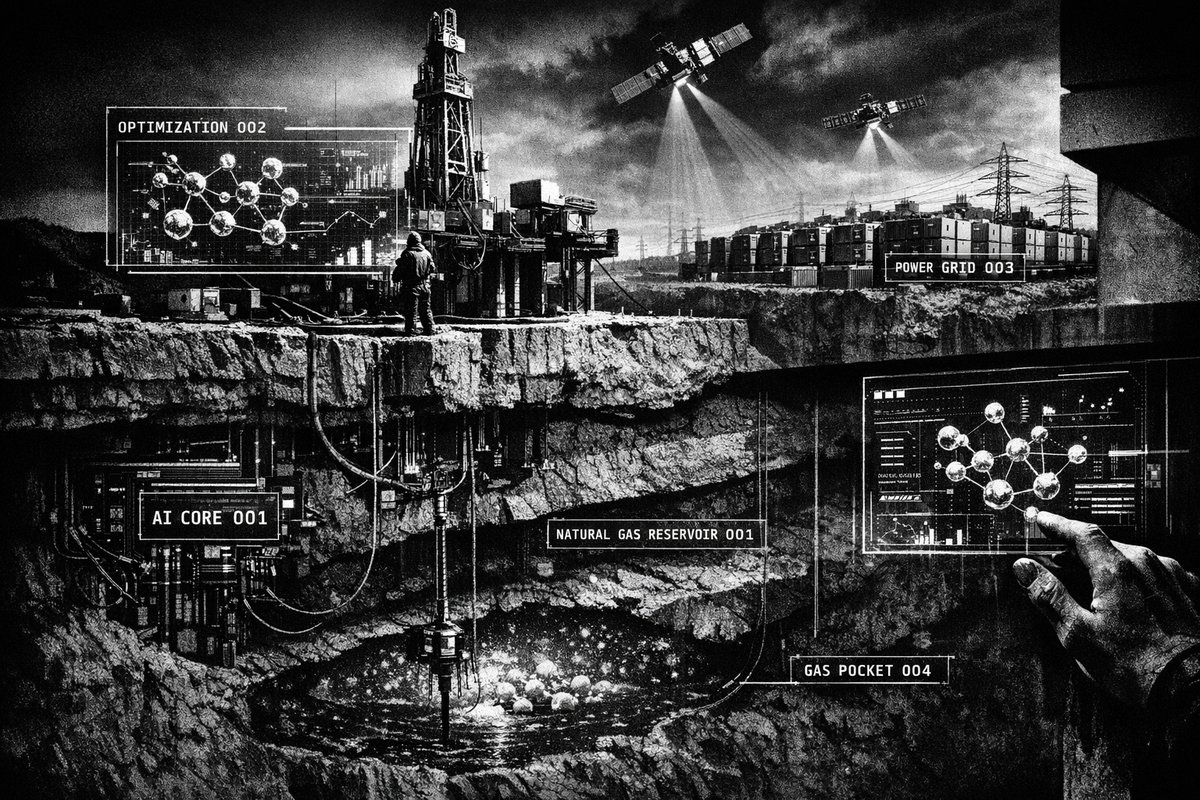
Key Applications Transforming Energy Storage and Generation
AI-accelerated materials discovery is targeting several critical energy challenges:
- Next-generation battery chemistries: Beyond lithium-ion to solid-state, sodium-ion, and metal-air technologies
- Photovoltaic efficiency: Novel semiconductor compositions pushing solar cell efficiency past current theoretical limits
- Hydrogen storage materials: Metal hydrides and porous frameworks for safe, efficient hydrogen economy infrastructure
- Fusion reactor materials: Plasma-facing materials that can withstand extreme temperatures and neutron bombardment
- Superconductors: Room-temperature superconducting materials for lossless power transmission
Each of these represents a trillion-dollar market opportunity. More importantly, each could fundamentally reshape global energy economics and geopolitics.
“Some people are saying the AI stock boom is already in mature phase and that it’s ‘too late’ to invest. They’re thinking way too small. We are still early. Demand for AI will be almost infinite: chips, memory, data centers, robotics, energy, agents, scientific discovery automation.” — @Dr_Singularity
The Computational Advantage
Density Functional Theory (DFT) calculations that once required supercomputer access now run on desktop workstations. Machine learning models trained on materials databases can predict crystal structures, electronic properties, and thermodynamic stability with remarkable accuracy. The bottleneck has shifted from computational limitations to experimental validation.
This computational advantage creates a new dynamic in materials research. Google DeepMind’s materials discovery efforts, Microsoft’s AI for Good materials initiatives, and numerous academic collaborations are generating candidate materials faster than laboratories can synthesize and test them. The challenge is no longer finding promising materials—it’s building the experimental infrastructure to validate AI predictions at scale.
Real-World Impact and Timeline
The implications extend far beyond academic papers. Tesla’s battery chemistry improvements, QuantumScape’s solid-state battery development, and breakthrough announcements from materials companies increasingly cite AI-assisted discovery in their development timelines. The technology is already in commercial use.
Energy security considerations add urgency to this research. Countries dependent on imported fossil fuels view AI-accelerated materials discovery as a path to technological sovereignty. China’s massive investments in AI research explicitly target energy applications. The European Union’s digital strategy emphasizes materials innovation. The United States has launched multiple initiatives connecting AI research to energy independence.
“Tiny particles, big discovery. The TAE team has learned that some fast ions — high-energy charged particles important for plasma current drive, heat and stability — can clump and “bounce” together along the geometrical axis of the linear device, a discovery that will produce even higher fidelity plasma modeling and simulations to advance commercial fusion R&D.” — @TAE
The Next Breakthrough Cycle
We’re approaching an inflection point where AI doesn’t just accelerate existing discovery methods—it enables entirely new approaches impossible without machine intelligence. Inverse design algorithms can work backward from desired properties to predict novel atomic arrangements. Generative models can propose materials that violate human chemical intuition but satisfy fundamental physical laws.
The timeline for the next major energy breakthrough has compressed dramatically. Where previous materials revolutions unfolded over decades, AI-accelerated discovery could deliver game-changing energy technologies within the next 5-7 years. The question isn’t whether this transformation will happen—it’s which institutions, companies, and countries will lead it.
The convergence of artificial intelligence and atomic-scale engineering represents more than technological progress. It’s the emergence of a new scientific methodology that could solve humanity’s most pressing energy challenges within this decade. The race is on, and the winners will reshape civilization itself.
Published in Stream · Dispatch #390 · May 27, 2026 · 4 min read.
Reply to paolo@mont3.ch - every email gets a human answer within 24h.