The convergence of artificial intelligence and blockchain technology is creating a new paradigm for digital ownership—one where AI agents transform into tradeable, ownable digital assets. According to Sreeram Kannan, founder of EigenLayer, this shift represents nothing less than a fundamental restructuring of how value is created and captured in the digital economy.
This isn’t just another crypto trend. Kannan’s vision positions AI agents as “the new companies,” entities that become valuable digital assets once property rights are established. But for this transformation to occur at scale, blockchain infrastructure must evolve beyond its current limitations—a challenge EigenLayer directly addresses through its innovative restaking protocol.
The Immutable Foundation in an AI-Disrupted World
Kannan’s entry into cryptocurrency stems from a profound realization about technological stability. While AI threatens to automate virtually every human task, blockchain and cryptography remain unbreakable. “Part of the reason I got into crypto is because blockchains and cryptography are the only things that are stable in a world where AI can do anything,” Kannan explains.
This stability isn’t merely theoretical—it’s becoming strategically critical as AI agents begin conducting autonomous transactions online. The Circle team reinforces this perspective:
“As AI agents begin to transact online, they’ll need money that works natively on the internet.” — @circle
Historically, similar technological convergences have created massive value shifts. The internet’s emergence in the 1990s fundamentally changed how businesses operated, much like the telegraph revolutionized commerce in the 1800s. Today’s AI-blockchain convergence represents an equally significant inflection point—but with one crucial difference: the underlying financial rails must be cryptographically secure and immune to AI manipulation.
Current Blockchain Limitations: The Programmability Gap
Despite blockchain’s inherent stability, existing infrastructure faces critical constraints. “Blockchains are not programmable expressive enough,” Kannan candidly admits. This limitation creates a fundamental bottleneck for advanced applications, particularly machine learning and complex AI agent interactions.
The programmability gap manifests in several ways:
- Limited computational expressiveness compared to traditional cloud platforms
- Insufficient throughput for real-time AI agent transactions
- Complex deployment processes that discourage developer adoption
- Security trade-offs when attempting to scale beyond basic financial transactions
These constraints echo the early internet’s limitations before cloud computing emerged. Just as Amazon Web Services transformed web development by abstracting infrastructure complexity, blockchain needs similar abstraction layers to support sophisticated AI applications.
EigenLayer’s Infrastructure Revolution
EigenLayer’s restaking protocol addresses these limitations through a novel approach: shared security across custom blockchain layers. “We’re like oh maybe if there’s a standard layer which lets anybody supply trust and shared security anybody can build their layer on top,” Kannan describes.
The protocol’s architecture enables developers to “write a program like you would write to deploy to a cloud, write it in and package it into a docker container.” This cloud-native approach dramatically reduces deployment barriers while maintaining blockchain’s trusted properties through trusted execution environments.
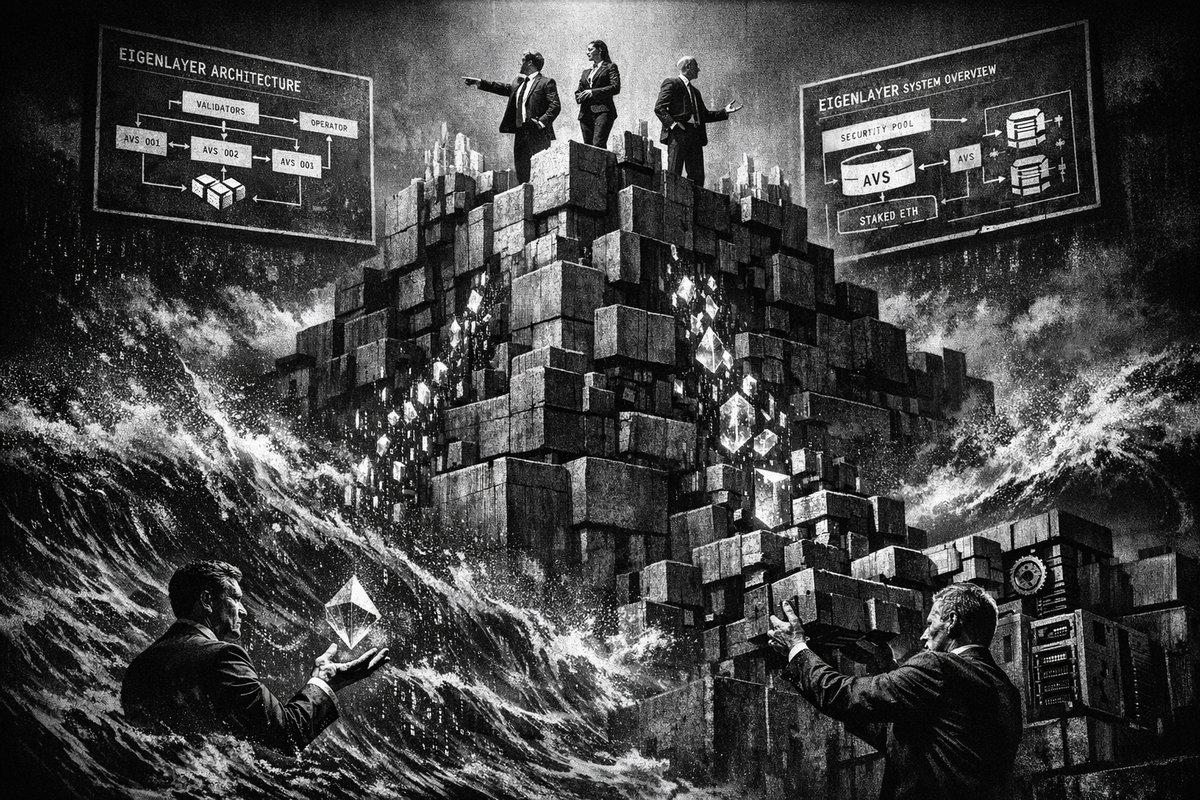
EigenLayer’s innovation lies in separating security provision from application logic. Traditional blockchains require each network to bootstrap its own security—an expensive, time-consuming process. EigenLayer allows applications to inherit Ethereum’s security while customizing their execution environment.
Market Reality Check: The Timing Challenge
Despite EigenLayer’s technical achievements, Kannan acknowledges significant market timing challenges. “I think it’s too early to have hyper modularization… the market size is not there, the revenue is not there, the apps are not there.”
This honest assessment reflects broader crypto market realities. While EigenLayer has “established itself as a market leader” in blockchain infrastructure, “it’s not clear the category has short-term value.” This tension between technological capability and market readiness mirrors many infrastructure innovations.
Consider Docker’s trajectory: the containerization technology existed for years before widespread enterprise adoption. Similarly, Kubernetes required substantial market education before becoming the container orchestration standard. EigenLayer may follow a similar path—technical leadership followed by gradual market acceptance.
Ethereum Ecosystem Momentum
The broader Ethereum ecosystem continues advancing rapidly, creating favorable conditions for EigenLayer’s eventual adoption. Recent developments demonstrate significant innovation across multiple fronts:
“From privacy breakthroughs to AI agents and institutional rails, the Ethereum ecosystem keeps shipping. Here are 22 things the ecosystem delivered over the past few weeks.” — @ethereum
These advances—including privacy enhancements, AI integration, and institutional infrastructure—create complementary technologies that could accelerate EigenLayer adoption once market conditions mature.
The Path Forward: Efficiency Meets Trust
EigenLayer’s ultimate value proposition centers on combining cloud computing efficiency with blockchain reliability. This hybrid approach could prove crucial as AI agents require both high-performance computation and tamper-proof financial rails.
The protocol’s architecture suggests a future where deploying blockchain applications becomes as straightforward as cloud deployment, but with cryptographic guarantees that AI cannot compromise. For developers building AI agents as digital assets, this combination could prove transformational.
The question isn’t whether AI agents will become valuable digital assets—that transformation is already beginning. The question is whether blockchain infrastructure can evolve quickly enough to support this new economy at scale. EigenLayer represents one of the most promising approaches to bridging this gap, combining immediate technical capability with long-term strategic positioning in an AI-dominated future.
Published in Stream · Dispatch #194 · April 14, 2026 · 4 min read.
Reply to paolo@mont3.ch - every email gets a human answer within 24h.