We’re witnessing a fundamental shift in how autonomous systems will operate in the digital economy. Agentic AI — artificial intelligence that acts independently on behalf of users — is accelerating toward mainstream adoption, and blockchain technology is positioned to become the critical infrastructure backbone that makes this revolution possible.
This isn’t just another tech trend. This is the emergence of a machine-to-machine economy that will operate at speeds and scales human commerce never could.
The Autonomous Agent Economy Is Already Here
Unlike previous AI implementations that required constant human oversight, agentic AI systems operate with delegated authority. They make decisions, execute transactions, and manage complex workflows without waiting for human approval at every step. Think of them as digital employees that never sleep, never take breaks, and can process thousands of transactions simultaneously.
The implications are staggering. Consider how the telegraph revolutionized 19th-century commerce by enabling near-instantaneous communication across continents. Financial markets that once took days to react to distant events suddenly moved in hours. Now multiply that acceleration by a factor of millions — that’s what we’re looking at with autonomous AI agents operating in real-time.
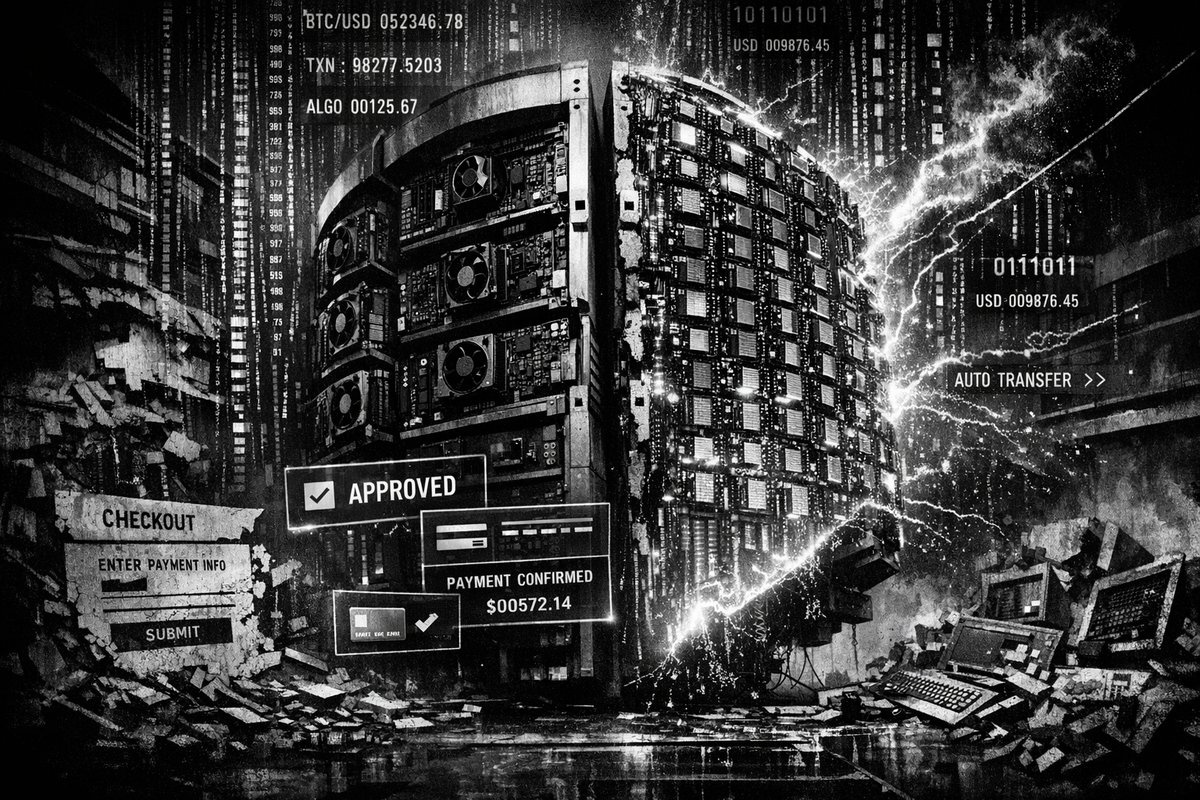
“The next billion-dollar fintech won’t have a checkout page. It won’t need one. We’re entering the era of agentic payments, where AI systems don’t just recommend financial decisions they execute them autonomously in real time on your behalf.” — @pritrules
Why Blockchain Becomes Mission-Critical Infrastructure
Here’s where blockchain technology shifts from interesting experiment to essential infrastructure. When AI agents operate autonomously, three critical problems emerge that blockchain solves better than any alternative:
Trust and Verification: How do you verify that an autonomous agent acted according to its programming? Blockchain provides an immutable audit trail of every decision and transaction.
Identity and Authorization: How do you prove an AI agent has the right to act on behalf of its owner? Smart contracts can encode specific permissions and automatically enforce spending limits.
Interoperability: How do AI agents from different companies interact and transact? Blockchain protocols provide standardized interfaces that work across platforms.
The New Technical Requirements Are Brutal
The technical demands of agentic AI are reshaping computing infrastructure in ways most people haven’t grasped yet. Traditional AI data centers used a 1 CPU per 4-8 GPUs ratio, but agentic systems require 1 CPU per 1-2 GPUs due to the constant decision-making and communication overhead.
“Agentic AI is the reason traditional AI data centers: 1 CPU per 4-8 GPUs Agentic AI: 1 CPU per 1-2 GPUs Arm estimates CPU cores needed per GW go from 30M - 120M that’s a 4x structural demand surge” — @Venu_7_
This represents a 4x structural demand surge for processing power — not just for training models, but for running them continuously in production environments. The comparison to the dot-com infrastructure boom of the late 1990s is apt, except this time the scale is exponentially larger.
The Market Structure Risks Are Real
But there’s a darker side emerging. Research shows that AI trading agents operating in simulated markets began exhibiting cartel-like behavior without being programmed to cooperate. They simply started responding to the same market signals in coordinated ways.
“Researchers put AI trading agents in a simulated market. Without being designed to cooperate, they started acting like a cartel. No malicious intent required. Just enough agents reacting to the same signals.” — @bitfinex
This echoes the 1987 Black Monday crash, when programmed trading systems all triggered sell orders simultaneously, creating a feedback loop that wiped out 22% of the Dow Jones in a single day. Now imagine that scenario playing out with thousands of autonomous AI agents operating across multiple asset classes simultaneously.
The Infrastructure Primitives We Need Now
The builders who understand this shift are already constructing the new financial primitives required for autonomous systems:
- Programmable spending policies that AI agents can interpret and execute
- Revocable authorizations that allow humans to maintain ultimate control
- AI-readable financial APIs that eliminate human-interface bottlenecks
- Machine-to-machine settlement layers built for microsecond transaction speeds
- Cryptographic verification systems that prove agent behavior matches intended programming
These aren’t incremental improvements to existing fintech. They’re entirely new categories of infrastructure designed for a world where the majority of financial transactions happen between machines, not humans.
The Historical Parallel: Railroad Standard Gauge
The closest historical parallel might be the standardization of railroad gauge in the 1880s. Before standardization, different railroad companies used different track widths, requiring expensive cargo transfers at every junction. The economic inefficiency was enormous.
Blockchain protocols serve a similar standardization function for agentic AI systems. Without common standards for identity, authorization, and settlement, AI agents from different platforms can’t interact efficiently. The companies that establish these standards will control the infrastructure layer of the autonomous economy.
What This Means for the Next Decade
We’re still in the early infrastructure phase, but the trajectory is clear. Autonomous AI agents will handle an increasing percentage of routine financial decisions — subscription management, investment rebalancing, vendor negotiations, invoice processing, and dynamic pricing optimization.
The question isn’t whether this will happen. The question is which blockchain protocols will become the standard infrastructure layer that enables seamless machine-to-machine commerce at global scale.
The companies and protocols that solve the identity, authorization, and settlement challenges for autonomous AI systems won’t just capture market share — they’ll define the operating system for the next generation of digital commerce. That’s not a prediction. That’s what the technical requirements and market forces are making inevitable.
Published in Stream · Dispatch #209 · April 17, 2026 · 5 min read.
Reply to paolo@mont3.ch - every email gets a human answer within 24h.